

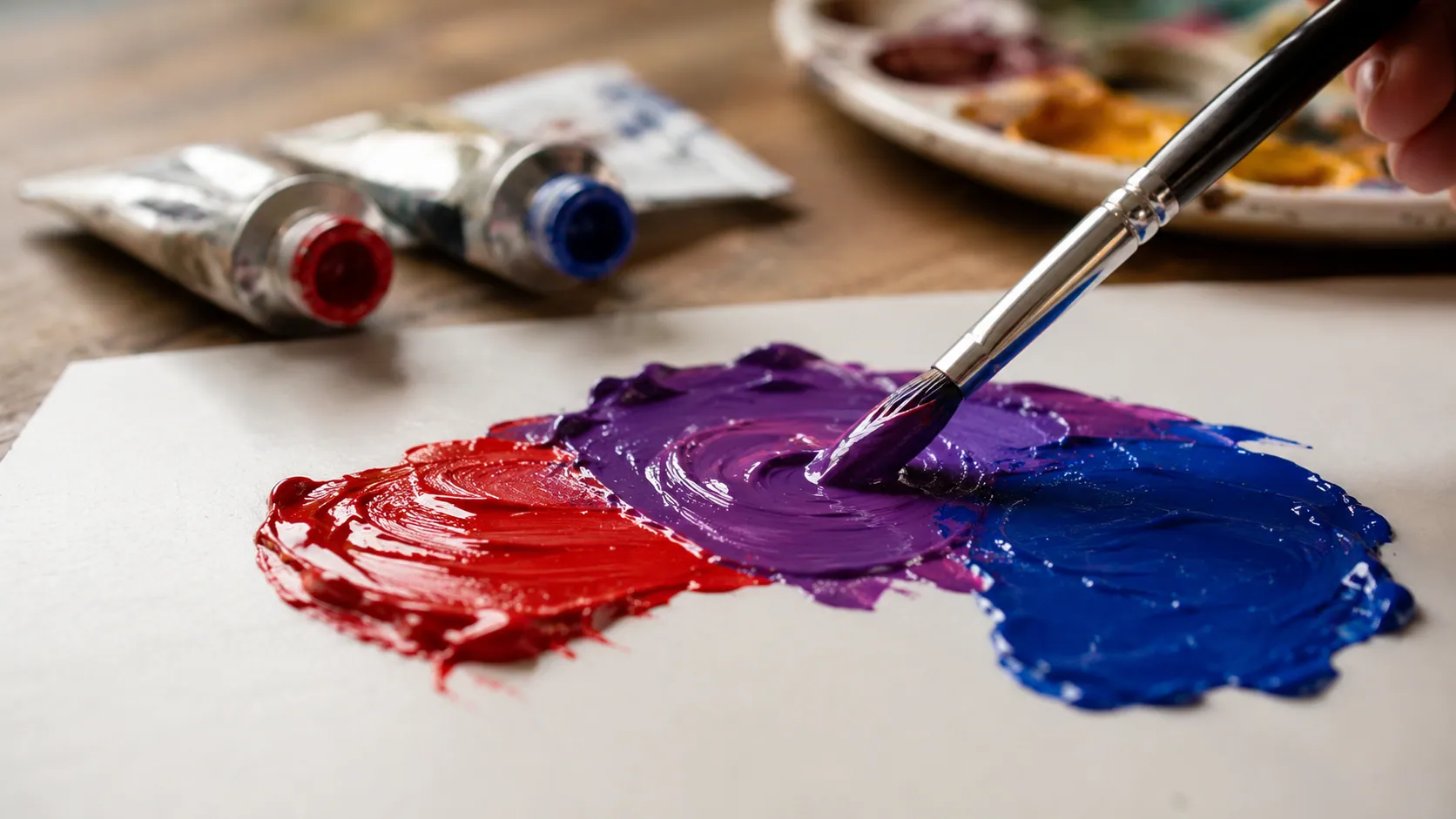
What colors do you mix to make the color purple is one of the most common questions in basic color mixing, and the simple answer is: red and blue make purple. In traditional paint mixing, when you combine red and blue, you create a secondary color called purple.
But there is one important detail: not every red and blue will make the same purple. Sometimes the result is a rich violet, sometimes it becomes soft lavender, and sometimes it turns into a muddy, brownish color that does not look purple at all. The final shade depends on the ratio, the type of red, the type of blue, the paint medium, and the hidden undertones in each color.
This guide explains what colors make purple, how to mix different purple shades, why purple can turn muddy, and how to make purple with paint, food coloring, frosting, and digital color codes.
What Colors Make Purple?
The basic answer is simple: red and blue make purple. In traditional RYB color theory, red, yellow, and blue are considered the main primary colors. When you mix two primary colors together, you create a secondary color. Red and blue create purple, blue and yellow create green, and red and yellow create orange.
So, if you are using regular paint, crayons, markers, or school art supplies, the answer to what two colors make purple is usually:
| Colors Mixed | Result |
| Red + Blue | Purple |
| More Red + Blue | Warmer red-purple |
| Red + More Blue | Cooler violet-purple |
| Purple + White | Light purple or lavender |
| Purple + Black | Dark purple |
However, the final result depends on the actual paint colors you use. A clean red and a clean blue usually create a more attractive purple. But if your red has an orange or yellow undertone, or your blue has a green undertone, the mixture can look dull.
That is why many beginners ask, “Why does my red and blue make brown instead of purple?” The answer is usually color bias. Some reds are warmer, some blues are greener, and those hidden undertones affect the final mix.
For most beginners, start with equal parts red and blue. Then adjust slowly until you get the purple you want.
What Ratio of Red and Blue Makes Purple?
The easiest starting ratio is 1 part red + 1 part blue. This creates a balanced purple. But once you understand the basic mix, you can adjust the ratio to make different shades.
If you want a cooler purple, add more blue. If you want a warmer purple, add more red. If you want a softer purple, add white. If you want a deeper purple, add more blue or a very small amount of black.
Here is a simple purple mixing chart for beginners:
| Purple Result | Mixing Formula |
| Balanced purple | 1 part red + 1 part blue |
| Violet purple | 1 part red + 2 parts blue |
| Warm purple | 2 parts red + 1 part blue |
| Lavender | Purple + white |
| Lilac | Purple + white + a tiny amount of pink |
| Dark purple | Purple + more blue |
| Deep purple | Purple + tiny amount of black |
| Dusty purple | Purple + gray |
| Muted purple | Purple + tiny amount of yellow or yellow ochre |
When mixing paint, always add colors little by little. It is much easier to darken or adjust a color than to fix a mixture after adding too much paint. For example, black is very strong. A tiny amount can make purple deeper, but too much can make it look flat, gray, or muddy.
A helpful artist rule is: mix small, test often, and adjust slowly. Use a scrap piece of paper, canvas paper, or a neutral surface to test your purple before applying it to your final artwork.
Why Does Purple Sometimes Turn Muddy or Brown?
If red and blue make purple, why does the mixture sometimes turn brown, gray, or muddy? The answer is usually undertones.
Paint colors are rarely pure. A red paint may lean slightly orange. A blue paint may lean slightly green. These hidden color directions are called color bias or hue bias. When yellow, orange, or green undertones enter the mix, they can dull the purple.
Purple and yellow are complementary colors, meaning they sit opposite each other on the color wheel. When complementary colors mix, they can neutralize each other. This is useful when you want a muted tone, but it is frustrating when you want a bright purple.
For example, if you mix an orange-red with a greenish-blue, you are not only mixing red and blue. You are also mixing small traces of yellow into the mixture. That yellow can cancel out the purple and create a brownish purple or murky purple.
To avoid muddy purple, choose a cool red and a blue that does not lean too green. Colors like Quinacridone Magenta, Permanent Rose, and some clean blue pigments are often better for bright purple than orange-heavy reds.
Here is a simple troubleshooting guide:
| Problem | Likely Cause | Fix |
| Purple looks brown | Yellow or orange undertone | Use a cooler red or magenta |
| Purple looks gray | Too much black or muddy pigment | Add fresh red, blue, or magenta |
| Purple looks dull | Wrong red/blue combination | Try cleaner pigments |
| Purple looks too blue | Too much blue | Add a little red or magenta |
| Purple looks too red | Too much red | Add small amounts of blue |
The key is to avoid introducing too much yellow unless you intentionally want a muted purple, dusty purple, or vintage-looking shade.
Best Red and Blue Paints for Bright Purple
If you want to know how to mix purple paint that looks bright and clean, the paint names matter. Basic red and blue can work, but artist-grade colors often give better results because they have clearer pigment behavior.
A good purple usually starts with a red that leans toward pink or magenta. This is why Quinacridone Magenta, Permanent Rose, and similar cool reds are popular choices. For blue, many artists use Ultramarine Blue, Cobalt Blue, Phthalo Blue, Turquoise Blue, or Prussian Blue, depending on the shade they want.
Here are useful combinations:
| Paint Combination | Result |
| Quinacridone Magenta + Ultramarine Blue | Rich purple |
| Permanent Rose + Ultramarine Blue | Clean violet-purple |
| Magenta + Turquoise Blue | Vibrant purple |
| Fluorescent Pink + Turquoise Blue | Bright warm purple |
| Magenta + Prussian Blue | Deep purple |
| Alizarin Crimson + Ultramarine Blue | Muted, traditional purple |
For vibrant purple, start with a magenta-like red and add blue slowly. If you add too much blue at once, the color can quickly become dark. If you are using acrylic paint, remember that some acrylics dry slightly darker than they look when wet.
For a strong but balanced purple, try this beginner method: place a small amount of Quinacridone Magenta on your palette, add a tiny bit of Ultramarine Blue, mix thoroughly, then continue adding blue until the purple looks right. If it becomes too dark, add a touch of Titanium White.
How to Make Light Purple, Lavender, Lilac, and Dark Purple
Once you know that red and blue make purple, you can create many related shades. The easiest way to make light purple is to mix red and blue first, then add white. This creates a softer tint.
Lavender is usually made by adding white to purple. For a cooler lavender, use slightly more blue. For a warmer lavender, add a tiny touch of pink or magenta. Lilac is similar, but it often looks softer, lighter, and slightly pinker than lavender.
| Shade | How to Mix It |
| Light purple | Purple + white |
| Lavender | Purple + more white |
| Lilac | Purple + white + tiny pink |
| Pastel purple | Purple + lots of white |
| Pale purple | Purple + white + a very small amount of gray |
Digit-based color references can help digital designers and artists visualize these shades. A common Light Purple HEX code is #CBC3E3, with rgb(203, 195, 227).
To make dark purple, add more blue or a very small amount of black. But be careful: black is powerful and can make purple look lifeless if overused. A better way to create a rich dark purple is to mix purple with Prussian Blue, Ultramarine Blue, or a small amount of deep red.
| Dark Purple Shade | How to Mix It |
| Dark purple | Purple + more blue |
| Deep purple | Purple + Prussian Blue |
| Plum | Purple + more red + tiny black |
| Eggplant purple | Purple + blue + tiny black |
| Moody purple | Purple + gray or deep blue |
A common Dark Purple HEX code is #35063E, with rgb(53, 6, 62).
Purple Shade Chart: Easy Mixing Recipes
Purple is not just one color. It includes many shades, such as violet, lavender, lilac, mauve, plum, indigo, amethyst, and royal purple. A clear purple shade chart makes it easier to mix the exact color you want.
| Purple Shade | Mixing Recipe |
| Purple | Red + blue |
| Violet | More blue + red |
| Red-purple | More red + blue |
| Lavender | Purple + white |
| Lilac | Purple + white + tiny pink |
| Mauve | Purple + gray + tiny red |
| Plum | Purple + red + tiny black |
| Indigo | Purple + more blue |
| Amethyst | Purple + blue + white |
| Royal purple | Purple + deep blue + tiny red |
| Dusty purple | Purple + gray |
| Muted purple | Purple + tiny yellow ochre |
If you are working digitally, shade codes are also helpful. Standard purple is often represented as #800080 or rgb(128, 0, 128). Rebecca Purple is #663399, Indigo is #4B0082, and Wisteria is often shown as #A87DC2.
For physical paint, these codes will not match perfectly because pigment mixing and digital color behave differently. Still, they are useful references when choosing a target shade.
The best way to build confidence is to make your own color chart. Mix small amounts of red and blue in different ratios, then label each result. This helps you see how more red than blue, more blue than red, and added white or gray change the final purple.
How to Make Purple With Paint, Food Coloring, and Digital Color
The answer to how to make purple changes slightly depending on the medium. Paint, food coloring, frosting, and digital screens do not all work the same way.
With acrylic paint, mix red and blue on a palette using a brush or palette knife. Acrylics dry quickly, so blend carefully and test the color before using it. With watercolor or watercolour, you can make purple softer by adding more water. With oil paint, the blend stays workable longer, which makes gradual adjustments easier. With gouache, purple can look bold and opaque.
For food coloring, start with blue and add red slowly, or start with red and add blue drop by drop. The exact ratio depends on whether you are using liquid food coloring or gel food coloring. Gel colors are more concentrated, so you need less.
For frosting, icing, buttercream, or fondant, the base color matters. White buttercream usually makes a cleaner purple. Yellowish buttercream can make the purple look warmer or slightly dull. Letting colored frosting sit for a short time can also deepen the shade.
For crafts like slime or playdough, use the same idea: combine red and blue, then adjust slowly. If the purple looks too pink, add more blue. If it looks too blue, add more red.
For digital design, you do not physically mix paint. Instead, you use color values. A common purple HEX code is #800080, and a standard purple RGB code is rgb(128, 0, 128). Tools like Photoshop, Canva, Figma, and Procreate let you choose purple using RGB, HEX, HSL, or CMYK values.
RYB vs RGB vs CMYK: Why Purple Changes by Medium
Many people learn that red and blue make purple in school, and that is true in the traditional RYB color model used for basic art and paint lessons. But color works differently in screens and printing.
In the RYB color model, the primary colors are red, yellow, and blue. This model is common in beginner painting, crafts, and art classes. In this system, purple is a secondary color made by mixing red and blue.
In the RGB color model, used for screens, the primary colors are red, green, and blue light. Digital color is based on additive mixing, which means light is added together. Screens create colors by combining different amounts of red, green, and blue light.
In printing and ink systems, you often see CMY or CMYK. CMY stands for cyan, magenta, and yellow, while CMYK adds black. This is subtractive mixing, because pigments or inks absorb certain wavelengths of light. In this model, purple-like colors are often made using magenta and cyan rather than basic red and blue.
This is also why purple vs violet can be confusing. Violet is associated with the visible spectrum and shorter wavelengths of light, while purple is often considered a non-spectral color made by the way our eyes interpret red and blue together. For everyday art, though, you can keep it simple: red and blue make purple in paint, while digital purple is controlled with RGB or HEX values.
How to Fix Common Purple Mixing Mistakes
Even if you know what colors make purple, mistakes can happen. Purple is sensitive because a small shift in red, blue, yellow, black, or white can change the result quickly.
If your purple is too blue, add a small amount of red or magenta. Mix slowly and test before adding more. If your purple is too red, add blue a little at a time. If it is too dark, add white or dilute the mixture depending on the medium.
If your purple is muddy, avoid adding more random colors. Instead, start a fresh mix with cleaner red and blue. A muddy purple usually means too many undertones have entered the mixture, especially yellow, orange, green, or too much black.
Here is a quick correction table:
| Purple Problem | How to Fix It |
| Too blue | Add a little red or magenta |
| Too red | Add a little blue |
| Too dark | Add white or dilute the paint |
| Too bright | Add a tiny touch of gray |
| Too dull | Add fresh magenta or clean blue |
| Too muddy | Start again with cooler red and cleaner blue |
| Too flat | Adjust value with white or deeper blue |
A useful mini case study: imagine a beginner mixing basic red acrylic with a greenish blue. The result turns brownish purple. Instead of adding more red and blue, the better fix is to switch to Quinacridone Magenta and Ultramarine Blue. This removes the yellow-heavy undertones and creates a cleaner, brighter purple.
As many artists say, “The best purple starts before you mix — it starts with choosing the right red and blue.”
FAQs About Mixing Purple
What two colors make purple?
Red and blue make purple in traditional paint mixing. Start with equal parts red and blue, then adjust the ratio depending on the shade you want.
Can you make purple without blue?
In traditional paint mixing, blue is usually needed to make purple. However, in some ink or digital systems, cyan and magenta can create purple-like shades.
Can you make purple without red?
You usually need red, pink, or magenta. Magenta can often replace red and may create a cleaner, brighter purple than a warm orange-red.
What colors make lavender?
Purple and white make lavender. Start with purple, then add white slowly until the shade becomes soft and pale. For a slightly warmer lavender, add a tiny touch of pink.
What colors make violet?
Violet is usually made by mixing more blue than red. A simple recipe is 1 part red and 2 parts blue, but the exact result depends on the paint colors used.
Why did my purple turn brown?
Your purple likely turned brown because the red or blue had yellow, orange, or green undertones. These undertones can neutralize purple and create a muddy color.
Is purple a primary or secondary color?
In traditional RYB color theory, purple is a secondary color because it is made by mixing two primary colors: red and blue.
What colors make purple food coloring?
Use red and blue food coloring. Add drops slowly and mix well. For frosting or buttercream, use a white base for the cleanest purple result.
Conclusion: Red and Blue Make Purple, But the Shade Depends on the Mix
When someone asks what colors do you mix to make the color purple, the simple answer is red and blue. But the best purple comes from understanding the details behind the mix. Equal parts red and blue usually create a balanced purple, more blue creates a cooler violet, and more red creates a warmer purple.
To make light purple, add white. To make dark purple, add more blue or a tiny amount of black. To avoid muddy purple, choose clean pigments and watch for yellow or orange undertones.
Whether you are using acrylic paint, watercolor, food coloring, frosting, or digital RGB codes, purple
Disclaimer: This article is for general informational and educational purposes only and does not constitute professional art, design, printing, or color-matching advice. Color results may vary depending on pigments, paint brands, materials, lighting conditions, display settings, and mixing techniques. Always test color mixtures on a small sample before applying them to your final project.