

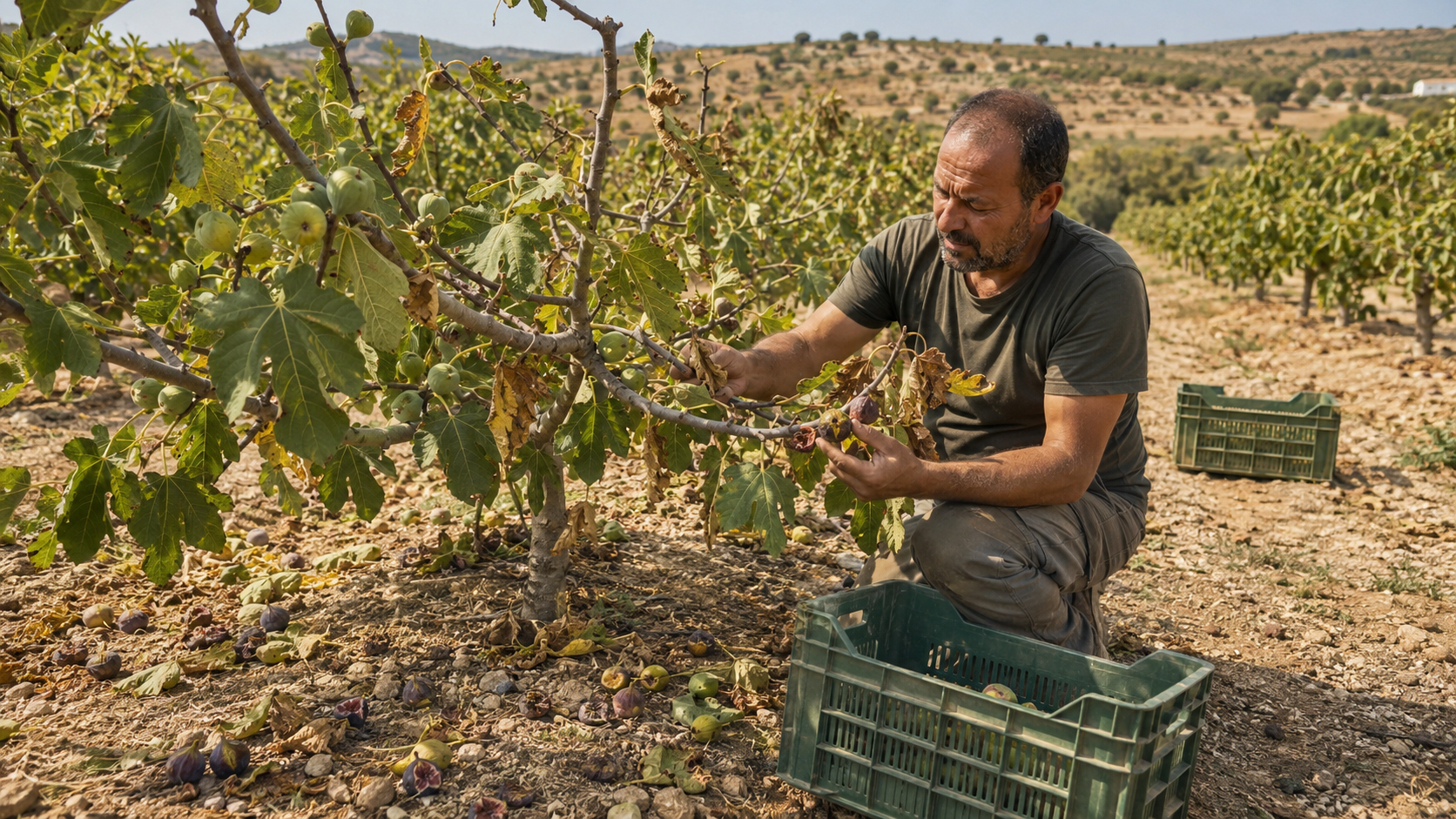
Italy has always been a symbol of agricultural abundance. Its southern regions — Apulia, Calabria, Sicily — have supplied figs to European and global markets for generations. But what the 2025 growing season revealed has changed the way farmers, buyers, and researchers think about Italian fig production. The italian fig crop loss recorded last year was not a rough patch in an otherwise stable industry. It was a convergence of frost, heat, disease, and broken supply chains happening simultaneously — and as the 2026 fioroni season now begins across Apulia, the lessons from 2025 have never been more relevant.
What makes this story worth understanding in full is the “double crisis” it created. On one side, consumer demand for Italian figs — both fresh and dried — remained strong across European markets throughout 2025. On the other, production collapsed by 50 to 70 percent in key growing zones. That gap between demand and supply sent ripple effects far beyond the farm gate, reaching wholesale buyers in Switzerland, Germany, and import markets across South Asia. With the 2026 season now entering its first harvest window, growers, buyers, and importers are all watching closely to see whether last year’s damage becomes a pattern or a turning point.
What Triggered the 2025 Italian Fig Crop Loss
The answer is not simply “bad weather.” What destroyed the 2025 early fig harvest was a very specific sequence of events, each one making the next more damaging — and understanding that sequence is essential going into 2026.
It started with an unexpected frost in early April 2025. Fig trees in Apulia had already started pushing out their fioroni flowers — the early-season figs that Italian growers depend on for May and June revenues. When the frost arrived, it burned those young flowers before they had any chance to set fruit. That alone would have been damaging enough. Then came the heatwave. Temperatures climbed sharply in late May, pushing whatever fruit had survived the frost into an accelerated ripening cycle — 17 to 23 days ahead of schedule in many orchards. Trees that should have been producing through mid-June were effectively finished by the first week of June.
On top of that, the previous winter had brought unusually heavy rainfall across southern Italy. While the rain encouraged strong shoot growth on paper, it also left soils waterlogged and root systems weakened before the growing season began. Trees that might have absorbed some stress in a normal year had no reserves left to draw on. The frost, the heat, and the saturated soil hit in sequence — and the result was the worst early fig season in at least three years. As growers now enter the 2026 campaign, the question is whether winter conditions this year provided better preparation, or whether the same vulnerabilities are still present.
Variety by Variety: Which Italian Figs Were Hit Hardest
Not every fig variety suffered equally in 2025, and understanding those differences matters whether you are a grower planning the 2026 season or a buyer trying to read supply signals accurately.
The fioroni — Italy’s early figs — took the hardest hit. These are the first-flush fruits that ripen before summer peaks, and their flowers were the ones directly in the path of the April 2025 frost. Among commercial varieties, Dottato is the most widely grown and the most exposed. It is the backbone of Apulia’s dried fig export trade, and it is precisely the type that failed most dramatically — with growers in Cisternino, Martina Franca, and Terlizzi reporting near-total loss of early crop. Heading into 2026, Dottato orchards that were already stressed from last season carry additional vulnerability if spring conditions turn unpredictable again.
The picture looked somewhat different for later-ripening varieties like Brogiotto and Nero. Because their active growth cycle starts later, they missed the worst of the April frost damage in 2025. That gave some mixed-variety growers a meaningful buffer last season. Farmers who planted a combination of early and late varieties — even by accident of inheritance rather than deliberate planning — found themselves in a significantly stronger position than single-variety operations. That gap in outcomes is one of the clearest lessons the 2025 season produced, and it is already influencing how more forward-thinking growers are approaching their 2026 orchard management.
The Harvest Calendar Collapse: Why Timing Failure Equals Financial Failure
To understand why Italian fig crop loss in 2025 was so financially devastating, you need to understand what a normal harvest timeline looks like — because the damage was not just about quantity. It was about timing, and that distinction matters enormously going into the current season.
In a healthy season, fioroni harvesting begins around the Feast of St. Anthony on June 13th and continues through late June. The main autumn crop follows from August through September, giving growers two distinct revenue windows across the season. Labor, cold storage, and transport logistics are all built around that calendar. Buyers place forward orders based on it. As of mid-June 2026, the fioroni season is just now opening — and whether it runs on schedule or collapses into another compressed window will define the entire first half of the year for Apulian producers.
In 2025, the early harvest was forced into a window running from late May to early June — weeks ahead of schedule and spanning days rather than weeks. When fruit ripens all at once, a farm that might process 200 crates over three weeks suddenly has to move them in three days. Without the labor, cold storage, or buyer readiness to absorb that pace, a significant portion of fruit goes unharvested or arrives bruised and unsellable. This “feast or famine” effect, which growers in Brindisi described firsthand last season, explains why a 70 percent production drop on paper often translates to near-total commercial loss in practice. It is the same risk growers face right now if the 2026 season opens too quickly.
From Farm to Global Market: How Italian Fig Crop Loss Affects Importers and Buyers
This is the part of the story that neither trade publications nor general farming blogs tend to cover — and it carries some of the widest consequences for anyone involved in the dried fig supply chain.
Italy occupies a specific and respected niche in the global dried fig market. It does not compete with Turkey or Iran on volume. Instead, Italian dried figs — particularly Dottato from Apulia — command premium pricing in specialty European markets based on flavor, texture, and authenticated origin. When Italian supply dropped by 50 to 70 percent in 2025, wholesale buyers did not simply wait. They redirected orders to Turkish suppliers almost immediately, and Turkish exporters — already operating at near-capacity — adjusted prices upward in response. The effect moved quickly through the supply chain, and it is a dynamic that buyers should already be monitoring as the 2026 Italian season begins.
If you are an importer of dried figs in markets like Germany, Switzerland, or South Asia, what the 2025 season showed is that a single bad Italian year can sever supply relationships that took years to build. The Swiss buyer who had just begun working with a Brindisi grower — confirmed supply lines established, samples approved, orders placed — found that supply had simply disappeared, with no short-notice replacement available at comparable quality or price. The practical lesson for serious buyers in 2026 is to treat early-season weather signals from southern Italy — particularly frost events in March and April — as direct market indicators, not just agricultural background news. Acting early on those signals is the difference between securing supply and chasing alternatives at a premium.
The September Pivot Strategy: What Experienced Apulian Growers Do After a Failed Spring
This is the approach that separates long-term survivors in the Apulian fig industry from those who abandon the season entirely after difficult spring results. I call it the September Pivot Strategy, and it is something the most experienced growers in the Molfetta and Brindisi districts apply almost instinctively — and what smart operators are already preparing for in the current 2026 season.
The core idea is straightforward: when the fioroni crop struggles, do not exhaust resources trying to salvage what the frost and heat have already decided. Instead, redirect all available attention — pruning care, irrigation discipline, pest monitoring — toward the main autumn fig crop, which typically begins in mid-August and runs through September. In 2025, the winter rains that damaged early-season soil conditions had also produced strong new branch growth across many orchards, which turned out to be a genuine positive for growers who stayed focused on the autumn campaign rather than writing off the year by July. The same careful summer management approach applies to 2026.
The mistake smaller operations often make is declaring total loss too early. That decision locks in the damage. The September campaign is a genuinely separate biological window, and in 2025, several producers in northern Bari province reported that their autumn prospects looked more promising than spring results had suggested. Growers who conserve irrigation water through July, apply targeted nutrient support, and monitor closely for fig moth pressure from mid-summer are the ones who walk into September with something to sell. In 2026, with the fioroni season only just opening, the window to set up a strong autumn campaign is still fully open.
Common Mistakes Farmers and Buyers Make During a Crop Loss Season
Crop loss seasons reveal habits that good years tend to hide. On the farm side, the most common mistake is panic harvesting — pulling fruit before it reaches optimal maturity because the ripening window feels like it is closing. Immature figs bruise more easily in transit and fail the firmness standards that export markets require. The result is fruit that arrives at the buyer and gets rejected, compounding financial damage on top of the original weather loss. This pattern played out repeatedly across Apulia in 2025, and it is a risk again in 2026 if the season opens with any early weather pressure.
A second farm-level mistake is over-irrigating after drought or heat stress. It feels counterintuitive to hold back water when trees look stressed, but saturated roots are more susceptible to fungal infection than slightly dry ones. Growers who drip-irrigate on a controlled schedule — rather than flooding in response to visible stress — consistently report better tree health through difficult seasons. On the buyer side, the most costly mistake is treating a single year of Italian supply failure as a permanent market shift and locking into long-term Turkish replacement contracts. The 2025 losses were serious, but Italy’s research programs, established orchards, and genuine farmer commitment to adaptation mean that Apulian supply will recover. Buyers who moved too aggressively away from Italian suppliers in 2025 may find those supply relationships harder and more expensive to re-enter as conditions improve.
Can Italian Fig Farming Survive Beyond 2030?
This is the question that researchers, regional cooperatives, and long-term growers are working through right now — and the honest answer is: it depends on which part of Apulia you are asking about, and how quickly adaptation moves.
In the zones closest to the Adriatic coast, microclimates offer slightly more temperature moderation, and growers there have better survival odds under current climate trajectories. Inland areas — particularly the higher-elevation zones around Castellana and Martina Franca — face a harder path. These areas recorded some of the worst losses in 2025, and climate projections for southern Europe point toward continued warming and reduced summer rainfall through the 2030s. Some traditional growing zones may become climatically unsuitable within a decade, not because of any single failure but through accumulated seasonal stress on trees that can no longer count on the Mediterranean balance they evolved under.
The more encouraging picture comes from active research programs developing drought-tolerant and Fig Mosaic Virus-resistant cultivars. Agrivoltaic systems — solar panel canopies combined with crop production, providing shade that reduces heat stress on developing fruit — are being piloted in southern Italian orchards with early results worth watching. The shift toward high-quality, low-volume production aimed at premium niche markets rather than bulk export is also gaining real traction among growers who have survived several difficult seasons. These are genuine adaptations, not wishful thinking. But they require time, investment, and sustained policy support. The 2026 season, now opening, is another data point in that longer story — and what it produces will shape how urgently the Italian fig industry moves on the changes it knows it needs to make.
Conclusion
The italian fig crop loss of 2025 was bigger than a weather story. It was a supply chain disruption, a cultural warning, and a climate signal compressed into a single growing season. Frost, heat, disease, and broken export relationships did not arrive one after another — they arrived simultaneously, in the same orchards, to farmers who had already absorbed difficult seasons in 2021, 2022, and 2023.
As the 2026 fioroni campaign now opens across Apulia, that history provides critical context. The growers who adapted after 2025 — planting mixed varieties, preparing their September campaign early, refocusing on the domestic market when export standards could not be met — are entering this season better positioned. But adaptation requires accurate information, not reassurance. If you are a buyer, a grower, or someone who tracks where food comes from and what it costs to grow it, both the 2025 record and the 2026 season in progress deserve your close attention. The cost of ignoring these signals is already visible in empty Apulian orchards and broken supply relationships. The opportunity to respond is still open — but narrowing with each season.
FAQ
What specifically caused the Italian fig crop loss in 2025?
The 2025 crop loss resulted from a damaging sequence: an April frost destroyed fioroni flowers just as they were forming, a subsequent heatwave compressed the ripening window by 17 to 23 days, and waterlogged soils from heavy winter rainfall had already weakened root systems before the season began. The combination of all three factors made 2025 significantly worse than previous difficult years and set the context growers are carrying into 2026.
Which fig varieties were most affected by the 2025 season failure?
The fioroni early figs took the heaviest losses, with the Dottato variety — the most commercially important in Apulia — suffering most severely. Later-ripening varieties like Brogiotto and Nero fared comparatively better because their growth cycle started after the worst frost damage had passed. Growers with mixed-variety orchards proved notably more resilient than single-variety operations, a lesson that is directly influencing planting decisions heading into 2026.
How does Italian fig crop loss affect global dried fig prices?
When Italian supply drops significantly, wholesale buyers redirect orders to Turkish and Iranian suppliers almost immediately. This increases demand pressure on those alternative sources and drives prices upward across the category. Markets in Switzerland, Germany, and South Asia that source Italian-origin dried figs experience both reduced availability and higher costs — a dynamic that was clearly visible in the second half of 2025 and that buyers are already factoring into their 2026 sourcing strategies.
Is the 2026 Italian fig season showing any improvement over 2025?
As of mid-June 2026, the fioroni season is just entering its opening window, which is itself a positive signal compared to the premature May start forced by heat in 2025. Whether the 2026 season delivers meaningful recovery depends heavily on whether summer temperatures remain moderate enough to avoid another compressed ripening window, and whether the September campaign — the main commercial opportunity — holds. It is still early to draw firm conclusions.
What should dried fig importers do when Italian supply collapses?
Importers should treat early-season frost and heat reports from southern Italy as direct market signals and act on them quickly before the wider market responds. At the same time, avoid permanently exiting Italian supply relationships after a single difficult season. Italy’s production has demonstrated partial recovery between difficult years, and the premium positioning of Italian-origin dried figs makes those supplier relationships worth maintaining through lean seasons rather than replacing entirely.
Disclaimer: This article is for informational purposes only and draws on reported data from the 2025 Italian fig season and publicly available agricultural research. It does not constitute agricultural, financial, or commodity investment advice. Growers and buyers making operational decisions should consult qualified agronomists or trade specialists relevant to their region and circumstances.
Loved Reading This? Discover More Exclusive Stories And Updates At [dailycultures.co.uk]!