

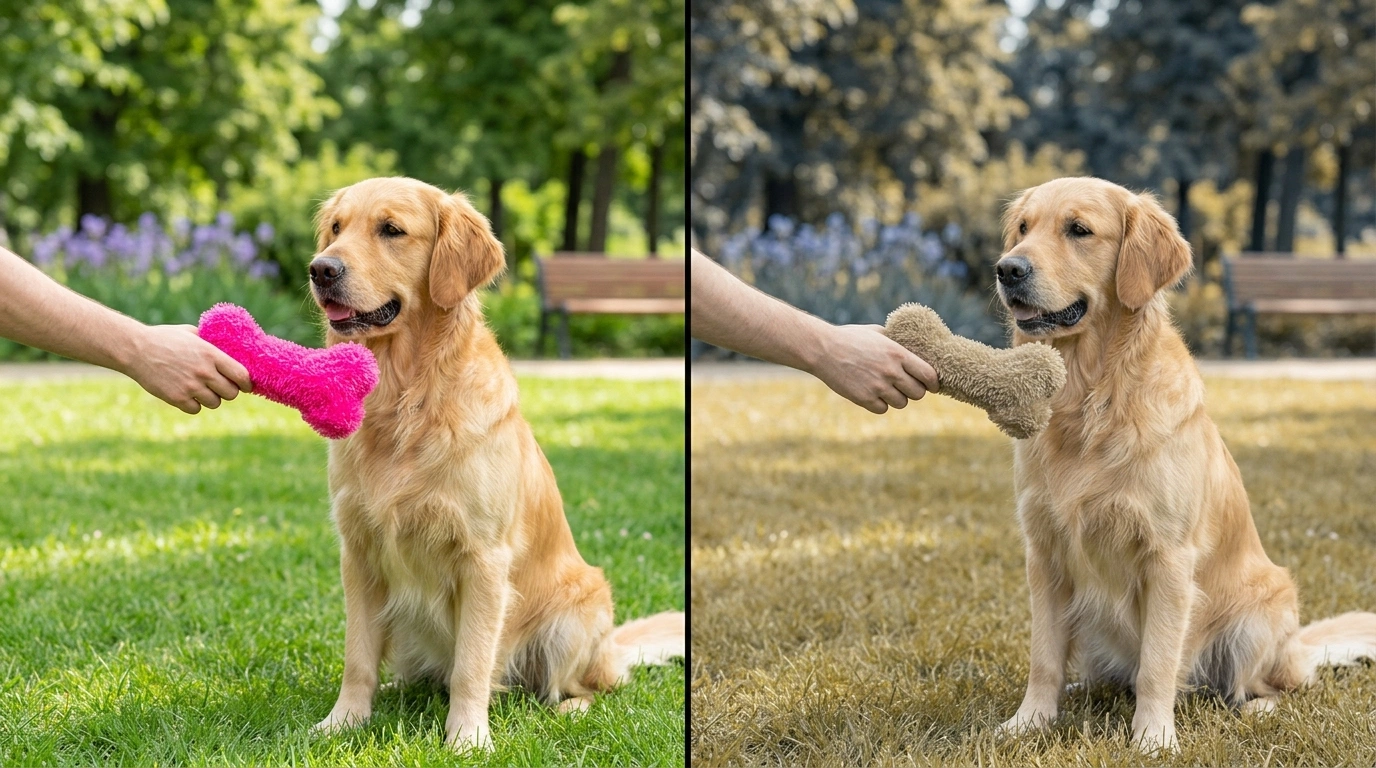
Dogs can see a pink object, but they do not see the color pink the same way humans do. To people, pink may look bright, soft, rosy, or neon. To dogs, pink usually appears much duller because dogs mainly see the world through shades of blue, yellow, gray, brown, black, and white. Dogs have two types of cones, while humans usually have three types of cones, so dogs have dichromatic vision instead of full human-like color vision.
That means a pink dog toy, blanket, collar, or ball is not invisible to your dog, but the pink color itself may look closer to pale yellow, cream, gray, white, or grayish-brown, depending on the exact shade and background. This is why a dog may easily chase a moving pink toy indoors but struggle to find the same toy in grass, sand, or low light.
In this guide, we’ll explain what pink looks like to dogs, why dogs see colors differently, which colors dogs see best, and whether pink toys are a good choice for play, training, and fetch.
The Short Answer: Can Dogs See Pink?
Yes, dogs can see a pink object, but they likely do not see pink as pink. The object is visible because dogs can notice shape, contrast, movement, brightness, smell, and sound. However, the color signal does not appear the same way it does to human eyes.
Pink belongs to the red spectrum, and dogs do not process red tones well. Bow Wow Labs explains that pink likely appears as a muted, grayish-brown shade to dogs. Other shades of pink may look more like pale yellow, off-white, cream, or light gray.
So, when asking “can dogs see pink?”, the clearest answer is:
Dogs can see pink objects, but they do not see pink as a bright or true pink color.
This matters most when choosing dog toys, balls, frisbees, training markers, or agility tools. A pink toy may look cute to humans, but it may not be the easiest color for a dog to spot quickly.
Why Dogs Do Not See Pink Like Humans Do
To understand why dogs do not see pink like humans, it helps to understand cones. Cones are special cells in the retina that help the eye detect color. Humans usually have three types of cones that allow them to see combinations of red, green, and blue. Dogs have only two types of cones, which allow them to see mostly blue and yellow. This is called dichromatic vision.
Because dogs do not have the same red-sensitive color system humans have, colors such as red, pink, orange, and green are harder for them to separate. This is often compared to red-green color blindness in humans.
A scientific study by Jay Neitz and colleagues found that the dog retina contains two classes of cone photopigment, supporting the idea that dogs have dichromatic color vision.
This does not mean dogs have poor vision overall. It simply means their vision is built differently. Dogs may not enjoy the full rainbow the way humans do, but they are excellent at noticing motion, contrast, and changes in light.
What Does Pink Look Like to Dogs?
The exact way pink appears to a dog depends on the shade of pink, the lighting, and the background. A hot pink toy may look stronger than a very pale pink toy because it has more brightness and contrast. But even hot pink probably does not look “hot pink” to a dog. It may look more like a dull brownish, grayish, or yellowish shade.
A light pink or baby pink object may be even harder for a dog to distinguish. It may look closer to cream, off-white, pale yellow, or light gray, especially if it is placed on a light carpet, beige floor, sand, or dry grass.
A neon pink toy may still catch a dog’s attention because of brightness and contrast, but the dog is likely responding more to the object’s visibility, motion, scent, or texture than to the pink color itself.
Here is a simple way to think about it:
- Hot pink may look like a dull, warm, muted shade.
- Light pink may look like cream, pale yellow, or gray.
- Baby pink may blend into pale backgrounds.
- Pink on grass may be harder to find than blue.
- Pink in motion may still be easy to chase.
So, what does pink look like to dogs? It is probably not one exact color in every situation, but it is usually much less colorful than it appears to us.
Dog Vision Color Chart: Pink Compared With Other Colors
Dogs do not see the full human color spectrum, but they can still see several useful contrasts. According to VCA Hospitals, dogs mainly discern blue and yellow, while humans can identify red, blue, and green combinations.
| Human Color | How It May Appear to Dogs | Visibility for Dogs |
| Blue | Clear blue or lighter blue | High |
| Yellow | Yellow or darker yellow | High |
| Pink | Pale yellow, cream, gray, or grayish-brown | Low to medium |
| Red | Brownish, dark, or dull | Low |
| Green | Yellowish, grayish, or brownish | Low |
| Orange | Yellowish or dull gold | Medium |
| Purple | Bluish shade | Medium |
| White | Bright white or strong contrast | High on dark backgrounds |
| Black | Dark contrast | High on light backgrounds |
This chart explains why blue and yellow dog toys are often easier for dogs to see than pink, red, or green toys. The color itself is not the only thing that matters, though. Contrast is very important. A white toy on snow may be hard to see, while the same white toy on dark grass may stand out clearly.
What Colors Can Dogs See Best?
Dogs see blue and yellow best. The American Kennel Club explains that dogs can distinguish yellow and blue from green, which may help explain why many dogs respond well to blue and yellow toys.
This is why many trainers and pet owners prefer blue toys for outdoor fetch. A blue ball often stands out against green grass better than red, orange, or pink. Yellow can also be easy for dogs to see, but it may blend into dry grass, sand, beige carpet, or pale flooring.
The best visible colors for dogs are usually:
| Best Dog Toy Color | Why It Works |
| Blue | Strong visibility on grass and many outdoor surfaces |
| Yellow | Easy for dogs to detect, especially on darker surfaces |
| High-contrast black and white | Useful when background contrast is strong |
| Blue and yellow combinations | Often easier than red, green, orange, or pink |
So, if you are choosing a ball, frisbee, chew toy, or training object, blue and yellow are usually better choices than pink for visibility.
Are Dogs Color Blind or Do They See in Black and White?
Dogs are not completely color blind, and they do not see only in black and white. This is one of the most common myths about dog eyesight.
The more accurate explanation is that dogs see fewer colors than humans. They can see shades of blue and yellow, but they struggle with colors in the red-green range. Scientific American summarizes this simply: dogs can see blues and yellows, but not reds and greens the way humans do.
So, if someone asks, “are dogs color blind?”, the best answer is:
Dogs are color blind compared with humans, but they are not blind to all color.
Their world is not just black, white, and gray. It includes color, but in a more limited way. Instead of seeing a bright pink toy as pink, they may see a duller tone. Instead of seeing a red ball clearly against grass, they may see something that blends into the background.
Are Pink Dog Toys Good for Dogs?
Pink dog toys are not bad for dogs, but they are not usually the best choice if your main goal is visibility. If your dog loves a pink toy because it squeaks, smells interesting, feels good to chew, or moves quickly, then the toy can still be useful and fun. Dogs do not choose toys by color alone.
However, if you are buying a toy for fetch, training, outdoor play, or easy retrieval, pink may not be the strongest option. A pink ball in grass may not stand out as clearly as a blue ball. A pale pink plush toy on beige carpet may blend into the background. A pink frisbee in low light may be harder to track than a blue or high-contrast toy.
A simple real-life example:
Case Study: A dog owner buys two fetch balls: one bright pink and one blue. At home, the dog plays with both because they smell and bounce the same. But at the park, the dog finds the blue ball faster in the grass. The pink ball is still visible to the owner, but not as visually clear to the dog. This does not mean the dog dislikes pink. It means the blue ball creates stronger contrast for canine vision.
If the toy is mostly for chewing indoors, pink is fine. If the toy is for fast outdoor play, blue or yellow is usually a better choice.
Pink Dog Toys vs Blue, Yellow, Red, and Green Toys
When choosing the best color toys for dogs, think about how the toy will look against the background. Dogs rely heavily on contrast, not just color.
| Toy Color | Best Use | Possible Problem |
| Blue | Outdoor fetch, grass, dog parks | May blend into blue surfaces |
| Yellow | Indoor play, dark floors, shaded areas | May blend with sand or dry grass |
| Pink | Owner preference, indoor use with contrast | May look dull or pale to dogs |
| Red | Easy for humans to see | May appear brownish or muted to dogs |
| Green | Human preference | Can blend into grass |
| Orange | Some outdoor visibility for humans | May appear yellowish or dull to dogs |
This is why pink vs blue dog toys is not just a style choice. For humans, pink may look bright and easy to spot. For dogs, blue usually sends a clearer color signal.
That said, dogs also use their sense of smell, hearing, mouth feel, and movement detection. A pink squeaky toy with a strong scent may still be more exciting than a plain blue toy that does nothing.
Why Your Dog May Ignore a Pink Toy
If your dog ignores a pink toy, color may be one reason—but it is not the only possible reason.
Your dog may ignore a pink toy because it blends into the background, especially on grass, beige flooring, sand, or pale carpet. The toy may also lack scent, sound, bounce, or texture. Some dogs prefer rubber toys, while others prefer plush toys, ropes, balls, or squeakers.
Dogs also respond strongly to movement. A dull-colored toy that moves quickly may be more interesting than a bright object sitting still. AKC notes that dogs can recognize objects best when they are moving, and their vision is different from human 20/20 vision.
So, if your dog does not care about a pink toy, do not assume your dog “hates pink.” It may simply be that the toy is hard to see, boring to smell, not fun to chew, or not moving enough.
A helpful trainer-style rule is:
“Choose toys for your dog’s senses, not just your own eyes.”
For dogs, scent, sound, texture, motion, and contrast can matter as much as color.
Does Pink Look Different Indoors, Outdoors, or in Low Light?
Yes, pink can look different depending on the environment. Indoors, a pink toy may stand out if it is placed on a dark floor, dark rug, or high-contrast background. But the same toy may be harder to see on pale carpet, cream bedding, beige tile, or light wood flooring.
Outdoors, the background matters even more. A pink toy in green grass may not stand out as well to a dog as it does to a human. A blue toy may be easier to find because blue is one of the colors dogs see best. A yellow toy may also work, but it can blend into dry grass or beach sand.
In low light, color becomes less important. Dogs have many rods, which help detect light and motion. They also have a reflective structure called the tapetum lucidum, which helps with night vision and low-light visibility. Petcube notes that dogs can see in conditions much dimmer than humans can.
So, in the dark, your dog may not care whether a toy is pink, red, or yellow. Movement, contrast, scent, and sound become much more important.
Dog Vision Compared to Human Vision
Human vision and dog vision are built for different strengths. Humans usually see more colors and sharper detail. Dogs see fewer colors, but they are often better at detecting motion and seeing in dim light.
AKC explains that perfect human vision is often described as 20/20, while a dog’s average vision is around 20/75. That means dogs may not see fine detail as clearly as humans do, but they can still navigate the world very well.
Dogs also often have a wider field of vision than humans, depending on breed and face shape. Some dogs can notice movement from the sides more easily than people can. This helps explain why dogs may react quickly to a squirrel, ball, or moving toy even if the color is not very clear.
In simple terms:
| Vision Feature | Humans | Dogs |
| Color range | Wider color spectrum | Mainly blue and yellow |
| Pink perception | Clear pink | Dull, pale, grayish, or yellowish |
| Sharpness | Usually sharper | Often blurrier |
| Motion detection | Good | Very strong |
| Low-light vision | Weaker than dogs | Stronger than humans |
Dogs do not see the world worse than humans in every way. They see it differently.
Can Dogs See Pink on TV, Phones, or Screens?
Dogs can see images on TV screens, phones, and tablets, but they may not respond to screens the way humans do. A dog may notice movement, animals, contrast, brightness, or sound before noticing color.
If pink appears on a screen, your dog likely still does not see it as true pink. The same color limits apply because the dog’s eyes still process color through blue-yellow dichromatic vision.
Some dogs love watching videos of dogs, squirrels, birds, or moving objects. Others ignore screens completely. If your dog responds to a pink object on a screen, it may be reacting to motion, sound, or contrast rather than the pink shade itself.
Quick Tips for Choosing Colors Your Dog Can See Easily
When buying dog toys, training tools, or fetch balls, color can help—but it should not be the only factor.
Choose blue toys for green grass, parks, and outdoor fetch. Blue often stands out better to dogs than red, pink, orange, or green. Choose yellow toys for darker rooms, shaded areas, or dark flooring. Use high-contrast toys if your dog is older, has vision changes, or often loses toys.
Pink toys are fine when the toy has other attractive features, such as a squeaker, strong smell, soft texture, or interesting movement. But if your goal is to help your dog see the toy quickly, pink is usually not the first choice.
Here are simple buying tips:
- Pick blue or yellow for visibility.
- Avoid green toys for grassy areas.
- Avoid relying on pink for long-distance fetch.
- Match the toy color to the background.
- Choose toys with scent, texture, bounce, or sound.
- Watch what your own dog actually prefers.
- Use brighter contrast for senior dogs.
The best toy is not always the prettiest toy. It is the toy your dog can see, smell, chase, chew, and enjoy.
FAQs About Dogs Seeing Pink
Can dogs see hot pink?
Dogs can see a hot pink object, but they probably do not see it as bright hot pink. It may appear more muted, dull, yellowish, grayish, or brownish.
Can dogs see light pink?
Dogs can see a light pink object, but light pink may be hard to distinguish from cream, white, pale yellow, or light gray backgrounds.
Do dogs see pink as gray?
Sometimes pink may appear grayish or grayish-brown to dogs, especially because pink is connected to the red spectrum.
Do dogs see pink as yellow?
Some pink shades may appear more pale yellow, cream, or off-white to dogs, depending on brightness and lighting.
Can puppies see pink?
Puppies do not see pink the way humans do either. As their vision develops, they still grow into the same general dog color vision system, which is based mostly on blue and yellow perception.
Can senior dogs see pink?
Senior dogs may have reduced visual acuity, eye cloudiness, or other vision changes. For older dogs, high-contrast toys are usually better than pale pink toys.
Are pink toys bad for dogs?
No, pink toys are not bad for dogs. They may simply be less visible than blue or yellow toys. If your dog enjoys the toy, it can still be a good choice.
Conclusion: So, Can Dogs See the Color Pink?
So, can dogs see the color pink? Dogs can see pink objects, but they do not see pink the same way people do. Because dogs have dichromatic vision, they mainly see blue and yellow, while colors in the red family—such as red, pink, and orange—often appear duller, grayish, yellowish, brownish, cream, or pale.
For everyday life, this does not hurt your dog. Dogs use many senses, including smell, hearing, motion detection, contrast, and texture, to understand the world. Pink collars, beds, bowls, and accessories are perfectly fine if you like them. But for fetch, training, and easy toy visibility, blue and yellow dog toys are usually better choices than pink.
Disclaimer: This article is for general informational purposes only. It is not a substitute for professional veterinary advice, diagnosis, or treatment. If you have concerns about your dog’s vision, behavior, or health, please consult a qualified veterinarian for proper guidance.