

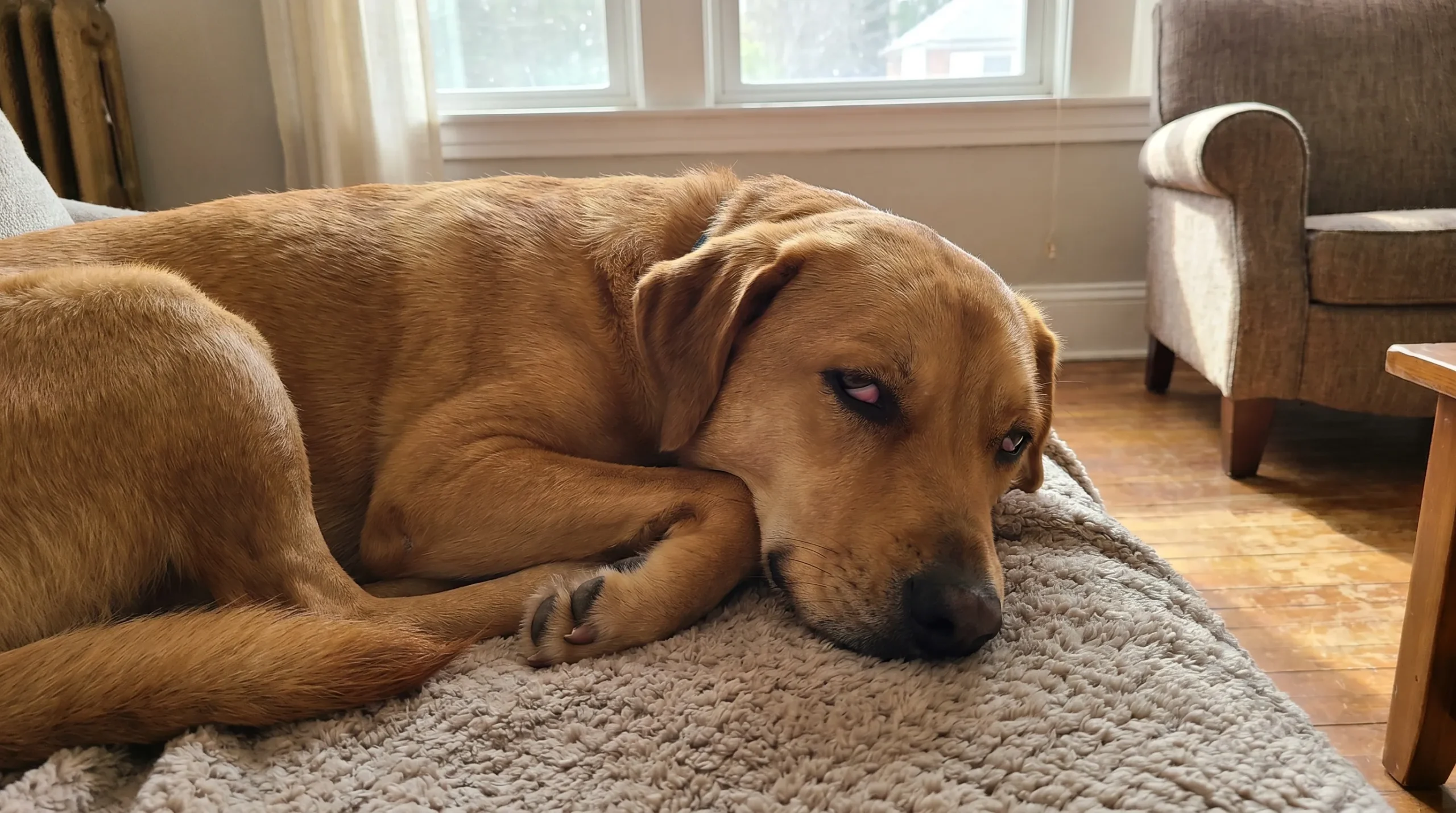
Yes—sometimes they do, and in many cases it is completely normal. A dog may be in light sleep, in REM sleep, or showing the third eyelid—also called the nictitating membrane—which can make the eyes look partly open even when the dog is genuinely asleep. At the same time, there are cases where sleeping with open eyes can point to an eye condition, narcolepsy, or even a seizure-like episode, especially if other symptoms show up.
For most dog owners, the real question is not just whether it happens, but whether it is harmless or a warning sign. That is why this guide looks at both sides: what is normal, why it happens, which breeds may do it more often, and when you should call a veterinarian. The goal is to give a calm, clear answer without ignoring the medical red flags.
Is It Normal for Dogs to Sleep With Their Eyes Open?
In many cases, yes, it is normal for dogs to sleep with their eyes open or partly open. PetMD says this is common and usually normal, especially when the dog wakes easily and acts normal afterward. PEDIGREE UK also notes that dogs can sleep with their eyes partially or fully open, and that what owners notice may sometimes be the raised third eyelid rather than the eyeball being fully exposed.
That matters because many owners see a dog resting on the bed, couch, or floor with half-open eyes, an unfocused stare, or slight twitching and immediately assume something is wrong. Often, it is just a normal part of dog sleep behaviour. If your dog is breathing normally, looks relaxed, and returns to full awareness when you quietly say their name or move nearby, that usually leans toward a harmless explanation rather than an emergency. PetMD specifically notes that dogs in these lighter sleep states often return to full awareness quickly when stimulated.
Why Do Dogs Sleep With Their Eyes Open?
There is not one single reason. Across the main veterinary and pet-advice sources, the most likely explanations are:
- Your dog is not fully asleep yet
- Your dog is in REM sleep and dreaming
- You are seeing the third eyelid
- Instinct may help dogs stay somewhat alert
- Breed anatomy may make full eye closure harder
- Aging or sleep-pattern changes may contribute
- A medical or neurological issue may be involved
Those themes appear consistently across PetMD, Northwest Animal Eye Specialists, and PEDIGREE UK, which is why they deserve the most space in a strong SEO article on this topic.
Your Dog May Not Be Fully Asleep Yet
One of the simplest explanations is that your dog is only partly asleep. In the early stages of sleep, dogs can look deeply relaxed without being fully unconscious. PetMD explains that in this state, dogs may appear asleep but have not fully lost consciousness, which is why their eyes may not fully close. PEDIGREE UK makes a similar point, saying that if the dog has just settled down, they may still be in a light stage of sleep.
This is often why owners ask, “Why does my dog sleep with his eyes half open?” or “Why does my dog sleep with their eyes partly open?” The answer may be as ordinary as a dog drifting in and out of a nap while staying lightly aware of the room. In practical terms, this kind of dog not fully asleep behaviour usually looks relaxed rather than dramatic. The dog may stir if you say their name, shift position, or brush past them. That quick return to awareness is one of the biggest clues that this is probably normal.
REM Sleep, Dreaming, Twitching, and Eye Movement
Another very common reason is REM sleep, the stage of sleep associated with dreaming. All three competitors connect open or half-open eyes with this phase. PetMD says many dogs sleep with their eyes partly open during REM sleep and may also show twitching, barking, or eye movements. PEDIGREE UK says dogs in REM may twitch their legs, yelp, bark, or move their eyes while dreaming. Northwest Animal Eye Specialists says the same pattern can make a dog appear awake even when it is just dreaming.
This is one of the most useful answers for the long-tail keyword “dog sleeping with eyes open during REM sleep.” A dog in REM may look odd to a human observer because the eyes can flicker, the face may move a little, and the body may twitch as if the dog is running in a dream. That can feel unsettling, but it is usually a normal sleep-stage behaviour, not automatically a medical problem.
Northwest Animal Eye Specialists adds one interesting stat: a dog’s wake-sleep cycle may run around 83 minutes, and the article contrasts that with humans more often sleeping in longer blocks of around seven to nine hours. That comparison helps explain why dog sleep can look more fragmented and active than human sleep, making eye movement and partial eye opening easier for owners to notice.
The Third Eyelid: What You May Actually Be Seeing
A major reason dogs appear to sleep with their eyes open is the third eyelid, or nictitating membrane. This is one of the strongest semantic entities in the topic, and all three sources mention it. PetMD describes it as a partly clear protective layer that can rise from the corner of the eye nearest the nose. PEDIGREE UK explains that it helps protect and clean the eye from dust, dirt, and debris and can help moisten the eye when needed.
This matters because sometimes owners are not seeing a truly open eye at all. Instead, they are seeing the raised third eyelid, which can create the impression that the dog is sleeping with eyes open. That is why the keyword “dog third eyelid showing while asleep” is such a valuable content gap to cover. It answers a very practical owner question that many competitor articles only mention briefly.
Here is a simple distinction:
| What you notice | What it may mean |
| Relaxed dog, partly open eyes, wakes easily | Often light sleep or REM sleep |
| Pinkish or pale membrane showing near the inner corner of the eye | Often the third eyelid / nictitating membrane |
| Redness, swelling, discharge, cloudiness, pain, squinting | More likely an eye problem |
| Fully open staring eyes, violent movement, unresponsive dog | Possible seizure-like event |
The most important takeaway is this: a visible third eyelid is not the same thing as a dangerous emergency by itself. But if it appears with irritation, discomfort, or other unusual symptoms, it is worth a veterinary check. PEDIGREE UK specifically notes that prolapse of the third eyelid may make the eyes uncomfortable and may require treatment.
Instinct and Staying Alert During Sleep
Another theory is that dogs may keep some level of situational awareness while sleeping. PetMD links this to evolution and says animals in the wild may benefit from staying partly aware of their surroundings. PEDIGREE UK frames it as a canine survival instinct, helping dogs remain alert to potential threats or deter predators.
This explanation is harder to prove than an anatomical one like the third eyelid, but it fits the broader pattern of how dogs behave as animals. Even well-loved house pets still carry instincts shaped long before they lived on couches and blankets. So when people search “dog sleeping with eyes open because of survival instinct,” they are tapping into a real concept found in competitor content.
Breed Anatomy Can Play a Role
Some dogs are more likely than others to sleep with eyes partly open because of their eye shape or facial structure. PetMD says disorders affecting eyelid closure are more common in dogs with short, smushed-in faces and big eyes, naming Pugs and Boston Terriers. Northwest Animal Eye Specialists also mentions breeds such as Bulldogs, Chihuahuas, and Pekingese in the broader anatomy discussion. PEDIGREE UK adds that dogs with large eyes may not be able to fully close them when asleep.
That makes brachycephalic breeds especially relevant in this topic cluster. If a dog’s lids are small relative to the eye or the face shape affects closure, the dog may be more likely to appear to sleep with open eyes. This does not always mean disease. Sometimes it is simply part of that dog’s anatomy. Still, if it suddenly starts, looks uncomfortable, or comes with discharge or irritation, it should not be dismissed.
Aging and Sleep Changes
Age can also matter. Northwest Animal Eye Specialists specifically notes that owners often ask, “Why does my older dog sleep with his eyes open?” and says changes in sleeping habits and patterns can happen as dogs reach their golden years.
That does not mean every senior dog who sleeps with open eyes has a problem. But it does mean age should be part of the context. If a senior dog has new sleep changes, reduced responsiveness, eye irritation, or unsteady movement after waking, the behaviour deserves closer attention. The biggest SEO value here is that senior dog sleep changes are a meaningful content gap most competitors do not fully develop, even though owners clearly worry about it.
When Sleeping With Eyes Open Can Mean a Health Problem
While open-eyed sleep is often harmless, there are times when it points to a real issue. The strongest medical clusters across the sources are eye conditions, eyelid abnormalities, narcolepsy, and seizure-like episodes. PetMD says some dogs develop eye or eyelid conditions that make it difficult or impossible to close the eyes normally, and these dogs may sleep with their eyes open consistently rather than only sometimes.
That “always versus sometimes” distinction is useful. If your dog only occasionally sleeps with eyes partly open, especially during naps or dreaming, that leans more normal. If the dog always sleeps that way, especially with discomfort or visible eye symptoms, a medical explanation moves higher on the list.
Eye Problems That Can Affect Eyelid Closure
Northwest Animal Eye Specialists gives the most detailed list of potential health concerns. These include eye infections such as conjunctivitis, dry eye syndrome, eye trauma, and structural issues such as ectropion or eyelid agenesis. The article says infections may lead to swelling, redness, discharge, and pain or discomfort, and that untreated infections can contribute to more serious problems, including vision loss.
PEDIGREE UK also notes that prolapse of the third eyelid can make the eyes uncomfortable and may require treatment from a veterinarian. PetMD adds that some eye or eyelid disorders make normal closure difficult, particularly in dogs with certain facial structures.
A few signs should make you think less about harmless sleep behaviour and more about an eye problem:
- Red eyes
- Irritated or inflamed eyes
- Swelling
- Cloudiness
- Unusual discharge
- Squinting
- Signs of pain
- A sudden change from normal sleeping behaviour
Those signs are all grounded in the competitor sources, and they are the most useful symptom-based terms to include naturally in a comprehensive article.
Narcolepsy and Seizure-Like Episodes
Two of the scariest possibilities are narcolepsy and seizures, which is why this section matters so much for both search intent and user trust. PetMD says dogs with narcolepsy may sleep with their eyes open, and that the condition is usually not subtle because affected dogs may fall asleep at inappropriate times, including while eating, playing, or even going to the bathroom. PEDIGREE UK similarly describes narcolepsy as a very rare possibility and calls it a neurological disorder affecting sleep.
Seizures are different from ordinary dreaming. PetMD says dogs experiencing a seizure often have more violent movements, may be impossible to arouse, and often have eyes fully open and staring into space, rather than the half-open, relaxed look seen in sleep. PEDIGREE UK adds more detail, saying the dog’s body and face may be tense, the jaws tight, the eyes may flicker from side to side, and the expression may look vacant rather than relaxed. It also says the dog may not be able to respond when you say their name. Northwest Animal Eye Specialists echoes the “violent movements” and “impossible to arouse” distinction.
That creates a useful rule of thumb:
A relaxed, twitching, half-open-eyed dog that wakes normally is more consistent with sleep.
A fully open-eyed, tense, staring, unresponsive dog is more concerning for a seizure-like event.
When to Worry: Signs Your Dog Needs a Vet
This is the section many owners care about most. PetMD says to worry if the dog does not seem normal after getting up, has trouble walking, falls over, or seems disoriented. It also flags falling asleep in strange places or at odd times, and eye symptoms such as redness, irritation, inflammation, discharge, or squinting. Northwest Animal Eye Specialists lists almost the same warning signs and adds restlessness, visible discomfort, and pain. PEDIGREE UK says to seek veterinary advice immediately if the pattern sounds more like a seizure or serious issue.
Call your vet promptly if:
- Your dog is hard to wake
- Your dog seems disoriented, falls over, or has trouble walking after waking
- Your dog falls asleep at odd times or in unusual places
- The eyes look red, cloudy, swollen, irritated, or have excessive discharge
- Your dog is squinting or seems in pain
- The body looks tense, the jaws are tight, or the eyes are fully open with a vacant stare
- The behaviour is new, sudden, or getting worse
Those are the core emergency or near-emergency signs hidden inside the top competitor articles, and they deserve to be made more visible than competitors currently do.
What to Do if Your Dog Sleeps With Their Eyes Open
If your dog sleeps with eyes partly open but otherwise seems normal, do not panic. Start by observing the pattern. Ask yourself: Does my dog wake easily? Does the face look relaxed? Is there any redness, discharge, pain, or strange behaviour after waking? That simple check helps separate harmless dog sleeping with eyes open but acting normal from something that needs medical attention.
The next step is to record a short video. PetMD specifically says a picture or video can be “worth a thousand words,” and Northwest Animal Eye Specialists also recommends recording what is happening so a veterinarian can assess the episode more accurately. That is one of the most practical tips in the SERP, and it deserves its own section because owners can actually use it.
A helpful at-home approach looks like this:
- Watch the eyes and face: Are they relaxed or tense?
- Notice the body: Mild twitching during dreams is different from violent movement.
- See how your dog wakes: Easy waking is reassuring.
- Check for eye symptoms: Redness, cloudiness, discharge, swelling, or squinting matter.
- Film the episode: Short clips help your vet far more than memory alone.
- Call your vet if anything seems abnormal, painful, sudden, or seizure-like.
This kind of owner-action framework is a content gap competitors only hint at, and it makes the article far more useful.
Normal Sleep vs Seizure vs Eye Problem
To make the differences clearer, here is a quick comparison:
| Feature | Normal light/REM sleep | Possible seizure | Possible eye problem |
| Eyes | Partly open, relaxed, may flicker | Often fully open, staring, vacant | May look irritated, cloudy, swollen, or unable to close |
| Body | Relaxed, mild twitching, dream movement | Tense, more violent movement, tight jaws | May paw at eye or seem uncomfortable |
| Response to name | Usually wakes or stirs | May be impossible to arouse | May wake normally but still show eye pain |
| After waking | Acts normal | May seem disoriented or unstable | May continue squinting, tearing, or showing redness |
| Best next step | Monitor | Seek veterinary care promptly | Book a vet exam, especially if symptoms persist |
This table is not a diagnosis tool, but it does reflect the distinctions made in the competitor sources and gives readers a much easier way to interpret what they are seeing.
Should You Wake a Dog Sleeping With Its Eyes Open?
Usually, no—not unless something looks wrong. PetMD says that if your dog awakens easily and seems normal afterward, it is probably nothing to worry about, and you can let them sleep. That is a useful reassurance point because many owners feel compelled to test the situation every time they notice half-open eyes.
But if the dog looks distressed, the body is stiff, the eyes are fully open and vacant, or the dog does not respond normally, then waking may not even be possible—and that is exactly why the situation becomes more urgent. In that case, stop thinking of it as a normal nap and start thinking in terms of veterinary evaluation.
FAQ
Do dogs sleep with their eyes open or just partly open?
Both can happen, but partly open is more commonly described in the reviewed sources. Sometimes what looks like an open eye is actually the third eyelid being visible.
Why does my dog sleep with his eyes half open?
The most likely reasons are light sleep, REM sleep, or a visible nictitating membrane. Less commonly, eye conditions or neurological problems may be involved.
Why does my older dog sleep with his eyes open?
Age-related changes in sleep patterns may play a role, according to Northwest Animal Eye Specialists. But if the change is sudden or comes with other symptoms, it is worth checking with a vet.
Can puppies sleep with their eyes open?
The reviewed competitors do not focus much on puppies specifically, but the same broad sleep-stage explanations can still apply. What matters most is whether the puppy seems comfortable, wakes normally, and has no eye symptoms. This is an inference based on the sources’ general explanation of sleep stages, not a direct quote from a puppy-specific source.
Is sleeping with eyes open always a sign of a seizure?
No. All three reviewed sources explain that REM sleep can involve twitching, eye movement, and partly open eyes. Seizures are more concerning when the dog has violent movement, tight jaws, fully open staring eyes, or is unresponsive.
Can a dog’s third eyelid show while sleeping?
Yes. In fact, this is one of the most common explanations for why a dog appears to be sleeping with eyes open.
The Bottom Line
Do dogs sleep with their eyes open? Yes—and often for perfectly normal reasons like light sleep, REM sleep, or a visible third eyelid. But if your dog seems painful, disoriented, hard to wake, develops redness or discharge, or shows tense, seizure-like behaviour, it is time to involve a veterinarian. The best approach is calm observation, a quick video, and fast action when clear warning signs appear.