

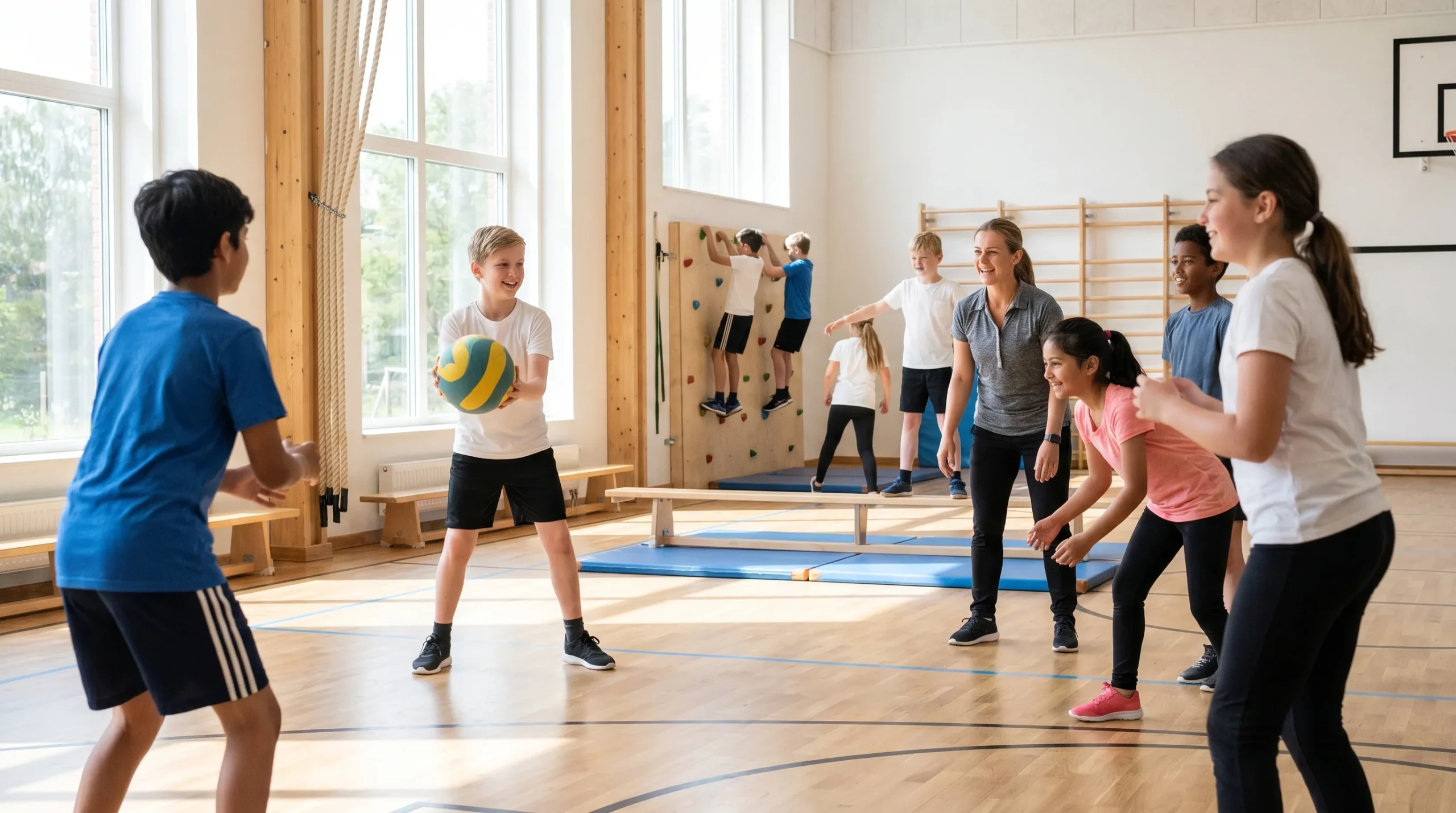
The main aim of physical education is to help students grow into healthy, confident, skilled, and active individuals by developing their physical fitness, motor skills, knowledge of movement, teamwork, self-discipline, and habits for lifelong physical activity. In modern schools, physical education is not just about games or exercise. It is a planned, standards-based academic subject that supports physical, cognitive, social, and emotional development from the early years through K–12 schooling.
For many students, parents, and teachers, this question sounds simple, but it is often misunderstood. Some people think PE exists only to make children run, play sports, or stay busy. In reality, good school physical education is designed to build movement literacy, physical competence, confidence, and the ability to stay active for life. It also helps students improve focus, learn cooperation, and build a healthier relationship with their bodies and daily activity.
What Is Physical Education?
Physical education is an academic subject built around structured movement, learning, and development. According to both SHAPE America and the CDC, PE is a planned, sequential K–12 curriculum based on standards. It is meant to develop motor skills, knowledge, and behaviors for physical activity and physical fitness, while also building sportsmanship, self-efficacy, and emotional intelligence.
That definition matters because it shows that PE is not random playtime. A strong PE program includes curricula and instruction, appropriate teaching, and student assessment. It gives students repeated chances to practice movement in an instructional climate focused on mastery, not just performance. That is one reason experts connect PE with the development of the physically literate individual—someone who has the skills, confidence, and understanding to keep moving throughout life.
In simple words, PE teaches students how to move well, why movement matters, and how to use physical activity to support health and wellbeing. That is a much broader mission than simply winning games.
What Is the Main Aim of Physical Education?
The purpose of physical education can be summed up in one clear idea: to support the whole development of the student through movement and active learning. This includes the body, the mind, and the student’s social and emotional growth.
At its core, physical education aims to:
- develop physical competence
- build confidence through movement
- improve physical fitness and health
- teach motor skills and coordination
- encourage teamwork, leadership, and respect
- create lifelong healthy habits
That broad goal is consistent across the strongest competitor and authority sources. SHAPE America describes PE as a subject designed to develop motor skills, active living, physical fitness, sportsmanship, self-efficacy, and emotional intelligence, while the CDC says PE gives students the ability and confidence to be physically active for a lifetime. FIFTH Movement similarly explains that PE nurtures physical competence, confidence, and lifelong engagement with physical activities.
So, when someone asks, “what is the main aim of physical education in schools?”, the best answer is this: PE aims to help every student become physically literate, healthy, socially aware, and ready to live an active life. Schools are also in a strong position to help students move toward the nationally recommended 60 minutes or more of moderate-to-vigorous physical activity daily, which makes PE important not only educationally, but also for public health.
Aim vs Objectives vs Benefits of Physical Education
Many people mix up the aim, objectives, and benefits of PE, but they are not the same.
The aim of physical education is the overall purpose. It is the big-picture reason the subject exists. In this case, the main aim is to support lifelong active living and whole-child development through structured movement and learning.
The objectives of physical education are the more specific targets teachers work toward. These include helping students improve motor skill development, coordination, balance, agility, self-management, sportsmanship, and knowledge about fitness, health, and movement. SHAPE America also highlights the three domains of learning in PE: the cognitive domain, the affective domain, and the psychomotor domain.
The benefits of physical education are the positive results students gain from meeting those objectives. These can include better fitness, stronger self-esteem, improved concentration, healthier daily habits, and stronger teamwork and communication skills. The CDC also notes that PE can help students improve grades and standardized test scores and stay on-task in the classroom, while increased time in PE does not negatively affect academic achievement.
This distinction matters for SEO and for readers. When a student asks for a short note on physical education, they often want the aim in one sentence. When a teacher asks about curriculum, they often need the objectives. When a parent asks why PE matters, they are usually thinking about the benefits.
Why Physical Education Matters in Schools
The importance of physical education in schools is much greater than many people realize. Schools are not just places for academic instruction. They are also environments where children learn habits, values, routines, and ways of caring for themselves and others. PE helps schools support that wider mission.
Because PE is a planned K–12 curriculum and an academic subject, it deserves the same seriousness as other areas of learning. It teaches students how to manage their bodies, how to work with others, and how to make activity part of daily life. In the UK-focused competitor, PE is even described as a statutory subject for pupils aged 5 to 16, showing how central it is in formal education systems.
PE also matters because it gives every student—not only the athletic ones—a chance to succeed. A well-designed program is meant to meet the needs of all students, keep them active for most of class time, teach self-management, and emphasize knowledge and skills for a lifetime of physical activity. That inclusive purpose is one of the strongest reasons why school physical education still matters in modern education.
The Physical Aim: Fitness, Health, and Active Living
One major answer to what is the main aim of physical education is the promotion of physical health. PE helps students improve important components of fitness such as cardiovascular endurance, muscular strength, flexibility, and healthy body composition. The Ecole Globale article gives practical examples like running, swimming, and cycling for endurance, and resistance exercises and stretching routines for strength and flexibility.
This matters because the goal of PE is not only short-term exercise. It is to build a foundation for active living and lifelong healthy habits. The CDC’s framing is especially useful here: schools can use PE and related activity opportunities to help students move toward 60 minutes or more of moderate-to-vigorous physical activity daily.
A simple way to understand this is to think of PE as early training for healthy adulthood. When students learn how to warm up, move safely, understand their bodies, and enjoy activity, they are more likely to carry those habits forward. That is why PE connects naturally with injury prevention, hydration, nutrition, rest and recovery, and other lifestyle basics—even when those topics are not the whole focus of the lesson. Good PE teaches that health is built through repeated, practical choices.
Key idea: Physical education is not only about making students tired. It is about helping them become stronger, healthier, and more active for life.
The Skill Aim: Motor Skills, Coordination, and Physical Competence
Another core objective of physical education is to develop motor skills and physical competence. This is one of the most repeated themes across the competitor set. SHAPE America says PE is designed to develop motor skills, knowledge, and behaviors for active living, while Ecole Globale highlights activities such as throwing, catching, dribbling, and jumping to build skill and coordination.
Motor development includes both basic and more advanced movement patterns. Students work on gross motor movements and fine motor movements, plus related capacities such as hand-eye coordination, agility, and balance. These skills matter in sports, but they also matter in everyday life. A child who moves with better control often feels more capable, more willing to participate, and more confident trying new activities.
This is where PE becomes more than exercise. It becomes education in movement. Students are not just moving; they are learning how to move with purpose, rhythm, control, and awareness. In the long term, that supports not only athletic ability, but also body confidence and participation in all kinds of physical activity.
The Social and Emotional Aim: Teamwork, Confidence, and Discipline
The social and emotional side of PE is often underestimated, but it is one of the strongest reasons the subject matters. Through team games, partner work, and group activities, students learn teamwork, communication, cooperation, leadership, and respect for different abilities. Ecole Globale specifically connects PE with leadership, empathy, and conflict-resolution skills, while FIFTH Movement emphasizes self-esteem, personal discipline, and mental wellbeing.
These lessons are powerful because they happen in real situations. A student learns patience by waiting their turn. They learn communication by calling out clearly during a game. They learn emotional control when they lose, make a mistake, or have to support a classmate instead of focusing only on themselves. That makes PE a natural place to build life skills.
In that sense, one aim of PE is to shape character. It helps students become more confident without becoming arrogant, more competitive without becoming disrespectful, and more disciplined without losing enjoyment. This is one reason PE supports whole-child development, not just physical growth.
The Cognitive Aim: Focus, Learning, and Academic Performance
A high-quality PE program also supports the cognitive domain. That means PE contributes to learning, thinking, attention, and classroom readiness. The CDC explicitly states that physical education can help students improve grades and standardized test scores and stay on-task in the classroom. It also notes that spending more time in PE does not harm academic achievement.
That finding matters because PE is sometimes seen as separate from serious learning. In reality, movement and learning are closely connected. Students who are more active often return to class more alert, more regulated, and more ready to focus. FIFTH Movement makes a similar point when it links PE with improved concentration and academic performance.
This does not mean PE should be justified only by test results. Its value is much bigger than that. But it does show that movement-based education can support the learning environment in practical ways. PE helps students think with their bodies as well as their minds.
What Is Physical Literacy, and Why Is It Central to PE?
One of the most important modern ideas in this topic is physical literacy. SHAPE America says that physical education develops the physically literate individual through well-designed learning tasks and a climate focused on mastery.
Physical literacy means more than being fit or sporty. It means having the confidence, competence, knowledge, and motivation to take part in physical activity throughout life. A physically literate person can move effectively, understands why movement matters, and feels able to join in different forms of activity.
This concept is useful because it answers the main keyword perfectly. The main aim of physical education is not just to teach a few games. It is to create people who can continue moving, learning, and caring for their health long after school ends. That is why PE is so often linked to lifelong physical activity rather than short-term performance alone.
Physical Education vs Sports: What Is the Difference?
Many readers confuse PE with sports, but they are not the same thing.
| Physical Education | Sports |
| Curriculum-based academic subject | Often competition-based activity |
| Designed for all students | Often selective or team-based |
| Focuses on learning, development, and inclusion | Often focuses on performance and results |
| Builds motor skills, health knowledge, and confidence | Builds sport-specific skill and competition experience |
| Happens during school instruction | May happen in school or outside school |
This difference appears clearly in the sources. SHAPE America and CDC define PE as a planned K–12 curriculum and an academic subject, while FIFTH Movement lists not only competitive programmes but also curricular, inclusive, and wellness-focused programmes.
So, PE may include sports, but it is not limited to sports. A student does not need to be highly athletic to benefit from physical education. That is one of its greatest strengths.
Examples of How PE Achieves Its Aim in Real School Life
The aims of PE become clearer when we look at real examples. A lesson in gymnastics may improve balance, body control, and confidence. A dance lesson can develop rhythm, coordination, creativity, and expression. A swimming unit may teach safety, endurance, and lifelong survival skills. A small-sided team game can build communication, cooperation, and decision-making. FIFTH Movement also highlights activity types such as games, athletics, dance, gymnastics, swimming, outdoor adventurous activities, yoga, and fitness circuits across different school programs.
Here is a simple classroom-style example:
A shy student joins a PE unit reluctantly. Over time, they improve their coordination in basic movement drills, contribute to a team activity, and complete a fitness circuit they once avoided. By the end of the term, the student is not just fitter. They are also more confident, more willing to participate, and more comfortable working with others.
That is the real success of PE. It turns movement into growth.
Short Exam-Ready Answer: What Is the Main Aim of Physical Education?
If you need a brief answer for school or exam use, this version works well:
The main aim of physical education is to develop students physically, mentally, socially, and emotionally through planned physical activities. It helps improve fitness, motor skills, teamwork, discipline, confidence, and healthy habits for lifelong active living.
A very short version is this:
Physical education aims to create healthy, skilled, confident, and active individuals.
Conclusion
The best answer to what is the main aim of physical education is not just fitness. It is whole-child development through movement. PE helps students build motor skills, improve physical health, grow in confidence, learn teamwork and discipline, and become more prepared for lifelong physical activity. That is why major education and health sources describe it as a planned, standards-based academic subject, not an optional extra.
When PE is taught well, it gives students far more than a class period of exercise. It gives them tools for health, learning, self-belief, and active living that can last far beyond school.
FAQs
What is the main aim of physical education in simple words?
The main aim of physical education in simple words is to help students stay healthy, active, skilled, and confident through movement and exercise.
Why is physical education important in schools?
It is important because it supports fitness, motor development, teamwork, mental wellbeing, and even classroom focus and academic performance.
Is physical education the same as sports?
No. Physical education is a school subject for all students, while sports are often more competitive and performance-focused.
What are the objectives of physical education?
The objectives include improving motor skills, coordination, fitness, self-management, sportsmanship, and development across the cognitive, affective, and psychomotor domains.
How does PE help mental health and confidence?
PE encourages movement, social interaction, achievement, and emotional regulation. Competitor sources connect it with self-esteem, mental wellbeing, emotional intelligence, and confidence through movement.
Disclaimer:
This article is for informational purposes only. Guidelines and recommendations about physical education may vary by school, region, or curriculum. Readers should consult qualified educators or health professionals for personalized guidance on physical activity and PE programs.