

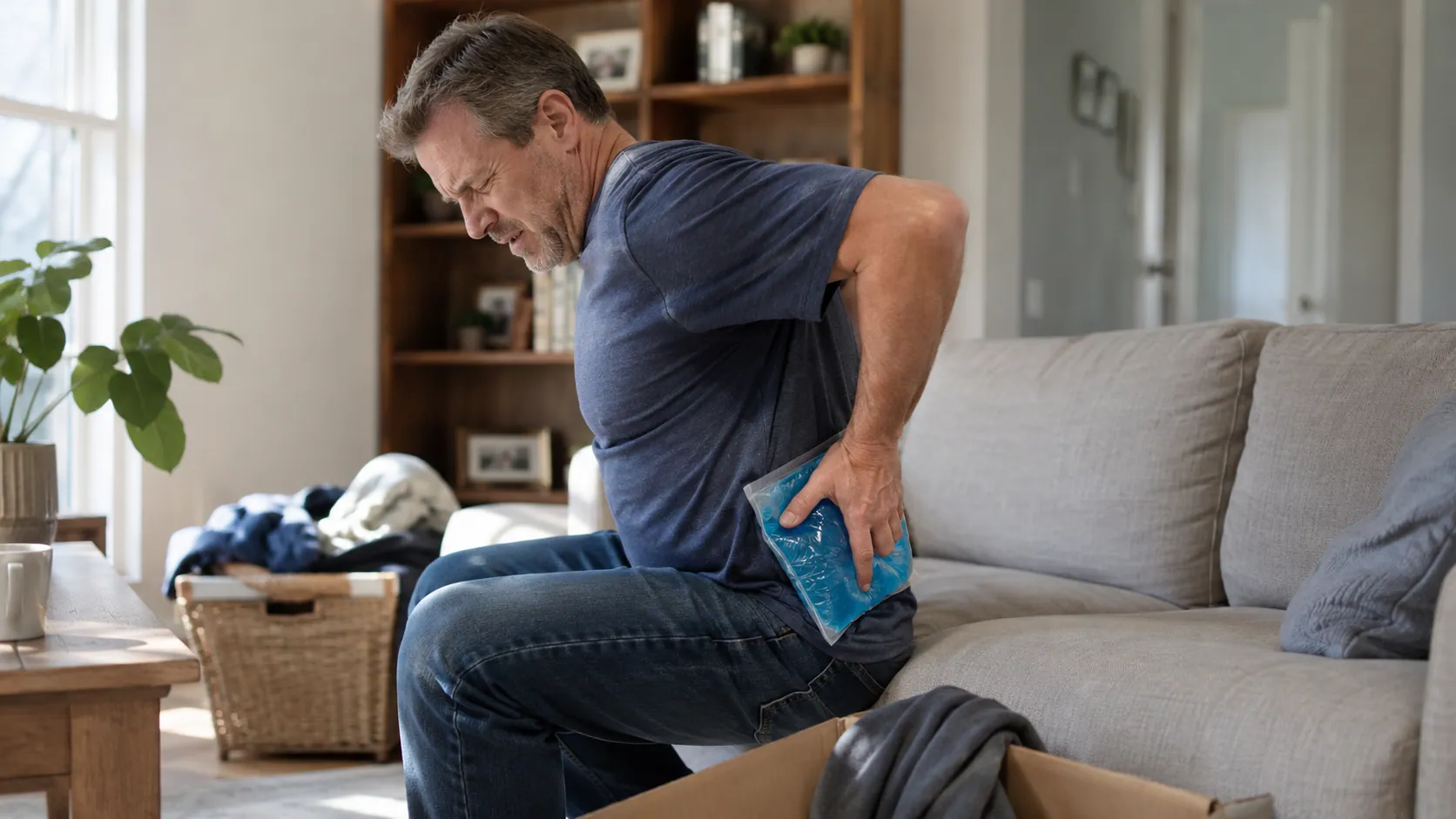
What to do when u throw out your back starts with stopping the painful movement, getting into a supported position, using ice early, avoiding heavy lifting or twisting, and watching for red-flag symptoms like leg weakness, numbness around the groin or buttocks, or bladder/bowel changes. Most cases of a thrown out back are linked to acute lower back pain, muscle strain, or a protective muscle spasm, but sudden back pain can feel scary because it may lock up your movement quickly.
The goal is not to panic, force your back to “loosen up,” or stay in bed for days. The goal is to calm the pain, move carefully, protect your spine, and know when to seek medical care. This guide explains what to do in the first 10 minutes, whether to use ice or heat, how to sleep and move safely, what not to do, and when a thrown-out back may need a doctor, urgent care, or the ER.
Important: This article is for general education. Sudden or severe back pain with neurological symptoms, bladder or bowel changes, fever, or pain after a serious accident needs medical attention.
Quick Answer: What Should You Do Right Now?
If your back went out, stop what you are doing immediately. Do not try to “walk it off” aggressively or test the pain by bending, twisting, or stretching hard. A thrown-out back often happens after lifting, bending, twisting, coughing, sneezing, shoveling, exercising, or standing up from an awkward position.
First, move into the least painful position. For many people, that means lying on the back with a pillow under the knees, lying on the side with a pillow between the knees, or standing with hands supported on a counter. Take slow breaths because fear and muscle guarding can make back spasms feel worse.
Use an ice pack or cold pack wrapped in a towel for short periods during the early stage, especially if the pain is sharp or sudden. Avoid putting ice directly on the skin. If you can walk, take short, gentle steps around the room. If movement sharply worsens the pain, pause and try again later.
A simple first-aid checklist looks like this:
| What to Do | Why It Helps |
| Stop the painful movement | Prevents further irritation |
| Find a supported position | Reduces muscle guarding |
| Use ice early | May reduce pain and inflammation |
| Avoid lifting and twisting | Protects irritated tissues |
| Watch for red flags | Helps identify serious symptoms |
Seek urgent help if you have loss of bladder or bowel control, saddle numbness, weakness in one or both legs, chest pain, fever, or pain after a serious accident. NHS guidance lists bladder/bowel changes, numbness around the genitals or anus, weakness or numbness in both legs, chest pain, and pain after a serious accident as reasons for emergency care.
What Does It Mean to Throw Out Your Back?
To throw out your back is not a formal medical diagnosis. It is a common phrase people use when they suddenly develop acute low back pain, stiffness, or a locked-up feeling in the lower back. In many cases, it may involve a muscle strain, muscle sprain, irritated ligaments, or a strong muscle spasm around the lumbar spine.
The pain can feel intense even when the injury is not dangerous. Your back muscles may tighten as a protective response, almost like your body is trying to stop you from moving in a way that could make things worse. This can create a cycle: pain causes guarding, guarding causes stiffness, and stiffness makes movement feel harder.
Common descriptions include sharp pain, shooting pain, a dull ache, tight back muscles, reduced range of motion, and trouble standing straight. Some people say, “my lower back locked up suddenly,” or “my back seized up and I can’t move.” These phrases usually describe sudden lower back spasm treatment at home needs, but they should still be taken seriously if symptoms are severe or unusual.
Common Symptoms and Causes of a Thrown-Out Back
The most common symptoms of a thrown-out back include sudden lower back pain, stiffness, muscle tightness, limited mobility, and pain that gets worse when bending, twisting, standing, or getting out of bed. You may also feel a sharp catch in the lower back or a cramping sensation like a “charley horse” in the back muscles.
Some symptoms may suggest nerve irritation, especially if pain travels into the buttock, hip, or leg. This may feel like radiating pain, tingling, numbness, or sciatica-like symptoms. Not every leg symptom means a serious problem, but worsening leg weakness, numbness in both legs, or bladder/bowel changes should not be ignored.
Common causes include heavy lifting, twisting while lifting, bending at the waist, poor posture, prolonged sitting, overreaching, shoveling snow, moving furniture, carrying luggage, or returning too quickly to exercise. A person might throw out their back after deadlifting, squatting, golfing, gardening, or even coughing or sneezing if the back is already irritated.
Risk factors can include weak core muscles, tight hips, poor lifting mechanics, job-related strain, stress, low activity level, smoking, weight gain, and repeated episodes of back pain. The cause is not always one dramatic injury. Sometimes it is cumulative wear and tear plus one final awkward movement.
First 10 Minutes: What to Do Before You Move Again
The first few minutes matter because many people make sudden back pain worse by panicking, forcing a stretch, or trying to “crack” the back. Instead, treat the first 10 minutes like a calm reset.
Start by staying still for a moment and breathing slowly. Try diaphragmatic breathing: breathe in through your nose, let your belly expand gently, then exhale slowly. This will not magically cure a muscle spasm, but it can reduce tension and help you move more carefully.
Next, check for red flags. Ask yourself: Do I have new leg weakness? Numbness around the groin, buttocks, or inner thighs? Trouble peeing or controlling bowel movements? Fever or chills? Did this start after a serious fall or car accident? If yes, get urgent medical help.
If there are no red flags, find a safe position. You may lie on your back with knees supported, lie on your side with a pillow between the knees, or stand supported with your hands on a sturdy surface. Do not repeatedly bend forward to “see if it still hurts.” That often irritates the area more.
When you do move, move slowly. Roll to your side before getting up, use your arms to push yourself, and keep your spine as neutral as possible. Your goal is not perfect posture; your goal is pain-free range of motion and avoiding sudden twisting.
Ice or Heat: Which One Should You Use?
One of the most common questions is: should you use ice or heat after throwing out your back? In the early stage, especially during the first 24 hours or first 48 hours, ice is often the better starting point for sharp, sudden pain. Cold therapy may help reduce pain and calm inflammation. MedlinePlus guidance for back pain recommends ice for the first 48 to 72 hours, followed by heat.
Use a cold pack, frozen gel pack, or ice pack wrapped in a towel. Apply it for about 15 to 20 minutes, then take a break. Never place ice directly on your skin, and do not fall asleep with an ice pack on your back.
Heat can be helpful later, especially if the pain feels more like tightness, stiffness, or a lingering muscle spasm. A heating pad, warm compress, or warm shower may help relax tight muscles and increase blood flow. Many people switch to heat after 48 hours, but the best choice can depend on what feels better.
Here is a simple guide:
| Situation | Better First Choice |
| Sudden sharp pain | Ice |
| New swelling or inflammation feeling | Ice |
| Tight, stiff muscles after a day or two | Heat |
| Lingering soreness | Heat or gentle movement |
| Pain worsens with heat | Stop heat and try ice later |
Do not overdo either one. Ice and heat are tools, not cures. They work best when combined with gentle movement, safe positioning, and avoiding activities that flare the pain.
Should You Rest or Keep Moving?
A little rest at the beginning is reasonable, especially if the pain is intense. But prolonged bed rest is usually not the best plan for a thrown-out back. Mayo Clinic notes that bed rest is not recommended for most back pain, and most back pain improves with home treatment within a month, especially in people under 60.
This does not mean you should force yourself through severe pain. It means you should avoid staying completely still for days. Gentle movement helps maintain mobility, supports blood flow, and can reduce stiffness. Start with very short walks, even just around the room. If that feels okay, try a few minutes at a time several times a day.
Think of movement as a dial, not a switch. You are not choosing between “lying flat all day” and “going back to the gym.” You are choosing small, controlled movement that does not sharply increase symptoms.
Good early movements may include walking slowly, changing positions every so often, standing with support, and gently rolling in bed. Stop or reduce activity if pain shoots down the leg, numbness increases, or the back spasms sharply.
A useful rule is: move often, move gently, and avoid movements that worsen symptoms.
What Not to Do When You Throw Out Your Back
Knowing what not to do can be just as important as knowing what to do. When your back is irritated, aggressive stretching, twisting, and heavy lifting can make symptoms worse.
Do not force deep stretches in the first painful stage. Many people bend forward hard, pull their knees aggressively to the chest, or twist side to side because they want the back to “release.” If the muscles are guarding, forcing the movement may increase pain.
Do not lift heavy objects, move furniture, carry laundry baskets, shovel snow, or return to weightlifting right away. Avoid bending at the waist and twisting the spine together. This combination is a common trigger for lower back strain.
Do not stay in bed for days unless a clinician tells you to. Too much rest can increase stiffness and make it harder to return to normal activities.
Do not ignore serious symptoms. Loss of bladder or bowel control, saddle numbness, new weakness, numbness in both legs, fever, chest pain, or pain after serious trauma are not “normal back strain” symptoms.
Do not take more pain medication than directed. OTC medicines like ibuprofen, naproxen, and acetaminophen can help some people, but they are not risk-free. Medication safety matters, especially if you have kidney disease, stomach ulcers, liver disease, take blood thinners, are pregnant, or have been told to avoid NSAIDs.
OTC Pain Relief and Medication Safety
For short-term back pain relief, some people use over-the-counter pain relievers. Common options include NSAIDs such as ibuprofen, naproxen sodium, Advil, Motrin, or Aleve, and non-NSAID pain relief such as acetaminophen or Tylenol.
These medicines may reduce pain enough to help you move more comfortably, sleep better, and avoid staying completely still. But they should be used carefully. Follow the label directions and do not combine medicines without checking whether it is safe.
Be extra cautious with NSAIDs if you have a history of stomach ulcers, kidney disease, high blood pressure, heart disease, blood thinner use, or pregnancy. Be careful with acetaminophen if you have liver disease or drink heavy amounts of alcohol. If you are unsure, ask a pharmacist or healthcare provider.
Topical pain relief, such as menthol rubs, anti-inflammatory gels, or lidocaine patches, may help some people with localized pain, but they should still be used according to directions.
Pain relievers should not be used to “push through” unsafe movements. If medicine masks pain and you lift, twist, or exercise too soon, you may irritate the back again.
How to Sleep, Sit, and Get Out of Bed Safely
A thrown-out back can make simple tasks feel difficult. Sleeping, sitting, standing up, driving, and getting out of bed may all trigger pain if you move suddenly.
For sleep, try lying on your back with a pillow under your knees. This can reduce tension in the lower back. If you prefer side sleeping, place a pillow between your knees to keep your hips and spine more aligned. Avoid sleeping on your stomach if it increases discomfort.
To get out of bed, use the log roll technique. Roll onto your side first, keep your shoulders and hips moving together, slide your legs off the bed, and push up with your arms. This avoids a sharp sit-up motion that can strain the lumbar spine.
When sitting, use lumbar support. A rolled-up towel or small pillow behind your lower back can help support the natural curve of the spine. Avoid sinking into a very soft couch for long periods because it may round your lower back and make standing up harder.
To stand, scoot toward the edge of the chair, keep your feet under you, brace gently through your core, and push through your legs. Avoid twisting while standing up.
If you need to drive, keep trips short at first. Use a small lumbar roll, avoid sitting too long, and take breaks to stand and walk if needed.
A Simple 48-Hour Recovery Plan
A structured 48-hour back pain recovery plan can make a thrown-out back feel less overwhelming.
During hours 0–24, focus on calming symptoms. Stop painful activity, use ice for short periods, rest in supported positions, and take short walks only if tolerable. Avoid heavy lifting, twisting, deep stretching, and long periods in one position.
During hours 24–48, continue gentle movement. Try walking in small increments and changing positions throughout the day. If ice still feels helpful, use it. If stiffness becomes the main issue, heat may feel better. Keep movements slow and controlled.
After 48 hours, many people begin adding more mobility. This may include gentle walking, pelvic tilts, or light stretches that stay within a comfortable range. Heat may help tight muscles at this stage. If pain is clearly improving, gradually return to light daily activities.
Here is a simple timeline:
| Timeframe | Main Goal | Helpful Actions |
| First 10 minutes | Calm and assess | Breathe, check red flags, find support |
| First 24 hours | Reduce irritation | Ice, supported rest, avoid twisting |
| 24–48 hours | Restore gentle movement | Short walks, position changes |
| After 48 hours | Gradual mobility | Heat, light stretches, daily activity |
| After a few days | Reassess | Seek care if worsening or not improving |
If pain is severe, worsening, or not improving after several days, consider contacting a healthcare professional.
Gentle Movements and Stretches That May Help
When pain starts to settle, gentle movement can help restore confidence and mobility. Mayo Clinic notes that exercise often helps ease back pain and prevent further discomfort by stretching and strengthening the back and supporting muscles.
Start with walking. Even short walks around the house can help you avoid stiffness. Keep the pace easy and stop if symptoms worsen.
Pelvic tilts may also help. Lie on your back with your knees bent, gently tighten your abdominal muscles, and flatten the low back slightly toward the floor. Hold briefly, then relax. This should feel gentle, not forced.
A single knee-to-chest stretch may help some people, but do it carefully. Pull one knee toward your chest only until you feel mild tension, not sharp pain. If it increases leg pain or causes symptoms to shoot downward, stop.
Other gentle options may include child’s pose modification, diaphragmatic breathing, light hip flexor stretching, or slow sit-to-stand practice. More advanced exercises like bridges, bird dogs, dead bugs, Pilates, yoga, or tai chi may be useful later, especially for prevention, but they may not be appropriate during the first severe pain stage.
A good rule is: stretches should reduce tension, not create sharp pain.
How Long Does a Thrown-Out Back Last?
A thrown-out back can feel dramatic, but many episodes improve over a few days to a couple of weeks. Some people feel much better within several days, while others have lingering stiffness or soreness longer. Mayo Clinic notes that most back pain improves within a month with home treatment, although some pain can last longer.
The recovery timeline depends on the cause, your activity level, age, previous injuries, overall health, and whether nerve symptoms are present. A mild muscle strain may settle quickly. A stronger spasm or irritated disc may take longer.
You should expect gradual improvement. Pain may not disappear all at once, but you should notice better movement, less sharp pain, easier walking, and improved sleep over time.
Seek medical care if pain gets worse instead of better, lasts longer than expected, keeps returning, travels down the leg with numbness or weakness, or prevents normal activity. If you have red flags, do not wait for a normal recovery timeline.
When to See a Doctor, Urgent Care, or the ER
Most simple back strains can be managed at home, but some symptoms need professional care.
Go to the ER now or seek emergency help if back pain comes with bladder or bowel changes, numbness around the genitals, anus, buttocks, or inner thighs, weakness or numbness in both legs, chest pain, or pain after a serious accident. These may point to serious problems, including rare but urgent conditions such as cauda equina syndrome, where compressed spinal nerves can affect bladder, bowel, and saddle-area sensation. NHS-linked guidance describes cauda equina syndrome as rare but serious and requiring emergency treatment.
Consider urgent care if pain is severe but you do not have emergency red flags, especially if you cannot walk comfortably, cannot sleep, or need help deciding whether medication or imaging is appropriate.
Schedule a visit with a doctor, physical therapist, chiropractor, or orthopedic specialist if pain does not improve, keeps coming back, interferes with work, or causes ongoing radiating pain. Imaging such as an X-ray, CT scan, or MRI is not always needed for simple acute back pain, but a clinician may consider it if symptoms suggest trauma, nerve involvement, infection, fracture, or another serious cause.
The safest approach is simple: home care is reasonable for improving mild-to-moderate symptoms, but red flags need urgent evaluation.
Can a Thrown-Out Back Be Sciatica or a Herniated Disc?
Sometimes a thrown-out back is mostly a muscle strain or muscle spasm. Other times, symptoms may involve a nerve. If pain travels from the lower back into the buttock, thigh, calf, or foot, people often worry about sciatica, a pinched nerve, or a herniated disc.
Radiating pain does not automatically mean you need surgery or imaging, but it does deserve attention if it is severe, worsening, or paired with numbness, tingling, or weakness. A clinician can help determine whether the pain is muscular, joint-related, disc-related, or nerve-related.
Be especially careful with progressive neurological symptoms, such as worsening leg weakness, foot drop, numbness in both legs, saddle numbness, or bladder/bowel changes. Those symptoms should not be treated as ordinary back strain.
How to Prevent Throwing Your Back Out Again
Prevention starts after the pain calms down. The goal is not to avoid all movement; it is to build a back that can handle everyday movement better.
Focus on core strengthening, hip mobility, glute strength, hamstring flexibility, and proper lifting mechanics. Mayo Clinic explains that core muscles include the abdominal muscles, back muscles, and muscles around the pelvis, and strong core muscles make many physical activities easier.
Learn the hip hinge technique. Instead of bending from your waist with a rounded back, push your hips back, keep the object close, brace gently through your core, and lift with your legs. Avoid twisting while lifting.
Take movement breaks if you sit for long periods. A simple microbreak every 30 to 60 minutes can reduce stiffness. Improve your desk setup with lumbar support, a screen at eye level, and feet supported on the floor.
Warm up before workouts, sports, shoveling, gardening, or moving boxes. If you repeatedly throw out your back, consider working with a physical therapist to identify movement patterns, weakness, or mobility restrictions that may be contributing.
FAQs
Is throwing out your back serious?
Sometimes, but not always. A thrown out back often involves acute lower back pain, muscle strain, or muscle spasm. However, it becomes more concerning if you have red flags like leg weakness, saddle numbness, fever, pain after serious trauma, or bladder/bowel changes.
Should I stretch immediately after throwing out my back?
Not aggressively. Gentle movement may help, but forcing deep stretches during severe pain can make symptoms worse. Start with supported positions, slow walking, and pain-free movement.
Is walking good after throwing out your back?
Walking can help if it does not sharply worsen pain. Start with short, easy walks and increase gradually. Avoid long walks at first if they increase spasms or radiating pain.
Should I use ice or heat first?
Ice is often better early, especially for sudden sharp pain. Heat may help later if stiffness and tight muscles are the main problem. Many people use ice during the first 24–48 hours, then heat after symptoms settle.
Can I go to work after throwing out my back?
It depends on your job and symptoms. Desk work may be possible with breaks and lumbar support. Manual labor, lifting, bending, or twisting may need temporary modification. If your job worsens symptoms, speak with a healthcare provider.
When should I worry about sudden back pain?
Worry if pain comes with bladder or bowel changes, numbness around the groin or buttocks, weakness or numbness in both legs, fever, chest pain, unexplained weight loss, or pain after a serious accident. These symptoms need urgent medical attention.
Conclusion
Knowing what to do when u throw out your back can help you stay calm and recover safely. Start by stopping the painful movement, finding a supported position, using ice early, avoiding heavy lifting or twisting, and adding gentle movement as symptoms allow. Most episodes of acute lower back pain improve with careful home care, but red-flag symptoms should never be ignored.
For long-term prevention, focus on core strength, posture, hip mobility, proper lifting, movement breaks, and gradual return to activity. A thrown-out back is painful, but with smart first steps and the right safety checks, you can reduce irritation, protect your spine, and lower the risk of it happening again.
Disclaimer
This article is for general informational and educational purposes only and is not a substitute for professional medical advice, diagnosis, or treatment. If you have severe back pain, worsening symptoms, numbness, leg weakness, fever, pain after an injury, or changes in bladder or bowel control, seek medical care immediately. Always consult a qualified healthcare professional before starting treatment, medication, stretching, or exercise for back pain.