

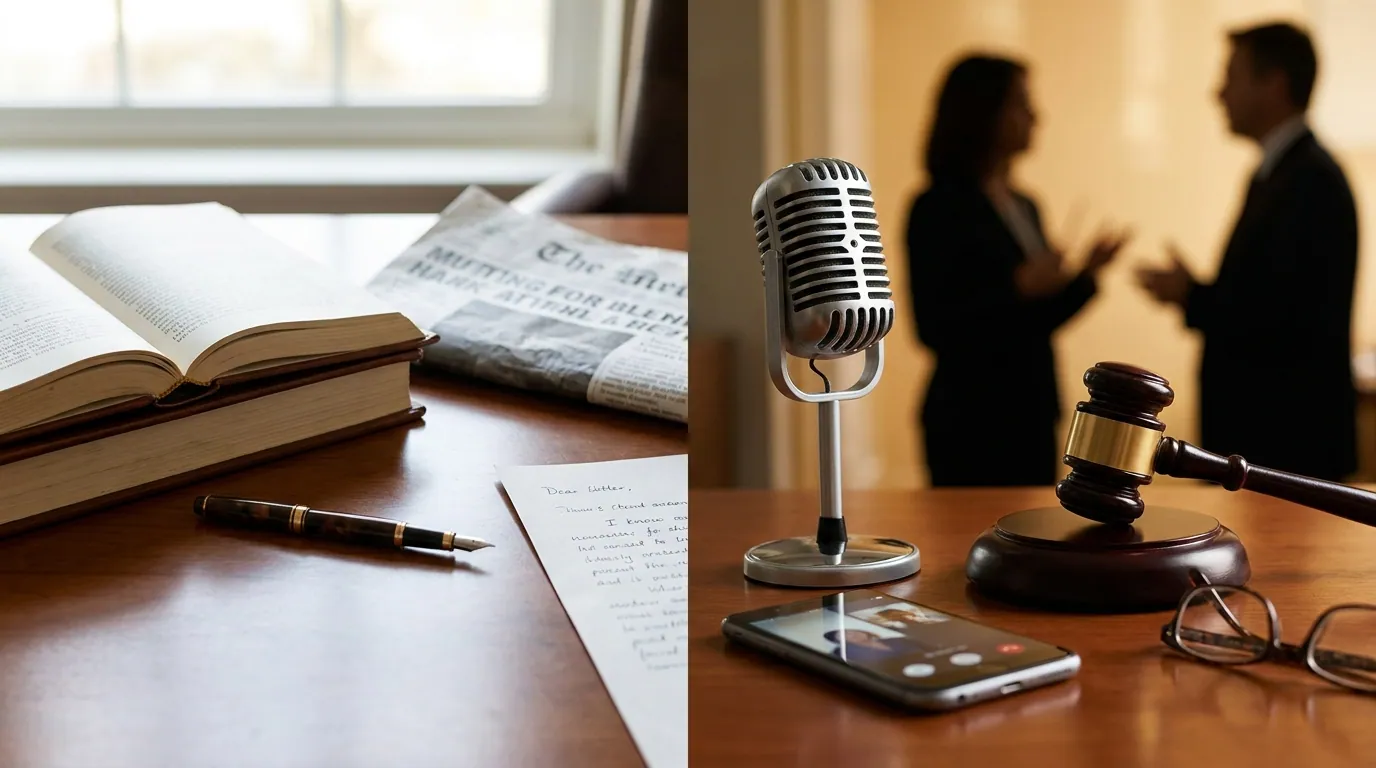
The simple answer is that libel is defamation in written, published, visual, or recorded form, while slander is defamation in spoken or oral form. Both are types of defamation, which generally means a false statement of fact that is communicated to someone else and harms a person’s reputation, character, business, or professional standing.
In everyday language, people often use libel, slander, and defamation as if they mean the same thing. Legally, they are closely related, but they are not always identical. The key difference usually comes down to the medium of publication: was the harmful statement written or published, or was it spoken?
This guide explains libel vs slander in simple terms, with examples, comparison tables, legal elements, online defamation issues, defenses, damages, and practical evidence tips.
Important note: Defamation laws vary by jurisdiction, state, and country. This article is for general information only and is not legal advice.
Quick Answer: Libel Is Written, Slander Is Spoken
The easiest way to remember the libel and slander difference is this:
Libel usually involves a written statement, published statement, image, video, post, review, article, or other lasting form of communication.
Slander usually involves a spoken statement, oral accusation, verbal rumor, live speech, or conversation.
Both can damage a person’s reputation if the statement is false and shared with a third party. For example, falsely writing online that someone stole money may be libel. Falsely saying the same thing in a workplace meeting may be slander.
The distinction used to be clearer when communication was either printed or spoken. Today, online communication makes things more complicated. A social media post, online review, blog comment, or YouTube caption is usually closer to written defamation because it is published and can be saved. A livestream, podcast, or recorded speech may raise more fact-specific questions depending on the law in that location.
Still, the basic rule remains simple: libel is written or published; slander is spoken.
What Is Defamation?
Defamation is the umbrella legal term that includes both libel and slander. In simple terms, defamation happens when someone makes a false statement of fact about another person or business, communicates it to someone else, and causes reputation harm.
A statement usually has to be more than rude, embarrassing, or insulting. It generally needs to make a factual claim that can be proven true or false. For example, “I don’t like this doctor” is usually an opinion. But falsely saying, “This doctor lost their license for fraud” is a factual claim and could create a defamation claim if it harms the doctor’s professional reputation.
Common parts of a defamation issue may include:
| Element | Simple Meaning |
| False statement | The claim is not true |
| Statement of fact | It can be proven true or false |
| Publication | Someone besides the speaker or writer received it |
| Identification | The statement points to a real person or business |
| Harm | It damages reputation, work, income, or standing |
| Fault | The speaker or writer acted carelessly, knowingly, or with required legal fault |
Because defamation law is often controlled by state law or local rules, the exact burden of proof, damages, and defenses can vary.
What Is Libel?
Libel is a type of defamation that appears in written, printed, visual, digital, or otherwise published form. A libel definition usually focuses on the fact that the harmful statement is recorded or preserved in a way that others can read, see, share, or revisit.
Examples of written defamatory statements may include:
| Example | Why It May Be Libel |
| A false newspaper article accusing someone of a crime | It is written and published |
| A false blog post damaging a business reputation | It is online and permanent |
| A false Google review accusing a company of fraud | It is a written online statement |
| A social media post falsely claiming a teacher abused a student | It is published to others |
| A meme that falsely implies someone committed misconduct | It may communicate a false factual claim |
Libel can appear in many forms, including emails, text messages, articles, online reviews, social media posts, blogs, internet forums, digital images, and sometimes video or broadcast content.
Libel is often easier to prove than slander because there is usually a record. A screenshot, URL, printed copy, archived page, or saved email can help show exactly what was said, when it was published, and who may have seen it.
However, a written statement is not automatically libel. It still generally needs to be false, factual, communicated to a third party, and harmful.
What Is Slander?
Slander is a type of defamation that usually involves a spoken defamatory statement. A basic slander definition is a false oral statement that harms someone’s reputation after being communicated to another person.
Slander may happen in everyday situations such as:
| Example | Why It May Be Slander |
| A coworker falsely tells others that an employee stole money | It is a spoken accusation |
| Someone falsely says at a meeting that a business owner committed fraud | It is verbal and shared with others |
| A person spreads a false rumor in a community | It may harm reputation |
| A speaker falsely accuses someone of professional misconduct | It may damage career standing |
Slander can be harder to prove than libel because spoken statements may disappear quickly. Unless there are witness statements, lawful recordings, meeting notes, or repeated verbal claims, it may be difficult to show the exact words used.
That does not mean slander is less serious. A spoken false statement can still cause a lost job, damaged relationships, business losses, or a damaged professional reputation. The seriousness depends on the words used, who heard them, how widely they spread, and what harm followed.
Libel vs. Slander Comparison Table
The table below gives a simple libel vs slander chart for quick comparison.
| Feature | Libel | Slander |
| Main form | Written, printed, visual, digital, or published | Spoken or oral |
| Common examples | Articles, posts, reviews, emails, blogs, images | Conversations, speeches, meetings, verbal rumors |
| Permanence | Often lasting or saved | Often temporary unless recorded |
| Evidence | Screenshots, copies, URLs, messages | Witnesses, recordings, testimony |
| Online example | False Google review | False claim made during a livestream conversation |
| Main harm | Reputation, business, career, or financial damage | Reputation, business, career, or financial damage |
The difference between defamation, libel, and slander is easiest to understand this way: defamation is the broad category, libel is written or published defamation, and slander is spoken defamation.
Examples of Libel and Slander in Real Life
Real-world examples make the difference between libel and slander easier to understand.
Imagine a restaurant customer writes a public review saying, “The service was slow, and I did not enjoy the food.” That is likely an opinion. But if the customer falsely writes, “The owner steals customers’ credit card numbers,” that could be libel because it is a written factual accusation that may damage the business.
Now imagine someone says during a neighborhood meeting, “My neighbor is a thief,” even though it is false. If other people hear it and the neighbor’s reputation is harmed, that may be slander.
Here are more examples:
| Situation | Likely Category | Reason |
| False accusation in a published article | Libel | Written and published |
| False statement in an email sent to multiple people | Libel | Written communication to third parties |
| False rumor spoken at work | Slander | Oral statement shared with others |
| False claim in a public speech | Slander | Spoken statement |
| False social media post | Libel | Written online publication |
| Private angry thought never shared | Usually not defamation | No third-party publication |
| “I think this business is terrible” | Usually not defamation | Likely opinion, not a factual claim |
A key point is that defamation usually requires a false harmful statement communicated to a third party. If no one else heard, read, or received the statement, there may be no publication element.
Is Social Media Defamation Libel or Slander?
A common modern question is: Is social media defamation libel or slander?
Most written social media content is closer to libel because it is published in a visible or shareable form. A defamatory Facebook post, X/Twitter post, Instagram caption, Reddit comment, TikTok caption, or YouTube description may be treated as written or digital defamation if it makes a false factual claim and harms someone.
For example, a false post saying, “This accountant stole client funds,” could be social media libel if it is untrue and damages the accountant’s reputation.
But some social media content is more complicated. A live video, livestream, podcast, voice chat, or spoken statement in a video may involve spoken words. Depending on the facts and jurisdiction, it may be analyzed as slander, libel-like publication, or a broader online defamation issue.
Social media also creates proof problems. Content can be deleted, edited, reshared, screenshotted, or posted anonymously. If the originator is unknown, identifying them may require platform records, IP addresses, or legal process.
For SEO and practical purposes, online defamation should be treated as a major topic because people increasingly face reputation harm through online comments, anonymous defamatory posts, review sites, and viral posts.
Are Online Reviews Libel?
An online review can be libel if it contains a false factual claim that harms a person or business. However, honest opinions and fair criticism are generally treated differently from false statements of fact.
For example:
| Review Statement | Likely Risk Level |
| “I did not like the service” | Usually opinion |
| “The food was cold and overpriced” | Usually opinion or customer experience |
| “This company stole my money” if false | Possible libel |
| “This doctor is not licensed” if false | Possible libel |
| “The contractor committed fraud” if false | Possible libel |
This is especially important for business review defamation, false Google reviews, false Yelp reviews, and review platforms such as Trustpilot or Glassdoor. A negative review is not automatically defamatory. But a false accusation of crime, fraud, professional misconduct, or dishonesty can cause serious business reputation damage.
For businesses, the strongest response is usually not emotional retaliation. It is better to save screenshots, URLs, dates, and evidence of harm such as lost clients, canceled contracts, or reduced sales.
What Do You Have to Prove in a Libel or Slander Claim?
To bring a libel or slander claim, a person generally must prove more than hurt feelings. While the exact rules vary by jurisdiction, a defamation claim often involves these elements:
- A false statement of fact was made.
- The statement was about an identifiable person or business.
- The statement was communicated to a third party.
- The statement caused reputation harm, financial loss, or another legally recognized injury.
- The required fault standard was met, such as negligence or actual malice, depending on the case.
This is why the phrase false statement of fact matters. A statement like “I think he is rude” may be protected opinion. But “He stole company funds” is a factual claim that can be proven true or false.
The burden of proof may also change based on whether the claimant is a private person, public figure, business, politician, influencer, or public official. The type of damages may matter too. Some cases require proof of special damages, such as lost income, lost clients, or another measurable economic loss.
Because defamation law is technical, people with serious financial or reputational harm often speak with a defamation attorney, especially when online content is spreading quickly.
Public Figures, Private People, and Actual Malice
Defamation claims involving public figures are usually harder to prove than claims involving private people. In many U.S. cases, public figures and public officials must prove actual malice.
Actual malice does not simply mean the speaker was angry or rude. In defamation law, it usually means the person made the statement knowing it was false or with reckless disregard for whether it was true.
This higher threshold exists because of First Amendment concerns, including freedom of speech, freedom of press, and debate on matters of public concern. Journalists, commentators, citizens, and media outlets often discuss public officials, celebrities, business leaders, and influencers. The law generally gives more breathing room for public discussion, even when statements are harsh or critical.
Private people may not always have to meet the same standard, but they still usually need to prove the basic parts of a defamation claim. Again, local law matters.
Is Libel Worse Than Slander?
Many people ask, which is worse, libel or slander? The answer depends on the facts.
Libel is often considered easier to prove because it leaves a record. A written article, online post, screenshot, email, or review can show the exact words used. Slander can be harder to prove because spoken words may depend on witnesses or recordings.
However, slander can still be very harmful. A false spoken accusation at work could cause someone to lose a job. A false verbal claim in a business setting could damage contracts or client trust. A rumor repeated to the right people can cause serious professional harm.
So, is slander harder to prove than libel? Often, yes. But that does not always mean libel is legally “worse.” The seriousness depends on the statement, evidence, audience, harm, and applicable law.
Defamation Per Se and Defamation Per Quod
Some jurisdictions recognize concepts called defamation per se and defamation per quod.
Defamation per se refers to statements that are considered so obviously harmful that the law may presume damage in certain situations. These may include false statements accusing someone of a serious crime, having a loathsome communicable disease, lacking ability in their profession, or committing serious sexual misconduct, depending on local law.
A common example is falsely saying a professional stole from clients. That statement may directly attack the person’s honesty and professional reputation.
Defamation per quod usually involves statements that require extra facts or proof to show why they are harmful. In some places, the person may need to prove special damages, such as lost salary, lost commission, lost job, or lost sale.
The phrase five types of defamatory per se statements appears in some legal discussions, but the exact categories vary. That is why it is important to avoid assuming the same rule applies everywhere.
What Is Not Libel or Slander?
Not every rude, unfair, or embarrassing statement is defamation. This is an important part of understanding libel vs slander in simple terms.
A statement may not be libel or slander if it is:
| Type of Statement | Why It May Not Be Defamation |
| True | Truth is generally a strong defense |
| Opinion | Opinions are usually protected unless they imply false facts |
| Vague insult | Name-calling may not be a factual claim |
| Satire or parody | Often not understood as literal fact |
| Private statement never shared | No third-party publication |
| Rhetorical hyperbole | Exaggeration may not be treated as fact |
For example, saying “That restaurant is the worst” is usually opinion. Saying “That restaurant serves expired meat” is a factual claim. If false, it may create legal risk.
Likewise, is an insult defamation? Usually not by itself. A vague insult like “he is awful” may be hurtful, but it is not necessarily a verifiable statement of fact.
Common Defenses to Libel and Slander
Several defenses may apply to a libel claim or slander claim.
The most important is the truth defense. If the statement is substantially true, it is usually not defamatory, even if it is embarrassing.
Another major defense is opinion. People are generally allowed to express opinions, criticism, and personal experiences. However, an opinion can become risky if it implies a false factual claim. “I think the contractor did a poor job” is different from “The contractor committed fraud” if that claim is false.
Other possible defenses include:
| Defense | Meaning |
| Truth | The statement is true or substantially true |
| Opinion | The statement is not presented as a factual claim |
| Privilege | Certain legal, government, or official settings may protect statements |
| Fair comment | Fair criticism on matters of public interest may be protected |
| Consent | The person agreed to publication |
| Anti-SLAPP laws | Some jurisdictions protect speech from lawsuits meant to silence public participation |
Absolute privilege and qualified privilege may protect certain statements made in court, legislative settings, official reports, or specific professional contexts. These defenses depend heavily on jurisdiction.
What Damages Can Libel or Slander Cause?
Libel and slander can cause different types of harm. Some harm is personal, such as embarrassment, stress, damaged relationships, or loss of community trust. Other harm is financial, such as a lost job, lost sale, canceled contract, or reduced income.
Common damages may involve:
| Type of Harm | Example |
| Reputational harm | People stop trusting the person |
| Professional harm | A worker loses credibility in their field |
| Business harm | Customers leave because of false reviews |
| Economic loss | Lost job, lost sale, lost salary, or lost commission |
| Emotional distress | Stress caused by public false accusations |
| Punitive damages | Possible in some serious cases, depending on law |
In some defamation cases, damages must be proven with evidence. In others, especially some defamation per se situations, harm may be presumed. Because damages rules vary, a person should not assume they have a strong case simply because a statement was offensive.
What Evidence Should You Save?
If you believe you were defamed, evidence matters. A strong defamation issue depends not just on what happened, but on what can be proven.
Useful evidence may include screenshots, URLs, dates, timestamps, usernames, emails, text messages, copies of posts, witness names, recordings where lawful, business records, lost contracts, and proof of lost income.
For online defamation, save the content before it disappears. Take screenshots that show the full post, account name, date, platform, and surrounding context. If possible, save the URL and note when you first saw the statement.
For slander, write down the exact words as soon as possible. Record who heard the statement, where it happened, when it happened, and how it affected you. Witness statements may become important if there is no written record.
Avoid deleting messages, responding angrily, or making counter-accusations. Retaliation can make the situation worse and may create additional legal problems.
Jurisdiction Matters: Defamation Laws Vary
Defamation law is not identical everywhere. The rules may vary by state, country, court system, and type of claim. Some places treat defamation mainly as a civil matter, while others may also recognize criminal defamation.
Key differences may include:
| Legal Issue | Why Location Matters |
| Statute of limitations | Deadlines for filing a claim vary |
| Damages | Some places require proof of special harm |
| Public figure rules | Actual malice standards may differ |
| Anti-SLAPP laws | Some jurisdictions offer stronger speech protections |
| Online defamation | Digital publication rules may vary |
| Criminal defamation | Some countries still recognize criminal penalties |
This is why a general article can explain concepts, but local legal advice may be needed for serious cases.
When Should You Talk to a Defamation Lawyer?
You may want to speak with a defamation lawyer if the false statement caused serious harm, spread widely online, accused you of a crime, damaged your profession, affected your business, or involved anonymous online attacks.
A lawyer may help evaluate whether the statement is legally actionable, whether it is libel or slander, what evidence is needed, and whether a cease and desist letter, retraction request, platform takedown request, or lawsuit makes sense.
Legal help may be especially important if the statement involves a business, public figure, media outlet, employer, professional license, viral post, or repeated online harassment.
Not every harmful statement is worth a lawsuit. Sometimes the best solution is documentation, correction, platform reporting, or a carefully written response. But when reputation, income, or safety is seriously affected, professional guidance can help avoid mistakes.
Frequently Asked Questions About Libel and Slander
Is libel written or spoken?
Libel is usually written or published. It can include articles, posts, emails, text messages, online reviews, images, videos, and other preserved forms of communication.
Is slander written or spoken?
Slander is usually spoken. It includes oral statements, verbal rumors, speeches, conversations, or spoken accusations shared with another person.
Is a text message libel or slander?
A text message is written, so it is usually closer to libel if it contains a false factual statement, is shared with a third party, and causes harm.
Is an email libel or slander?
An email is written communication, so it is generally treated as libel-like defamation if it meets the legal requirements.
Is a voicemail slander?
A voicemail is spoken but recorded. It may be treated differently depending on local law and context, but it often raises slander-related issues because the words are oral.
Is gossip slander?
Gossip may be slander if it includes a false statement of fact, is spoken to others, and harms someone’s reputation. But vague rumors, opinions, or true statements may not qualify.
Is an insult defamation?
Usually, a simple insult is not defamation. Name-calling, exaggeration, or rude opinion may be protected unless it implies a false factual claim.
Can a meme be libel?
Yes, a meme can create libel risk if it communicates or strongly implies a false factual claim that harms someone’s reputation.
Is defamation a crime?
In many places, defamation is mainly handled as a civil lawsuit. However, some jurisdictions still have criminal defamation laws, so local law matters.
Can truth be defamation?
Usually, no. Truth is generally one of the strongest defenses to libel and slander. A true statement is typically not defamatory, even if it causes embarrassment.
Conclusion: Libel and Slander Are Different Forms of Defamation
The difference between libel and slander comes down mainly to how the false statement is communicated. Libel is usually written, published, visual, or digital defamation. Slander is usually spoken or oral defamation. Both fall under defamation, and both can harm a person’s reputation, career, business, or community standing.
The most important question is not just whether a statement is rude or upsetting. The real issue is whether it is a false statement of fact, communicated to a third party, and harmful enough to support a legal claim.
In modern life, defamation often happens online through social media posts, reviews, videos, and comments. That makes evidence especially important. If a statement is serious, save screenshots, document harm, avoid escalating the situation, and check the law in your jurisdiction before taking action.
Disclaimer: This article is for general informational and educational purposes only and does not constitute legal advice. Defamation, libel, and slander laws vary by jurisdiction, and legal outcomes depend on specific facts and local regulations. If you believe you have been defamed or face a defamation claim, consult a qualified attorney for advice tailored to your situation.