

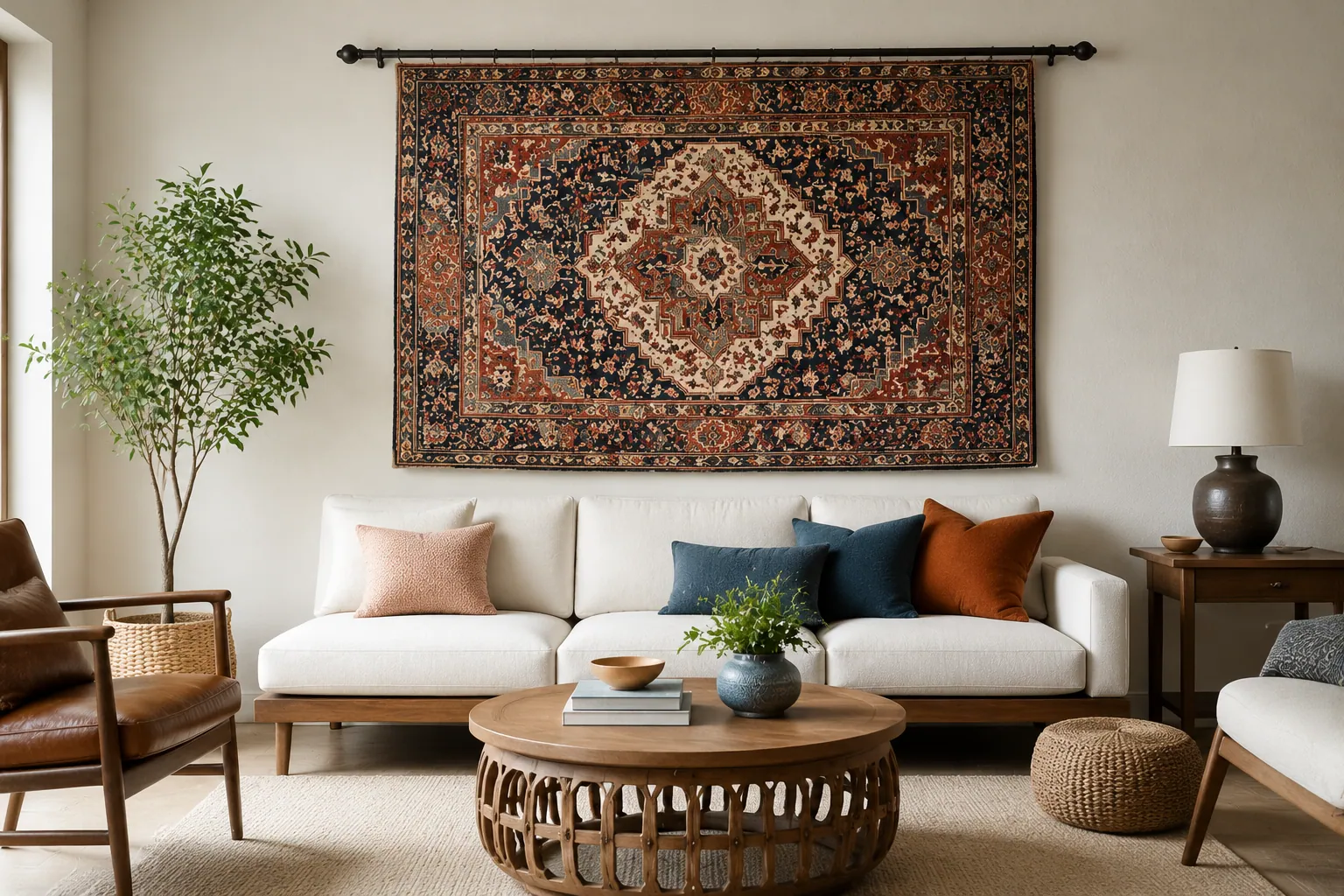
How to hang a rug on the wall is a question many homeowners, renters, and design lovers ask when they want to turn a beautiful rug into wall art without damaging the rug or the wall. A wall-hung rug can add texture, warmth, color, pattern, and personality to a room, but the right hanging method depends on the rug’s weight, material, size, value, and wall type.
A lightweight cotton rug may work with a simple Velcro method, while a heavy wool rug may need a curtain rod, rug rod, wooden slat, wall anchors, or full width support. If the rug is antique, handmade, Persian, Moroccan, or valuable, you need a more careful approach that protects the rug fibers and prevents stretching.
This guide explains the best ways to hang a rug safely, beautifully, and without sagging.
Why Hang a Rug on the Wall?
Hanging rugs as wall art is not just a modern design trend. Rugs, tapestries, and woven textiles have been used on walls for centuries to add warmth, insulation, sound muffling, and visual appeal. Today, a rug wall hanging can work like a large piece of textile art, especially in rooms that feel plain or unfinished.
A rug on the wall can make a living room feel cozier, soften sound in a home office, or turn a bedroom wall into a dramatic focal point. It is also a smart way to display a family heirloom rug, a travel rug, a Moroccan rug, a Persian rug, or a handmade piece that is too special for foot traffic.
Instead of hiding a beautiful rug in storage, you can use it as rug wall art. This helps protect it from spills, shoes, pets, and everyday wear while still letting you enjoy its colors, craftsmanship, and texture.
A wall rug is especially useful when you want:
| Goal | Why a Rug Works |
| Add warmth | Rugs create a soft, cozy atmosphere |
| Decorate a blank wall | A rug works as oversized wall décor |
| Reduce echo | Textile surfaces help muffle sound |
| Show off craftsmanship | Handmade rugs look beautiful as art |
| Protect a valuable rug | Wall display keeps it away from foot traffic |
Choose the Right Hanging Method Before You Start
Before choosing Velcro strips, a curtain rod, rug hanger, or carpet clamps, look closely at the rug and the wall. The safest method depends on four main things: rug weight, rug size, rug material, and wall surface.
A lightweight rug or small tapestry-style piece may be easy to hang with hook-and-loop tape, removable strips, or clip hangers. A medium-weight rug usually needs better support across the top edge. A heavy rug, especially a thick wool or hand-tufted rug, should be mounted with stronger hardware such as a rug rod, wooden board, wall studs, or drywall anchors.
Also consider the rug’s value. A decorative machine-made rug can usually handle more flexible hanging methods. But an antique rug, vintage rug, silk rug, hand-knotted rug, or heirloom rug should not be nailed, stapled, glued, or stretched tightly. For valuable pieces, use a gentle method such as a fabric sleeve, unbleached muslin backing, or museum-style textile mounting.
Wall type matters too. Drywall needs studs or anchors. Plaster walls can crack if the wrong hardware is used. Brick and concrete walls require masonry anchors or screws. If you rent, you may need a no-drill rug hanging method, but be realistic: adhesive strips are best for lightweight rugs, not heavy wall rugs.
A helpful rule is simple: the heavier or more valuable the rug is, the more important full width support becomes.
Best Ways to Hang a Rug on the Wall
There is no single best way to hang every rug. The best method depends on whether your priority is damage-free rug hanging, easy removal, a polished design, or heavy-duty support.
Here is a quick comparison:
| Method | Best For | Damage Risk | Skill Level |
| Velcro / hook-and-loop tape | Lightweight to medium rugs | Low if sewn to backing | Easy to medium |
| Curtain rod / rug rod | Decorative or heavier rugs | Low with fabric sleeve | Medium |
| Rug hangers / carpet clamps | No-sew display | Medium if clamped too tightly | Easy |
| Wooden slat / board | Large or heavy rugs | Low if installed properly | Medium |
| Frame or stretcher frame | Small rugs used as textile art | Low to medium | Medium |
| Adhesive strips | Lightweight renter-friendly displays | Medium | Easy |
The goal is to support the rug evenly so it does not sag, stretch, or pull at the corners. Avoid hanging a rug from only two points unless it is very small and lightweight.
Method 1: Velcro or Hook-and-Loop Tape
The Velcro method is one of the most popular ways to hang a rug on the wall because it can look clean, flat, and nearly invisible. It works best for lightweight rugs, flatweave rugs, cotton rugs, tapestry rugs, and some medium-weight wool rugs.
This method uses two sides: the hook side and the loop side. One side is attached to the wall support, and the other is attached to the rug or to a fabric backing. For better protection, avoid sticking adhesive-backed Velcro directly onto the rug. Instead, sew the Velcro to a strip of muslin, canvas fabric, or cotton backing, then attach that backing to the rug with careful stitching.
For larger rugs, a 2-inch wide Velcro strip provides better grip and more even weight distribution than a narrow strip. The Velcro should run across most of the top edge, not just at the corners.
Basic steps:
- Measure the top width of the rug.
- Cut a strip of unbleached muslin or canvas.
- Sew the loop side of the Velcro to the fabric strip.
- Attach the fabric strip to the back of the rug using carpet thread.
- Attach the hook side to a sealed wooden strip or wall-mounted support.
- Press the rug evenly into place and check that it hangs level.
This is a good damage-free rug hanging method when done carefully. However, do not use sticky-back Velcro directly on antique, silk, or valuable rugs because adhesive residue can harm the backing and fibers.
Method 2: Curtain Rod, Rug Rod, or Fabric Sleeve
The curtain rod method or rod and sleeve method is a strong, attractive way to display a rug. It works well for decorative rugs, handmade rugs, antique rugs, heavy rugs, and rugs that need full width support.
With this method, a fabric sleeve or cotton casing is sewn across the back top edge of the rug. A curtain rod, rug rod, metal rod, or wooden dowel slides through the sleeve, and the rod rests on wall brackets. This spreads the rug’s weight evenly across the width, which helps prevent sagging and stretching.
Use strong fabric such as cotton twill, heavy cotton, or canvas for the sleeve. The sleeve should be wide enough for the rod to slide through easily but not so loose that the rug droops. If the rod will be visible, choose a decorative rod with finials that match your room.
This method is especially useful if you want the rug to look intentional and polished. It is also safer than clips for delicate pieces because the rug is supported across the top edge instead of being pinched in a few spots.
For heavy rugs, mount the brackets into wall studs when possible. If studs are not available, use proper wall anchors that are rated for the rug’s weight.
Method 3: Rug Hangers, Carpet Clamps, or Clip Hangers
A rug hanger, carpet clamp, or clip hanger can be a good choice if you want a simple no-sew option. These systems hold the top edge of the rug with clamps, clips, rails, or hangers. They are useful for people who want to display a rug without sewing a sleeve or Velcro strip.
This method can create a clean floating effect and works well for many decorative rugs. It is also a convenient option if you want to change the rug later.
However, clamps should be used carefully. If they are too tight, they may leave marks or stress the rug fibers. If they are too far apart, the rug may sag between the clips. For best results, use enough clips to support the rug evenly across the top edge.
This method is best for small to medium rugs, not extremely heavy or fragile antique pieces. If the rug is valuable, test the clamp pressure first or choose a gentler mounting method.
Method 4: Wooden Slat or Board for Heavy Rugs
For a heavy rug, a wooden slat, wooden board, or batten system can provide strong and even support. This method is useful for large wool rugs, thick pile rugs, hand-tufted rugs, and oversized textiles.
A wooden slat can be mounted securely to the wall, then the rug can be attached using sewn Velcro, a sleeve, or another fabric-safe method. The key benefit is that the weight is distributed across the full width instead of being concentrated at two or three points.
Use sealed wood rather than raw untreated wood, because untreated wood may transfer acids or stains to the rug backing over time. A wood strip around 2.5 inches wide is often practical for support, depending on rug size.
If the rug is over 2.3kg / 5 pounds, do not rely on adhesive strips alone. Use a stud finder to locate wall studs or install weight-rated drywall anchors. Heavy rugs need secure hardware because falling rugs can damage the wall, the rug, furniture, or even injure someone.
When in doubt, choose stronger support than you think you need.
Method 5: Frame the Rug Like Textile Art
If you want a gallery-style look, you can frame the rug or mount it on a canvas frame, wood frame, or stretcher frame. This works best for small rugs, flat textiles, delicate pieces, or rugs that are being displayed mainly as textile art.
Framing gives the rug a finished look and can make it feel like a true art piece. It also keeps the rug flat and helps protect the edges. For valuable rugs, ask a professional about archival rug mounting, acid-free fabric backing, and conservation-safe materials.
Be careful not to stretch the rug too tightly. Too much tension can cause warping, buckling, or fiber stress. The rug should be supported, not forced into shape.
How to Hang a Heavy Rug Safely
Learning how to hang a heavy rug on the wall is different from hanging a lightweight tapestry. Heavy rugs need structural support. That means you should think about the wall, the hardware, and the rug’s weight before drilling or mounting anything.
For drywall, the strongest option is to screw hardware into wall studs. If you cannot hit studs, use drywall anchors rated for the load. For plaster walls, use plaster-safe anchors and drill carefully to avoid cracks. For brick or concrete, use masonry screws or concrete anchors.
A heavy rug should be supported across its full width. The safest methods are usually:
- Rod and sleeve method
- Wooden slat or board method
- Heavy-duty rug hanger
- Wall-mounted rail system
- Professional textile mounting
Avoid hanging a heavy rug with only adhesive strips, small nails, or two corner hooks. These methods create tension points and often lead to sagging, stretching, or failure.
A simple expert rule is:
“If a rug feels heavy in your hands, it needs full-width support on the wall.”
This prevents stress on the weave and keeps the display looking straight over time.
Renter-Friendly Ways to Hang a Rug Without Nails or Drilling
If you rent, you may want to know how to attach a rug to a wall without nails. The good news is that renter-friendly options do exist, especially for lightweight rugs and temporary displays.
For small rugs, tapestry rugs, or thin flatweaves, you may be able to use Command strips, removable adhesive-backed hanging strips, no-show strips, or lightweight hook-and-loop systems. Clean the wall first, let it dry completely, and follow the product’s weight rating carefully.
For a more secure no-drill method, consider hanging the rug from a tension rod if the space allows, such as between two walls or inside a recessed area. You can also use lightweight clip hangers if the rug is not delicate.
However, no-drill methods have limits. Adhesive strips may fail on textured walls, damp walls, dusty surfaces, or heavy rugs. They can also leave wall marks or pull paint if removed incorrectly.
For renters, the safest approach is:
| Rug Type | Renter-Friendly Option |
| Small lightweight rug | Removable strips or clips |
| Thin flatweave rug | Velcro on removable wall support |
| Medium rug | Tension rod or multiple clips |
| Heavy rug | Ask landlord before using anchors |
| Valuable rug | Avoid adhesives directly on rug |
No-drill does not always mean no-risk, so test carefully before hanging a special rug.
How High Should You Hang a Rug on the Wall?
A wall rug should be placed like large wall art. The best height depends on the room, furniture, and rug size. In most cases, the center of the rug should sit around eye level, or the rug should visually connect with the furniture below it.
Above a sofa, leave enough breathing room between the sofa back and the rug so the wall does not feel crowded. Above a bed, a rug can work beautifully as a soft headboard wall decor piece. In a hallway or entryway, a vertical rug can add drama and make a narrow space feel more designed.
Think about rug orientation too. A horizontal rug works well above a sofa, console, or bed. A vertical rug suits tall walls, stairways, and narrow spaces. A round rug can create a softer, more playful look as round rug wall decor.
Before installing hardware, use painter’s tape to mark the rug’s outline on the wall. Step back and check the placement from different angles. This simple step helps prevent crooked or awkward placement.
How to Prevent Rug Damage, Sagging, and Common Mistakes
The biggest mistake when hanging a rug is supporting it from only a few points. This can cause sagging, stretching, buckling, uneven hanging, and fiber stress. Rugs are textiles, so they need gentle, even support.
To prevent sagging, support the rug across the top edge using a rod, sleeve, Velcro strip, wooden slat, or evenly spaced clamps. The wider the rug, the more important full-width support becomes.
Avoid these common mistakes:
- Nailing directly through the rug
- Stapling an antique or handmade rug
- Using sticky adhesive on valuable fibers
- Hanging a heavy rug with weak strips
- Ignoring wall studs or anchors
- Placing rugs near fireplaces, vents, or heat sources
- Hanging in strong sunlight without UV protection
- Pulling the rug too tight
- Using untreated wood against the backing
You should also avoid glue unless the rug is inexpensive and you fully accept the risk. Glue damage and sticky residue can be difficult to remove.
If the rug starts to sag after hanging, take it down and upgrade the support. Do not keep tightening clips or pulling the corners harder. That usually makes the problem worse.
How to Protect Antique, Vintage, Persian, or Moroccan Rugs
Special rugs need special care. If you are hanging an antique rug, vintage rug, Persian rug, Oriental rug, Moroccan rug, or heirloom piece, focus on textile preservation first and decoration second.
The safest options usually include a rod and sleeve, sewn muslin backing, or museum-style mounting. Unbleached muslin, archival muslin, canvas fabric, and acid-free materials are better choices than glue, staples, or sticky tape.
Do not puncture the rug with nails. Do not staple it to the wall. Do not attach adhesive directly to the back. These shortcuts can damage the rug fibers, distort the shape, and reduce the rug’s value.
Sunlight is another concern. Strong direct sun can cause sunlight fading, especially on natural dyes. Keep valuable rugs away from bright windows when possible, or use UV protection such as curtains, shades, or UV-filtering window film.
For fragile or expensive pieces, consider speaking with a rug conservator or professional installer. A professional can recommend a safe display method that protects the textile while still letting it shine as wall art.
How to Clean and Maintain a Rug Hanging on the Wall
A wall-hung rug still needs care, even if nobody walks on it. Dust, sunlight, humidity, moths, and air movement can all affect the textile over time.
For regular wall-hung rug care, dust lightly with a soft cloth or use a low-suction vacuum with a soft-bristle attachment. Avoid harsh scrubbing. If the rug is delicate, test any cleaning method on a small area or ask a professional cleaner.
Inspect the rug every few weeks or months for moth activity, insect activity, loose threads, frayed edges, discoloration, or sagging. Also check behind the rug occasionally. Poor air circulation can trap moisture, especially in humid rooms.
Avoid hanging rugs in damp bathrooms, basements, or rooms with poor ventilation. Humidity can lead to odor, mildew, or mold problems. Keep rugs away from fireplaces, heating vents, and strong direct sunlight.
A simple maintenance schedule:
| Task | How Often |
| Light dusting | Every 2–4 weeks |
| Visual inspection | Every 1–3 months |
| Check hardware | Every 3–6 months |
| Professional cleaning | As needed |
| Rotate or rest delicate rugs | Occasionally |
Good maintenance helps your wall rug stay clean, flat, and beautiful for years.
Best Tools and Supplies for Hanging a Rug on the Wall
The tools you need depend on the method you choose. For the Velcro method, you may need hook-and-loop tape, muslin, carpet thread, a needle, a wooden strip, screws, and anchors. For a curtain rod method, you need a rod, brackets, a fabric sleeve, and proper wall hardware.
For heavy rugs, the most important supplies are a stud finder, wall anchors, mounting screws, a level, and strong support such as a wooden board or rug rod. For no-drill displays, you may use removable strips, lightweight clips, or adhesive-backed hanging strips, but always check the weight limit.
For antique rugs, include preservation-safe supplies such as unbleached muslin, acid-free backing, cotton thread, and sealed wood. These materials help reduce the risk of fiber stress or staining.
The best rug hanging kit is not always the fanciest one. It is the one that matches your rug weight, wall type, and damage risk.
Frequently Asked Questions
What is the best way to hang a rug on the wall?
The best way to hang a rug on the wall depends on the rug’s weight and value. For lightweight rugs, Velcro strips or rug clips may work. For medium or heavy rugs, a curtain rod, rug rod, fabric sleeve, wooden slat, or wall-mounted rug hanger is usually safer.
Can you hang a rug on the wall without nails?
Yes, you can hang a lightweight rug without nails using removable strips, clip hangers, tension rods, or no-drill Velcro systems. However, heavy rugs usually need stronger support such as anchors, studs, or brackets.
Can Command strips hold a rug?
Command strips may hold a very lightweight textile or small rug, but they are not ideal for thick, heavy, valuable, or high-pile rugs. Always check the product’s weight limit and avoid using adhesive directly on delicate rug fibers.
Is Velcro safe for hanging rugs?
Velcro can be safe if it is used correctly. The best approach is to sew Velcro to a fabric backing, such as muslin or canvas, instead of sticking adhesive directly onto the rug. This helps protect the rug from sticky residue and fiber damage.
How do you stop a rug from sagging on the wall?
Support the rug across the full top edge. Use a rod and sleeve, a wide Velcro strip, a wooden slat, or evenly spaced clamps. Sagging usually happens when the rug is held from only a few points.
Should you nail or staple a rug to the wall?
In most cases, no. Nails and staples can tear rug fibers, create holes, distort the weave, and reduce the value of handmade or antique rugs. Use textile-safe mounting methods instead.
Conclusion
Knowing how to hang a rug on the wall safely comes down to choosing the right method for your rug and your wall. Lightweight rugs can often use Velcro, clips, or renter-friendly strips, while heavy rugs need full width support, wall studs, anchors, rods, or a wooden slat system.
If the rug is antique, vintage, Persian, Moroccan, handmade, or valuable, avoid nails, staples, glue, and direct adhesive. Use gentle materials like muslin, fabric sleeves, sealed wood, and preservation-safe mounting.
Disclaimer: This article is for general informational and educational purposes only and does not constitute professional interior design, textile, rug, or construction advice. Wall rug installation, mounting methods, and preservation techniques vary by rug weight, material, value, and wall type. Always follow proper mounting guidelines and consult professionals when hanging valuable, antique, or heavy rugs to prevent damage or injury.