

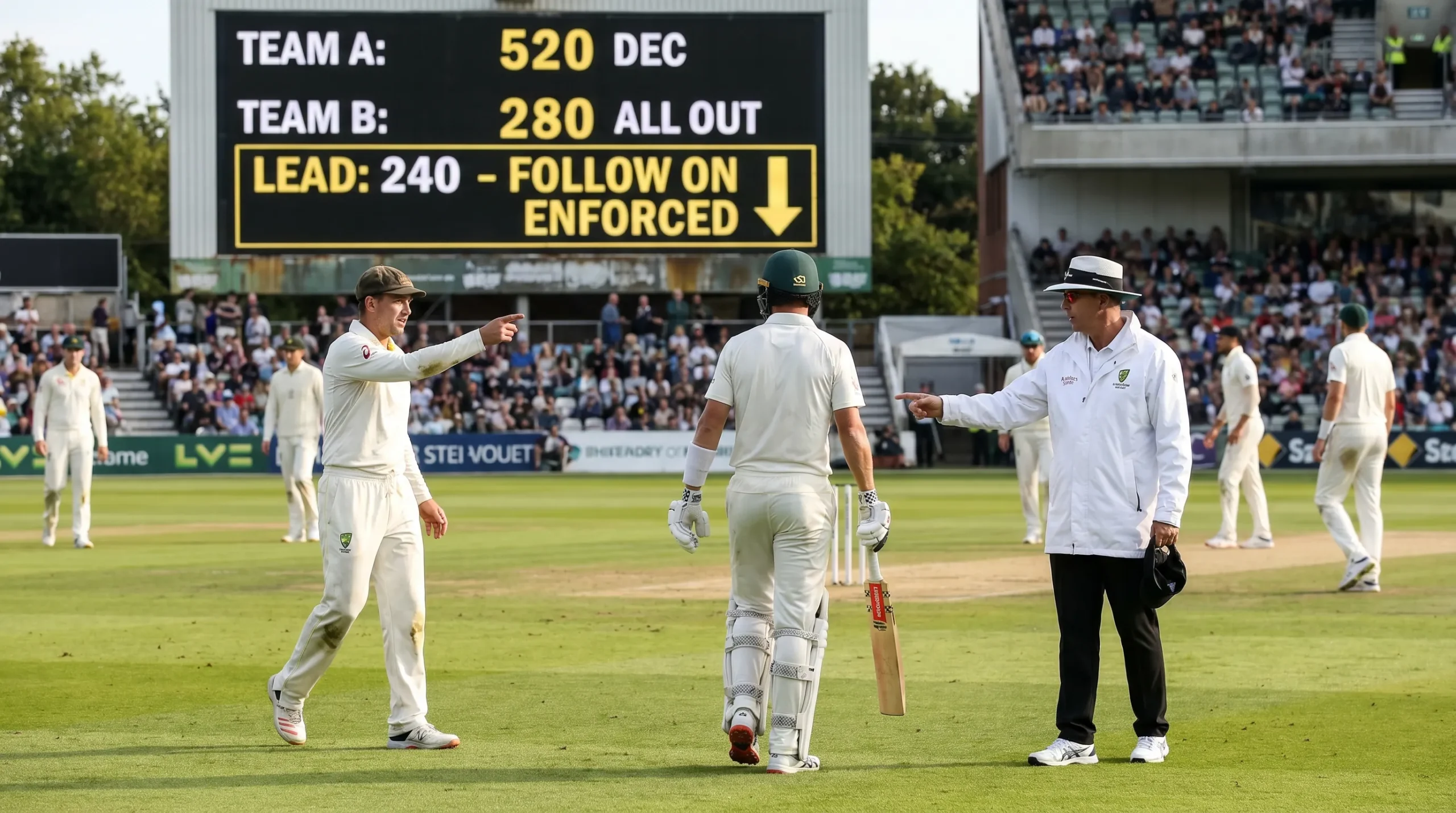
How to calculate the follow on in test cricket is actually simple once you know the first-innings lead rule. In a standard 5-day Test match, if the team batting first leads by 200 runs or more after both sides have completed their first innings, that team can ask the opposition to bat again immediately. This is called enforcing the follow-on, and it comes from MCC Law 14. In shorter two-innings matches, the required lead changes to 150 runs for 3- or 4-day matches, 100 runs for 2-day matches, and 75 runs for 1-day matches.
For most readers, the real question is not just what is the follow-on in Test cricket, but how many runs are needed to avoid the follow-on, how to check it from a scorecard, and whether the decision is automatic or optional. That is where many articles stop too early. This guide will walk you through the follow-on formula in Test cricket, give you worked examples, explain the difference between follow-on vs declaration, and show why captains sometimes choose not to enforce it even when they can.
What Is the Follow-On in Test Cricket?
The follow-on in Test cricket happens when the side that batted first builds a large enough lead after the first innings and then makes the other team bat again immediately instead of taking its own second innings. In a normal Test, that required margin is a 200-run lead. The rule exists to help the stronger side press home its advantage and try to force a result rather than let the match drift toward a draw.
Here is the key point many beginners miss: the follow-on rule in cricket is based on the first-innings deficit, not on the final result of the match and not on some special “target” score. You simply compare the first team’s total with the second team’s first-innings total. If the gap is 200 or more in a five-day Test, the captain has the option to enforce the follow-on.
It is also important to understand that this is a captain’s option. The side batting first is allowed to enforce it, but does not have to. That is why you will often hear commentators debate whether a team should enforce the follow-on or bat again and use a declaration later.
- Simple definition
If Team A leads Team B by 200 runs or more after the first innings of a 5-day Test, Team A may ask Team B to bat again right away.
The Simple Formula to Calculate the Follow-On
If you want the quick follow-on rule, here it is.
In a 5-day Test:
First-innings lead = Team A first-innings score − Team B first-innings score
If the answer is 200 or more, the follow-on can be enforced.
You can also flip that into a runs needed to avoid follow-on formula:
Minimum score needed to avoid follow-on = Team A first-innings score − 199
That second formula is practical for readers following a live match. For example, if Team A scores 450, then Team B must reach at least 251 to avoid the follow-on. If Team B makes 250 or less, the lead is 200 or more, so the follow-on becomes available. This is exactly why people search for a cricket follow-on calculator or ask how to work out the follow-on target quickly.
So the follow-on equation is not complicated. You are really just checking whether the team batting second is at least 200 runs behind after the first innings in a standard Test. Once you understand that, the rest becomes much easier to read from any scorecard.
How to Work Out the Follow-On From a Scorecard?
A lot of fans get confused in the middle of a match because live scores move quickly. The easiest way to use the follow-on calculation formula is to break it into steps.
First, look at the team batting first and note its first innings total. Then find the team batting second and check its first-innings total. Subtract the second number from the first. If the difference is 200 runs or more, the follow-on is on the table in a Test match.
Let’s say the first team made 473/9 declared, and the second team is all out for 237. Subtract 237 from 473 and you get a 236-run lead. Because 236 is greater than 200, the team that batted first can enforce the follow-on. Another way to view the same situation is this: the second side needed 274 to avoid the follow-on, so at 237 it finished 36 runs short. Calculator-style pages use this kind of logic because it is faster for fans to apply during a live Test.
This is why how to work out the follow-on from a scorecard is such an important angle. It translates the legal wording of Law 14 into something that makes instant sense when you are following a match in real time.
Worked Examples: Follow-On Calculation With Scores
The best way to understand how to calculate the follow on in test cricket is to see a few examples.
Example 1: Team A 450, Team B 250
Team A has a 200-run lead. That means the captain can enforce the follow-on. Team B has not done enough to avoid it.
Example 2: Team A 450, Team B 251
Now the lead is 199 runs, not 200. That means the follow-on is not available. Team B has done just enough to avoid it.
Example 3: Team A 469, Team B 269
The lead is exactly 200. So yes, the follow-on can be enforced. If Team B wanted to avoid the follow-on in this case, it needed 270 runs. That is why you sometimes see the phrase “Team B needs 270 to avoid the follow-on.”
Example 4: Team A 578, Team B 378
Again, the lead is exactly 200 runs, so the follow-on is available. This is one of the cleanest examples because it shows that exactly 200 is enough.
Here is a quick table that makes the idea even clearer:
| Team A first-innings total | Team B must score at least | If Team B scores less than this |
|---|---|---|
| 350 | 151 | Follow-on possible |
| 400 | 201 | Follow-on possible |
| 450 | 251 | Follow-on possible |
| 469 | 270 | Follow-on possible |
| 500 | 301 | Follow-on possible |
| 578 | 379 | Follow-on possible |
This kind of runs needed to avoid the follow-on table is useful because it answers the search intent immediately. It is especially good for beginners who want the follow-on rule explained for beginners instead of a long legal explanation.
Follow-On Thresholds by Match Length
One of the most common mistakes in cricket articles is treating the 200-run lead as if it applies to every first-class match. It does not. According to MCC Law 14, the threshold changes depending on the scheduled length of the match.
For matches of 5 days or more, the required lead is 200 runs. For 3- or 4-day matches, it drops to 150 runs. In a 2-day match, the follow-on threshold is 100 runs, and in a 1-day two-innings match, it is 75 runs.
That means the phrase first-class cricket follow-on is broader than Test cricket follow-on. A Test uses the familiar 200 runs, but domestic or shorter multi-day matches can follow different numbers. If you are writing a complete guide, this section matters because it adds authority and avoids misleading readers.
Is the Follow-On Automatic or Optional?
This is one of the biggest user pain points, so it deserves a direct answer.
No, the follow-on is not automatic. Even if a side has the required 200-run lead, the captain may choose not to enforce it. The law allows the option, but does not force the decision.
That distinction matters because a lot of casual readers think the moment the trailing side falls 200 behind, the umpire automatically sends it back in. That is not how it works. The decision belongs to the fielding side’s captain, who must think about bowler fatigue, pitch conditions, weather conditions, and the amount of time left in the match.
So if you ever ask, “Is the follow-on automatic in Test cricket?”, the answer is simple: it is optional, not automatic.
Why Captains Sometimes Do Not Enforce the Follow-On
At first glance, enforcing the follow-on seems like the obvious move. If your team already has a commanding position, why not make the opposition bat again and finish the game quickly?
In reality, modern captains often think twice. One reason is bowler workload. If your fast bowlers have just delivered a long innings, asking them to bowl again immediately can leave them tired and less effective. Another reason is the pitch. Some captains prefer to bat again, pile on more runs, and let the pitch wear down further before making the opposition chase in the fourth innings. Weather also plays a role. If rain is around, the captain may worry that there is not enough time left to force a win, so a larger target could feel safer.
This is why the topic is not only about math. It is also about strategy, risk, mental momentum, and scoreboard pressure. Even when the follow-on law allows it, the smarter move is not always to use it. That is one reason articles about why captains rarely use the follow-on continue to attract interest.
Follow-On vs Declaration: What’s the Difference?
The decision often comes down to follow-on vs declaration, and this is where readers can get mixed up.
Enforcing the follow-on means the opposition bats again immediately after its first innings because it trails by enough runs. Declaring, by contrast, is when a batting side voluntarily closes its innings to set a target and try to force a result. These are two very different tools, even though both are used to control the direction of a match.
A captain might decline the follow-on, bat again, score quickly, and then declare later to set a massive chase. That can create more scoreboard pressure and may protect tired bowlers at the same time. So the difference between follow-on and declaration is not just technical. It is a real tactical choice that shapes the entire match.
Famous Matches Where the Follow-On Changed the Game
A good article should not only explain the rule but also show why it matters. Cricket history has famous examples where the follow-on produced drama, pressure, and unforgettable comebacks.
The most famous is probably India vs Australia at Kolkata in 2001. Australia enforced the follow-on after gaining a huge advantage, but India fought back brilliantly. VVS Laxman, Rahul Dravid, and Harbhajan Singh became central figures in one of Test cricket’s great turnarounds. The match is still used as proof that a team can recover even after being asked to follow on.
Another classic example is Headingley 1981, where England staged a remarkable comeback against Australia. Matches like this are why fans still ask, “Can a team win after following on in Tests?” The answer is yes, although it is rare. Historical explainers highlight these games because they show that enforcing the follow-on carries real risk as well as potential reward.
These case studies also add depth to your content. They bring in powerful NLP entities such as Kolkata 2001, Headingley 1981, Ian Botham, Steve Waugh, VVS Laxman, and Rahul Dravid, which strengthen the article semantically and make it more engaging.
Common Mistakes When Calculating the Follow-On
Readers often make the same few errors, and clearing them up can make your article much more helpful.
The first mistake is confusing lead with target. The follow-on is based on the first-innings lead, not on a future chase or projected result. The second mistake is forgetting that the rule is optional, not automatic. The third is assuming the threshold is always 200 runs, even outside a five-day Test. As noted earlier, the margin drops in shorter matches under Law 14.
Another common mistake is getting the minimum avoidance number wrong by one run. If Team A scores 450, Team B must score 251, not 250, to avoid the follow-on. That is because a score of 250 leaves a 200-run lead, and 200 is enough to enforce it. These tiny details are exactly why people search for a follow-on cheat sheet or a cricket follow-on calculator.
Quick Follow-On Cheat Sheet
If you want the rule in the simplest possible form, use this:
- In a 5-day Test, a 200-run lead allows the follow-on.
- To avoid it, the second team must score at least first team’s score minus 199.
- The follow-on is optional, not automatic.
- In shorter matches, the threshold changes to 150, 100, or 75 depending on duration.
That is the MCC follow-on rule summary most readers are really looking for.
FAQ About the Follow-On in Test Cricket
What is the follow-on in Test cricket?
It is when the side batting first gains a big enough first-innings lead and asks the opposition to bat again immediately. In a standard Test, the required lead is 200 runs.
How many runs are needed to avoid the follow-on?
Take the first team’s first-innings score and subtract 199. That tells you the minimum score needed to avoid the follow-on in a 5-day Test. So if Team A scores 400, Team B needs 201.
Is the follow-on automatic in Test cricket?
No. The captain may choose whether to enforce it.
Can a team win after following on?
Yes. Famous examples include Headingley 1981 and Kolkata 2001, which are often cited in cricket history discussions about the follow-on.
Does the follow-on rule change in shorter matches?
Yes. The threshold becomes 150 runs for 3- or 4-day matches, 100 runs for 2-day matches, and 75 runs for 1-day two-innings matches.
Why do captains sometimes avoid enforcing the follow-on?
Usually because of bowler fatigue, the state of the pitch, the weather forecast, or a desire to bat again and create more scoreboard pressure with a later declaration.
Final Answer: How to Calculate the Follow-On in One Line?
To calculate the follow-on in Test cricket, subtract the second team’s first-innings total from the first team’s first-innings total; if the lead is 200 runs or more in a 5-day Test, the captain may enforce the follow-on.
That is the full rule in one line. Once you understand that simple piece of math, every scorecard becomes much easier to read.
Disclaimer:
This article is for informational purposes only. Cricket rules, including the follow-on, may vary by competition and governing body. Readers should consult official cricket laws or match officials for authoritative guidance before applying any rules or calculations.