

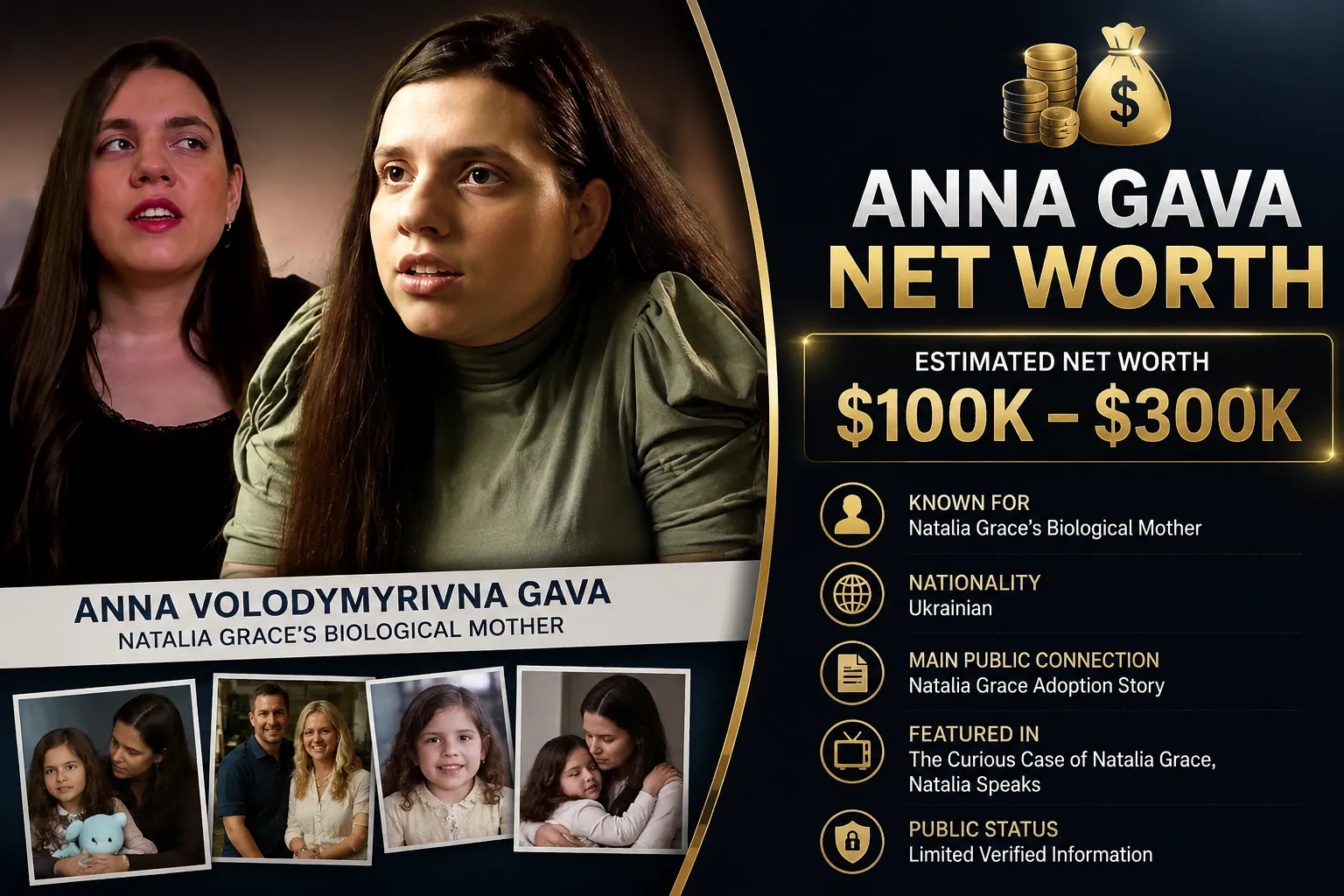
Anna Volodymyrivna Gava is a name many people search after watching or reading about Natalia Grace, the Ukrainian-born adoptee whose story became one of the most discussed adoption and age-controversy cases in recent years. Anna Gava is publicly known because she has been identified in media and documentary coverage as Natalia Grace’s biological mother.
Her story is not a normal celebrity biography. It is connected to international adoption, disability, family separation, legal age disputes, and several documentaries about Natalia Grace’s life. Because of that, the topic needs to be handled with care. Some details about Anna Gava are publicly reported, some come from documentary coverage, and some remain unclear because Anna is not a public figure who regularly gives interviews.
This article explains who Anna Volodymyrivna Gava is, how she is connected to Natalia Grace, why her name became important in the Natalia Grace age controversy, what is known about her role in the adoption story, and why people still search for where Anna Gava is now.
Who Is Anna Volodymyrivna Gava?
Anna Volodymyrivna Gava, also commonly called Anna Gava, is best known as the reported birth mother of Natalia Grace. Natalia Grace was born in Ukraine and later adopted by American families. Her story became widely known after her adoptive parents, Michael Barnett and Kristine Barnett, claimed she was not a child but an adult.
Anna Gava entered public discussion because information about Natalia’s birth family became important to understanding Natalia’s real age. Media coverage and documentary reporting have connected Anna to Natalia through birth records, Ukraine-based investigation, and DNA-related claims.
Unlike Natalia Grace, Anna Gava has not lived most of her life in the public eye. She is not an entertainment celebrity, social media personality, or public official. Most of what people know about her comes from coverage of The Curious Case of Natalia Grace, Natalia Speaks, entertainment articles, and reporting about the Barnett adoption case.
That is why any article about Anna Gava should be careful. It is fair to explain what has been reported, but it is not fair to treat every online detail as fully confirmed. The safest way to understand Anna is this: she is a private Ukrainian woman who became publicly known because of her reported biological connection to Natalia Grace.
Quick Facts About Anna Gava
The details below summarize the most commonly reported information connected to Anna Volodymyrivna Gava. Some personal details vary by source, so they should be read as public-reporting details, not as a complete official biography.
| Detail | Information |
| Full name | Anna Volodymyrivna Gava |
| Also known as | Anna Gava |
| Known for | Being reported as Natalia Grace’s biological mother |
| Main public connection | Natalia Grace adoption story |
| Related location | Ukraine, often connected with Mykolaiv |
| Related media | The Curious Case of Natalia Grace, Natalia Speaks |
| Main search reason | Her role in Natalia Grace’s birth, adoption, and age controversy |
| Public status | Limited verified public information is available |
These quick facts help answer the basic question: who is Anna Volodymyrivna Gava? She is mainly known because of one sensitive and widely discussed case, not because she has chosen a public career.
Anna Gava and Natalia Grace: What Is Their Connection?
The biggest reason people search Anna Gava Natalia Grace is to understand their family connection. Anna Gava has been reported as Natalia Grace’s biological mother. Natalia’s birth name has also been reported as Natalia Vadymivna Gava, which connects her to the Gava family name.
This connection matters because Natalia’s case was built around one major question: Was Natalia a child when she was adopted and later left to live on her own, or was she actually an adult?
The Barnetts argued that Natalia was older than her documents suggested. In 2012, her legal birth year was changed from 2003 to 1989, making her legally an adult instead of a child. This legal change later became one of the most controversial parts of the case.
Anna Gava’s information became important because a biological mother can help support a birth timeline. If Natalia was born in 2003, then she was a child during the early events in the Barnett case. If she had been born in 1989, as the later legal age change stated, the entire story would look very different.
Reports about Anna Gava and Natalia Grace often mention DNA testing and Ukrainian birth records. However, for a careful article, it is better to say that documentary and media coverage reported a biological connection rather than making broad claims beyond what public sources support.
Natalia Grace’s Early Life and Ukrainian Adoption Background
To understand Anna Volodymyrivna Gava, readers also need to understand Natalia Grace’s adoption story. Natalia was born in Ukraine and diagnosed with a rare form of dwarfism called spondyloepiphyseal dysplasia congenita. This condition affects bone growth and can cause short stature, mobility challenges, and the need for medical care.
Natalia reportedly spent part of her early life in a Ukrainian orphanage before being adopted by an American couple. Later, she was adopted by Michael and Kristine Barnett in the United States. At that time, Natalia was understood to be a young child.
Her life became the center of public attention after the Barnetts claimed that Natalia was not the child they believed they had adopted. They said they noticed signs that made them think she was older. These claims became part of a much larger legal and media story.
The adoption background is important because Anna Gava’s role is connected to the beginning of Natalia’s life, not to every later event. Anna was not the person making decisions in the Barnett household. Her relevance comes from Natalia’s birth, early medical history, and biological identity.
This is why the keyword natalia grace biological mother often appears with searches for anna volodymyrivna gava biography.
Why Did Anna Gava Give Natalia Grace Up for Adoption?
One of the most sensitive long-tail questions is: why did Anna Gava give Natalia Grace up for adoption?
Public reporting and documentary coverage have suggested that Anna Gava placed Natalia in care because of difficult circumstances after Natalia’s birth. These reports often mention Natalia’s disability, expected medical needs, financial hardship, and advice from medical workers. In some accounts, Anna expressed sadness or regret about not keeping Natalia.
This part of the story should not be written with judgment. Many international adoption stories involve poverty, disability, lack of support, and pressure from social or medical systems. A parent’s decision in those circumstances can be painful and complicated.
Natalia’s condition, spondyloepiphyseal dysplasia congenita, likely made the situation even harder. Children with this condition may need ongoing care, surgeries, mobility support, and medical attention. For a mother with limited resources, especially in a difficult social environment, the decision may have felt impossible.
Still, the article should avoid saying Anna “abandoned” Natalia in a harsh or sensational way. A better phrase is that Natalia was placed in an orphanage or placed for adoption, because that language is more neutral and respectful.
The goal is to help readers understand the context without turning a private family tragedy into gossip.
Natalia Grace’s Medical Condition and Why It Matters
Natalia Grace’s medical condition is central to the story. She has been described as having spondyloepiphyseal dysplasia congenita, a rare form of dwarfism that affects the bones and spine. In simple terms, this condition can make a person much shorter than average and may affect mobility, joints, and physical development.
This matters because much of the Natalia Grace age controversy involved how people interpreted her body. The Barnetts claimed certain physical signs made them believe Natalia was older. Others argued that her medical condition, trauma history, and disability could have caused confusion or misinterpretation.
When discussing disability, it is important to be careful. A person’s body should not be treated as proof of character. A medical condition can affect appearance, growth, and development, but it should not be used to make unfair assumptions.
This is also where many readers get confused. The public story was often framed like a mystery: child or adult? But the more responsible way to discuss it is to look at birth records, medical evidence, legal records, DNA-related reporting, and the lived experience of Natalia herself.
Including this medical context gives the article more depth than a simple biography of Anna Gava.
The Age Controversy: Why Natalia Grace’s Birth Year Became a Major Issue
The Natalia Grace age controversy is one of the biggest reasons people search for Anna Volodymyrivna Gava. The issue became public because Natalia’s legal age changed dramatically.
Natalia’s original reported birth year was 2003. However, in 2012, Michael and Kristine Barnett successfully petitioned to have her legal birth year changed to 1989. That change moved Natalia from being legally a child to legally an adult.
This mattered because the Barnetts later moved Natalia into an apartment in Indiana. If Natalia was an adult, the situation looked one way legally. If Natalia was a child, it looked very different.
The legal age change became controversial because later reporting, documentary evidence, DNA testing, and birth-family information all raised serious questions about whether Natalia had actually been a child when those events happened. Anna Gava’s reported birth information became important because it supported the idea that Natalia’s original birth year was closer to 2003 than 1989.
The question why did the Barnetts re-age Natalia Grace is therefore not just a curiosity. It sits at the center of the legal, emotional, and ethical debate around the case.
For readers, the simplest way to understand it is this: Natalia’s age was not just a number. It affected how people saw her, how the law treated her, and how the public understood what happened to her.
What Did Anna Gava Say About Natalia Grace’s Real Age?
Another common question is: what did Anna Gava say about Natalia Grace’s age?
Reports from earlier media coverage said Anna Gava challenged the idea that Natalia was born in 1989. She reportedly said Natalia was her daughter and that Natalia was born years later than the Barnetts claimed. This mattered because if Anna’s information was accurate, then Natalia would have been a child during the events that made the case famous.
Some reports also note that investigators and documentary teams looked into Ukrainian records and family connections. DNA-related reporting later became part of the public discussion around whether Anna Gava was Natalia’s biological mother.
This is one of the most important places to use careful wording. Instead of saying “Anna proved everything,” a better approach is to say that Anna Gava’s reported statements and the documentary coverage became part of the larger evidence people used to question the 1989 birth year.
That makes the article accurate, balanced, and less sensational.
Documentary Coverage: The Curious Case of Natalia Grace and Natalia Speaks
Many people discovered Anna Gava’s name through The Curious Case of Natalia Grace, the Investigation Discovery docuseries that explored Natalia’s adoption, the Barnetts’ claims, and the legal controversy.
The follow-up series, Natalia Speaks, gave Natalia more room to respond to the accusations made against her. It also renewed public interest in her early life, her biological family, and the question of whether she might ever reconnect with Anna Gava.
The documentary format made the case more visible, but it also created a challenge. Documentaries can include interviews, emotional storytelling, dramatic editing, and conflicting perspectives. They can help the public understand a case, but they are still media products. Viewers should separate documentary storytelling from official records and verified facts.
That is why an article about Anna Gava documentary searches should explain both the media coverage and the limits of what is publicly known.
Anna Gava’s role in the documentary story is mainly connected to Natalia’s origin, biological family, and age timeline. She is not the central character in the U.S. adoption conflict, but her information helps readers understand why Natalia’s birth year was so important.
Did Natalia Grace Reconnect With Anna Gava?
The question did Natalia Grace reconnect with her biological mother became more popular after entertainment coverage reported that Anna Gava wanted to reconnect with Natalia after many years apart.
This is an emotional part of the story. A possible reunion between Natalia Grace and Anna Gava is not just a headline. It involves identity, trauma, adoption separation, disability, and the pain of being separated from one’s birth family.
Natalia’s reported reaction has been cautious and understandable. A person who grew up through adoption disruption, public accusations, legal conflict, and media attention may not be ready to reconnect quickly with a biological parent. Even when a birth parent wants contact, the adopted person’s feelings matter deeply.
The phrase Anna Gava wants to reconnect with Natalia Grace should not be treated like a simple happy-ending story. Reconnection after adoption can be healing, but it can also be confusing, emotional, and slow.
For SEO, this section should naturally include phrases like Natalia Grace biological mom wants to reconnect 19 years later, mother-daughter relationship, family reunion, and adoption separation. But the writing should remain respectful.
Where Is Anna Gava Now?
Many readers search where is Anna Gava now because they want to know whether Natalia Grace’s biological mother is still alive, where she lives, and whether she has contact with Natalia.
The honest answer is that limited verified public information is available about Anna Gava’s current life. She has been connected in reporting to Ukraine, especially the Mykolaiv area, but she is not a public celebrity with regular verified updates.
Some competitor articles give very specific details about Anna’s age, residence, children, and family life. Those details may come from media or documentary reporting, but they should still be handled carefully. A responsible article should say that Anna appears to live a private life and that her current situation is not fully documented in public sources.
This is also important for privacy. Anna Gava is searched because of Natalia Grace’s story, but that does not mean every part of Anna’s personal life should be treated as public property.
So the best answer to where is Anna Volodymyrivna Gava today is: she is publicly known through her reported connection to Natalia Grace, but her current private life is not widely confirmed.
What Is Confirmed, Reported, and Still Unclear About Anna Gava?
Because the topic includes public records, documentaries, court disputes, and entertainment articles, it helps to separate information into three groups.
| Category | What readers should know |
| Widely reported | Anna Volodymyrivna Gava is identified in media coverage as Natalia Grace’s biological mother. |
| Documentary-reported | DNA-related claims and Ukraine-based investigation have been discussed in Natalia Grace documentary coverage. |
| Legally and publicly debated | Natalia’s birth year was changed from 2003 to 1989, which became central to the case. |
| Still unclear | Anna Gava’s full current life, exact family details, and private relationship with Natalia are not fully public. |
| Should be avoided | Unsourced claims, gossip, private addresses, or harsh judgments about family decisions. |
This section is important because many online articles about Anna Gava repeat details without explaining where they come from. For a stronger SEO article, the goal should be clarity, not drama.
Readers want answers, but they also need honesty. If something is not confirmed, say it is not confirmed. If something comes from documentary coverage, label it that way. If something is private, do not pretend to know more than the public record shows.
Anna Gava Timeline: Key Events in Natalia Grace’s Story
A timeline helps readers understand how Anna Gava fits into the bigger Natalia Grace case.
| Year | Event |
| 2003 | Natalia Grace’s original reported birth year is connected to Ukraine. |
| 2008 | Natalia was reportedly adopted by an American family before later being adopted again. |
| 2010 | Michael and Kristine Barnett adopted Natalia Grace. |
| 2012 | Natalia’s legal birth year was changed from 2003 to 1989. |
| 2013 | Natalia was moved into an apartment in Indiana. |
| 2019 | The case received wider media attention, and Anna Gava’s name became more visible. |
| 2023–2024 | Documentary coverage and DNA-related reporting renewed discussion of Natalia’s age. |
| 2025 | Hulu’s Good American Family brought new viewers to the story. |
This timeline shows why Anna Gava timeline and Natalia Grace timeline explained are useful search angles. Anna’s role is connected mainly to the earliest part of Natalia’s story, but that early information affects how people understand everything that came later.
Good American Family and Why Anna Gava Is Not the Main Focus
The Hulu series Good American Family brought the Natalia Grace story to a wider audience. Many viewers then searched for Anna Volodymyrivna Gava, Natalia Grace biological mother, and why Anna Gava is not in Good American Family.
The reason is simple: dramatized shows often focus on a specific part of a real case. Good American Family mainly centers on Natalia’s life with the Barnetts, the age controversy, and the legal and emotional conflict in the United States. Anna Gava’s role is more connected to Natalia’s birth background in Ukraine, so she may not be a central character in a dramatized version of the American adoption case.
It is also important to remember that a scripted series is not the same as a documentary or court record. It may be based on real events, but it uses actors, scenes, structure, and dramatic choices. Viewers should use it as a starting point, not as the full factual record.
This section gives your article a competitive edge because many readers now discover the story through Hulu, not only through Investigation Discovery.
Media Coverage, Privacy, and Responsible Storytelling
The story of Anna Gava and Natalia Grace attracts attention because it includes mystery, adoption, family conflict, disability, and legal controversy. But it should not be treated like simple true-crime entertainment.
Anna Gava is a private person. Natalia Grace is a real person who lived through serious public accusations and personal hardship. The Barnetts, the Mans family, and other people connected to the case have also been discussed heavily in media.
A responsible article should avoid words that make the story sound like gossip. It should not mock disability, shame adoption decisions, or present unverified claims as fact. It should also avoid publishing private personal details that do not help readers understand the case.
The best approach is to focus on verified facts, reported claims, documentary coverage, and what remains unclear. That makes the article more trustworthy and more useful for readers.
FAQs About Anna Volodymyrivna Gava
Who is Anna Volodymyrivna Gava?
Anna Volodymyrivna Gava is publicly known as the reported biological mother of Natalia Grace, the Ukrainian-born adoptee at the center of a widely discussed adoption and age controversy.
Is Anna Gava Natalia Grace’s biological mother?
Media and documentary coverage have identified Anna Gava as Natalia Grace’s biological mother. DNA-related reporting has also been discussed in connection with their relationship.
Where is Anna Gava now?
Public information about where Anna Gava is now is limited. Reports connect her to Ukraine, but her current private life is not widely verified.
Why did Anna Gava give Natalia Grace up for adoption?
Reports suggest that Natalia’s disability, medical needs, and difficult personal circumstances played a role. This should be discussed carefully because it involves private family hardship.
What did Anna Gava say about Natalia Grace’s age?
Anna Gava reportedly challenged the claim that Natalia was born in 1989. Her reported statements supported the idea that Natalia was born much later and was still a child during key events.
Did Natalia Grace reconnect with Anna Gava?
Public reporting has said Anna Gava wanted to reconnect with Natalia Grace after many years apart. However, the full status of any private relationship between them is not clearly public.
Is Anna Gava in The Curious Case of Natalia Grace?
Anna Gava is connected to the documentary story because investigators and media coverage explored Natalia’s biological family and birth background.
Is Anna Gava shown in Good American Family?
Good American Family focuses mainly on Natalia’s life with the Barnetts and the U.S. legal controversy. Anna Gava is not the main focus of that dramatized story.
What is still unknown about Anna Gava?
Her full current life, exact personal circumstances, and private relationship with Natalia Grace are not fully known publicly.
Conclusion
Anna Volodymyrivna Gava is important to the Natalia Grace story because she represents Natalia’s biological beginning, Ukrainian birth background, and one of the key pieces of the age controversy. Her reported connection to Natalia helped the public better understand why the difference between 2003 and 1989 mattered so much.
At the same time, Anna Gava is not a traditional public figure. The most respectful way to write about her is to focus on what is reported, explain what remains unclear, and avoid turning a painful adoption story into gossip.
For readers searching who is Anna Volodymyrivna Gava or where is Anna Gava now, the clearest answer is this: she is publicly known as Natalia Grace’s reported biological mother, but much of her current life remains private.
Disclaimer
This article is for general informational purposes only. The information is based on publicly available details and media coverage. Individual experiences, interpretations, and situations may vary, so readers should use their own judgment when understanding this topic.