

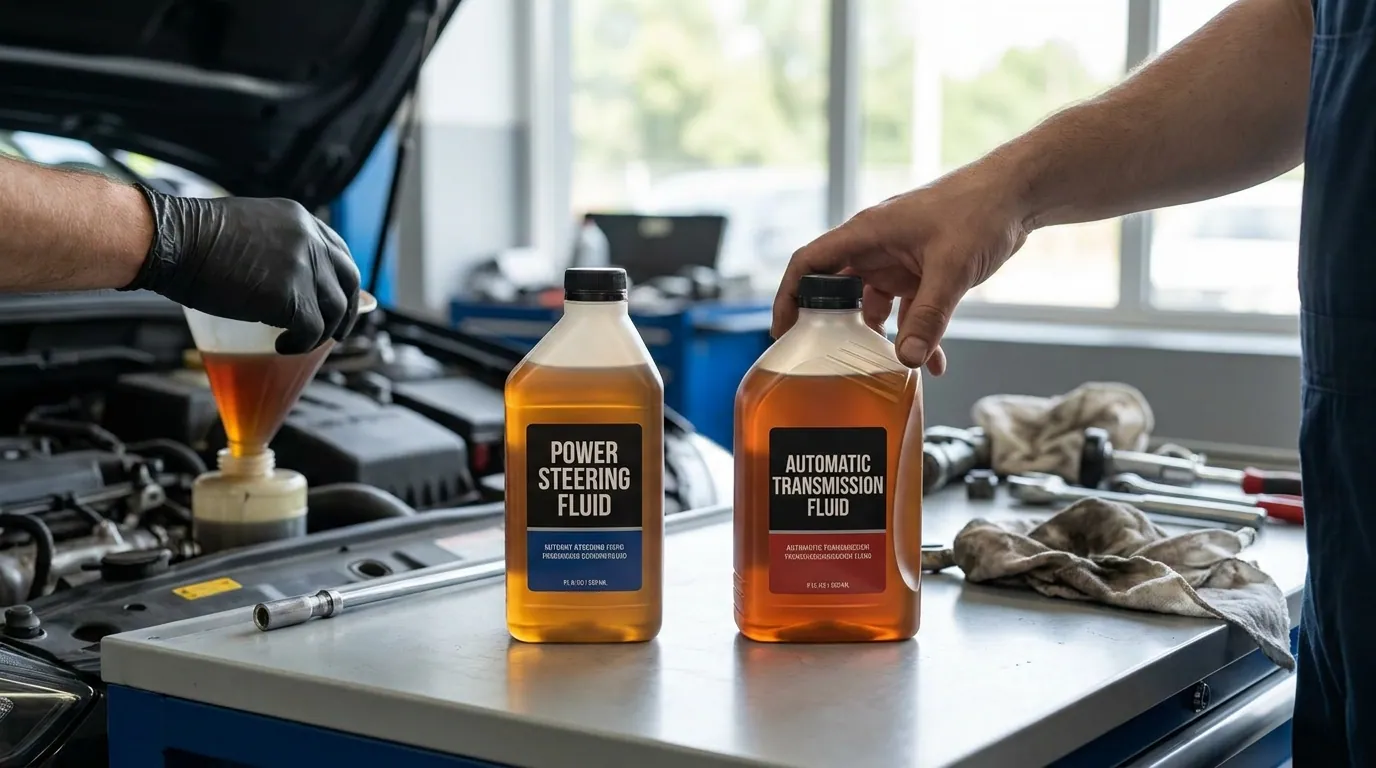
The simple answer is no, not always. Power steering fluid and transmission fluid may look similar, and in some vehicles automatic transmission fluid (ATF) is approved for the power steering system, but that does not mean the two fluids are universally interchangeable.
This is one of those car maintenance questions where the safest answer depends on your vehicle’s owner’s manual, the manufacturer specification, and the exact type of fluid required. Some cars use Dexron, Mercon, or ATF+4 in the steering system. Others need a dedicated OEM power steering fluid, synthetic fluid, or even CHF hydraulic fluid.
Using the wrong fluid can lead to stiff steering, whining noise, fluid leaks, rough shifting, or expensive component damage. So before topping off either reservoir, it is important to understand the difference.
Quick Answer: Power Steering Fluid and Transmission Fluid Are Not Always the Same
Power steering fluid and transmission fluid are not automatically the same. They are both hydraulic-style automotive fluids, but they are designed for different systems.
Power steering fluid helps the steering system create smooth hydraulic assistance. It supports the power steering pump, rack and pinion, hoses, seals, and steering gear. Transmission fluid, especially automatic transmission fluid, is designed to lubricate, cool, and control shifting inside an automatic transmission.
The confusing part is that some vehicles specifically allow ATF in power steering. In those cases, transmission fluid can be used as power steering fluid only because the manufacturer designed the system for that type of fluid. But if your vehicle does not call for ATF, using it can be risky.
The safest rule is simple:
Use transmission fluid in the power steering system only if your owner’s manual, reservoir cap, or manufacturer specification clearly says it is approved.
Also, the reverse is usually not safe. Power steering fluid should not be used in a transmission unless a manufacturer specifically approves it, which is uncommon. Transmissions need precise friction modifiers, heat resistance, and additives for clutch plates, gears, and hydraulic control.
Power Steering Fluid vs Transmission Fluid: Key Differences
The main difference between power steering fluid vs transmission fluid is what each fluid is designed to do.
Power steering fluid is mainly about hydraulic pressure, steering assistance, seal protection, and pump lubrication. Transmission fluid is about lubrication, cooling, smooth shifting, friction control, and gear engagement.
| Feature | Power Steering Fluid | Transmission Fluid |
| Main purpose | Helps steering feel smooth and easy | Helps transmission shift and stay lubricated |
| Main system | Power steering system | Automatic transmission system |
| Key components | Pump, rack and pinion, hoses, seals | Clutch plates, gears, torque converter, valve body |
| Common properties | Hydraulic pressure, seal compatibility, smooth flow | Friction modifiers, detergents, heat resistance |
| Can they be swapped? | Only if specified | Only if specified |
Transmission fluid vs power steering fluid also differs in additives. ATF often contains detergents, friction modifiers, and compounds designed for transmission clutch operation. Power steering fluid may focus more on hydraulic performance, pump protection, and compatibility with steering seals.
Another difference is system stress. Transmissions deal with heat, shifting pressure, internal gears, and clutch engagement. Power steering systems deal with steering load, pump pressure, and hose movement. Because each system works differently, the wrong fluid can affect performance even if the fluid looks similar.
What Power Steering Fluid Does
Power steering fluid is the fluid that helps a hydraulic steering system make turning the steering wheel easier. When you turn the wheel, the power steering pump pressurizes the fluid and sends it through lines to help move the steering mechanism.
In older and many traditional vehicles, this hydraulic assistance is what keeps the steering wheel from feeling heavy, especially at low speeds or while parking. The fluid also helps lubricate the rack and pinion, steering gear, pump internals, seals, and pressure hoses.
Good power steering fluid supports:
- Smooth steering
- Quiet pump operation
- Proper hydraulic pressure
- Seal and hose protection
- Reduced wear inside the steering system
Some modern vehicles use electric power steering, which may not use traditional power steering fluid at all. That is another reason you should check your exact vehicle requirements before buying or adding fluid.
If the fluid is low, old, foamy, or contaminated, you may notice stiff steering, a whining noise, squealing during turns, or fluid leaks around the pump or hoses.
What Transmission Fluid Does
Transmission fluid is designed for the transmission system, especially an automatic transmission. It lubricates moving parts, helps control hydraulic pressure, cools internal components, and supports smooth gear changes.
In an automatic transmission, fluid does more than reduce friction. It helps the transmission shift correctly by working with the torque converter, clutch plates, valve body, gears, and internal passages. That is why ATF has a more specialized additive package than ordinary hydraulic fluid.
Transmission fluid helps with:
- Smooth shifting
- Gear engagement
- Cooling
- Lubrication
- Friction control
- Wear protection
There are also different kinds of transmission fluid. Automatic transmission fluid, manual transmission fluid, and CVT fluid are not the same. A continuously variable transmission often requires a specific CVT fluid, and using the wrong type can cause serious problems.
This is why power steering fluid in a transmission is usually a bad idea. A transmission needs a fluid that matches exact friction, viscosity, and heat requirements.
Can You Use Transmission Fluid as Power Steering Fluid?
Yes, transmission fluid can be used as power steering fluid in some vehicles, but only when the vehicle manufacturer approves it.
This is where many drivers get confused. Some cars, trucks, and older vehicles list ATF as the correct power steering fluid. These vehicles may call for fluid types such as Dexron, Dexron V, Mercon, Mercon V, or ATF+4. In those cases, using the specified ATF is not a shortcut; it is the correct fluid.
However, that does not mean every ATF is safe in every power steering system. ATF+4, Dexron VI, Mercon LV, CVT fluid, and multi-vehicle ATF products are not automatically interchangeable. Each fluid has its own formula, viscosity, friction behavior, and additive balance.
Before using ATF in power steering, check:
- The owner’s manual
- The power steering reservoir cap
- The service manual
- A trusted VIN-based fluid lookup
- Manufacturer fluid charts or dealer guidance
If the manual says to use a dedicated power steering fluid, do not substitute ATF just because it is red or available. Some vehicles, especially certain Honda, Acura, and European models, may require specific power steering fluid or CHF hydraulic fluid.
So the best answer to “can transmission fluid be used as power steering fluid?” is: sometimes, but only when your vehicle specifically allows it.
Can You Use Power Steering Fluid in a Transmission?
In most cases, no, you should not use power steering fluid in a transmission.
A transmission is far more sensitive to fluid chemistry than many people realize. Transmission fluid must manage friction control, heat, hydraulic pressure, clutch engagement, and internal lubrication. Power steering fluid is not usually designed to protect clutch plates, support the torque converter, or control shift timing.
If power steering fluid gets into an automatic transmission, it may cause:
- Rough shifting
- Slipping gears
- Delayed shifting
- Burnt smell
- Transmission overheating
- Fluid contamination
- Internal wear
- Transmission damage from wrong fluid
If you accidentally put power steering fluid in the transmission reservoir, do not keep driving and hope it will mix safely. The best move is to stop, confirm what happened, and contact a mechanic or service center. In many cases, a transmission flush or professional inspection may be needed.
This mistake can be much more expensive than adding ATF to a compatible power steering system, because transmissions rely heavily on exact fluid performance.
ATF vs Power Steering Fluid: When They May Be Interchangeable
ATF vs power steering fluid is not a simple “yes or no” comparison. The fluids may be interchangeable only when the manufacturer says they are.
ATF is technically a type of transmission fluid, but it can also work as a hydraulic fluid in some steering systems. That is why some vehicles list ATF as the correct power steering fluid. In those vehicles, the pump, seals, hoses, and steering gear were designed to work with that fluid.
But in other vehicles, using ATF may cause problems because the power steering system needs a different viscosity or additive package. It may affect seal compatibility, steering feel, pump noise, or long-term wear.
The safest way to think about it is this:
ATF and PSF are not universally interchangeable. They are only interchangeable when they meet the same approved specification for your vehicle.
Also, fluid color does not prove compatibility. Many fluids are red, amber, clear, or brown depending on brand, age, dye, and condition. Never choose fluid based on color alone.
Fluid Types and Specs: Dexron, Mercon, ATF+4, CVT, OEM, and CHF
Not all automatic transmission fluid is the same, and not all power steering fluid is the same either. This is why matching the exact specification matters.
Common ATF-related terms include:
| Fluid Type | Common Use | Important Note |
| Dexron / Dexron V / Dexron VI | Often linked with GM-style ATF specs | Use only where specified |
| Mercon / Mercon V / Mercon LV | Often linked with Ford-style specs | Not all Mercon fluids are the same |
| ATF+4 | Often used in Chrysler / Stellantis applications | Use only if required |
| CVT fluid | Continuously variable transmissions | Not the same as regular ATF |
| Multi-Vehicle ATF | Aftermarket fluid with broad claims | Must still match your vehicle spec |
Power steering fluid types can include OEM power steering fluid, universal power steering fluid, synthetic power steering fluid, mineral-based hydraulic fluid, and European fluids such as CHF 11S or CHF 202.
Some European vehicles, including certain BMW, Mercedes, Audi, and Volkswagen models, may require CHF-type hydraulic fluid rather than regular ATF or universal PSF. Some Asian vehicles may need specific OEM-compatible fluid.
The word “universal” does not mean safe for every car. Always match the fluid to the OEM specification.
How to Tell the Difference Between Transmission Fluid and Power Steering Fluid
It can be hard to tell the difference between transmission fluid and power steering fluid just by looking at it. Both fluids may appear red, amber, pink, brown, or dark depending on age and formula.
Still, a few clues can help.
| Clue | Possible Power Steering Issue | Possible Transmission Issue |
| Whining when turning | Very likely | Less likely |
| Stiff steering wheel | Very likely | Not usually |
| Rough or delayed shifting | Not usually | Very likely |
| Red fluid near front engine bay | Possible | Possible cooler line leak |
| Red puddle under center of car | Less likely | More likely |
| Burnt smell | Possible old fluid | Common warning sign |
| Dark or gritty fluid | Contamination possible | Serious concern possible |
A red fluid leak does not automatically mean transmission fluid. Some power steering fluids are also red because of dye or because the system uses ATF. Likewise, old fluid may turn brown or dark.
Location matters. A leak near the power steering pump, steering rack, or pressure hoses may point to the steering system. A leak under the transmission area, cooler lines, or pan may point to transmission fluid.
Symptoms also matter. Whining noise, stiff steering, or bubbles in the power steering reservoir usually suggest steering trouble. Slipping gears, clunking, rough shifting, or delayed engagement usually suggest transmission trouble.
What Happens If You Use the Wrong Fluid?
Using the wrong fluid can cause different problems depending on which system is affected, how much fluid was added, and how long the vehicle was driven.
If the wrong fluid goes into the power steering system, possible symptoms include stiff steering, whining noise, foaming fluid, squealing during turns, leaks, or pump strain. In some cases, incompatible fluid can contribute to seal swelling, rubber seal damage, hose deterioration, or rack and pinion issues.
If the wrong fluid goes into the transmission, the risks are often more serious. Transmission fluid must match precise friction and pressure requirements. The wrong fluid can cause rough shifting, slipping, overheating, clutch wear, and internal damage.
Here is a simple example:
Case study: A driver notices low power steering fluid and adds a small amount of ATF because a friend said “it is all the same.” If that vehicle’s manual approves Dexron-type ATF for power steering, the driver may be fine. But if the car requires a special OEM power steering fluid, the driver may later hear pump noise or notice leaks. The same action can be harmless in one vehicle and risky in another.
That is why the best advice is not “always use ATF” or “never use ATF.” The best advice is: use the exact approved fluid.
What to Do If You Already Added the Wrong Fluid
If you already added the wrong fluid, do not panic. The right next step depends on what fluid was added, where it was added, and whether the vehicle has been driven.
First, stop adding more fluid. Do not try to “balance it out” by mixing in another product. Next, check your owner’s manual, the reservoir cap, or a trusted service guide to see whether the fluid you added is approved.
If you added ATF to the power steering reservoir and your vehicle allows that exact ATF type, you may not need to do anything else. Monitor the system for noise, leaks, or steering changes.
If the fluid is not approved, or if you notice whining, stiff steering, foaming, or leaks, it may need a power steering fluid drain and refill or a full fluid flush.
If you added power steering fluid to the transmission, treat it more seriously. Avoid driving if possible and contact a professional shop. A mechanic may recommend a transmission fluid exchange or inspection before damage occurs.
The key is to act early. The less time the wrong fluid circulates, the better the chance of avoiding expensive repairs.
Vehicle-Specific Rules: Why the Owner’s Manual Matters Most
There is no single fluid rule that applies to every car. Vehicle make, model, year, and system design all matter.
Some Ford and General Motors vehicles may use ATF-type fluids in power steering systems. Some Chrysler, Jeep, or Stellantis applications may specify ATF+4. Some Honda and Acura models commonly require Honda-compatible power steering fluid rather than generic ATF. Some Toyota or Subaru vehicles may allow certain ATF types, depending on year and model. Many European vehicles may require CHF 11S, CHF 202, or another specific hydraulic fluid.
This is why searches like Honda power steering fluid vs ATF, Toyota power steering fluid ATF, Ford power steering fluid type, and European car CHF power steering fluid are so common. Drivers want a universal answer, but the correct answer is usually vehicle-specific.
To find the correct fluid, check:
- Owner’s manual
- Reservoir cap
- Dealer parts catalog
- Service manual
- VIN-based fluid lookup
- Trusted mechanic or service center
The owner’s manual matters more than internet opinions, fluid color, or what worked in another car.
Power Steering and Transmission Fluid Maintenance Tips
Good fluid maintenance can prevent many steering and transmission problems. Check both systems regularly, especially if you notice leaks, noise, hard steering, rough shifting, or burnt-smelling fluid.
For transmission fluid, many vehicles may need service somewhere around 30,000 to 60,000 miles, but the exact interval depends on the vehicle, driving conditions, and manufacturer schedule. Some modern transmissions have longer intervals, while vehicles used for towing, stop-and-go traffic, or hot climates may need more frequent service.
Power steering fluid may be serviced around every two years or 25,000 miles in some maintenance schedules, but again, the owner’s manual is the final guide.
When checking fluid, look for:
- Proper level between MIN and MAX marks
- Clean fluid color
- No burnt smell
- No foam or bubbles
- No grit or milky appearance
- No leaks around hoses, pump, rack, or transmission lines
Do not top off with unknown fluid. If you are unsure what is already in the system, get the fluid identified or replaced with the correct specification.
Quick Fluid Compatibility Chart
| Fluid Question | General Answer | Safest Action |
| Can ATF go in power steering? | Sometimes | Use only if specified |
| Can power steering fluid go in transmission? | Usually no | Do not drive; get advice |
| Can CVT fluid go in power steering? | Usually no | Avoid unless specified |
| Can universal PSF be used? | Maybe | Match the spec first |
| Can CHF replace ATF? | No, unless specified | Use exact OEM fluid |
| Can you mix ATF and PSF? | Risky | Avoid unless approved |
This chart is only a general guide. The correct fluid is always the one that matches your manufacturer specifications.
FAQs About Power Steering Fluid and Transmission Fluid
Is ATF the same as power steering fluid?
ATF is not automatically the same as power steering fluid. Some vehicles use ATF in the power steering system, but others require dedicated PSF, OEM fluid, synthetic fluid, or CHF hydraulic fluid.
Can I use transmission fluid instead of power steering fluid?
You can use transmission fluid as power steering fluid only if your vehicle specifically calls for that type of ATF. If the manual does not approve it, do not use it.
Can I put power steering fluid in my transmission?
Usually, no. Power steering fluid does not normally contain the correct friction modifiers and transmission-specific additives needed for automatic transmission operation.
Why are power steering fluid and transmission fluid both red?
Many fluids are dyed red for identification, but color does not prove compatibility. Both fluids can also turn amber, brown, or dark as they age.
Should I flush power steering after using the wrong fluid?
You may need a flush if the fluid is not approved, the system is noisy, the steering feels stiff, or the fluid looks foamy, milky, gritty, or dark. A mechanic can confirm whether a drain-and-refill or full flush is best.
How do I know what fluid my car takes?
Check the owner’s manual, reservoir cap, manufacturer fluid chart, or a VIN-based fluid lookup. When in doubt, ask a qualified mechanic or dealership parts department.
Conclusion: Final Answer
So, is power steering fluid the same as transmission fluid? No, not always. Power steering fluid vs transmission fluid comes down to system design, additives, viscosity, and manufacturer approval.
Some vehicles are designed to use ATF in the power steering system, but that does not mean all transmission fluids work in all steering systems. It also does not mean power steering fluid is safe for a transmission.
The best rule is simple: use the fluid your vehicle manufacturer recommends. Check the owner’s manual, reservoir cap, or service guide before topping off. If you already added the wrong fluid, stop guessing, avoid unnecessary driving, and get the system checked before small fluid confusion turns into expensive damage.
Disclaimer: This article is for general informational and automotive maintenance purposes only. Power steering fluid and transmission fluid requirements vary by vehicle make, model, year, and manufacturer specifications. Always follow your owner’s manual and use only approved fluids to avoid steering, transmission, seal, or hydraulic system damage.