

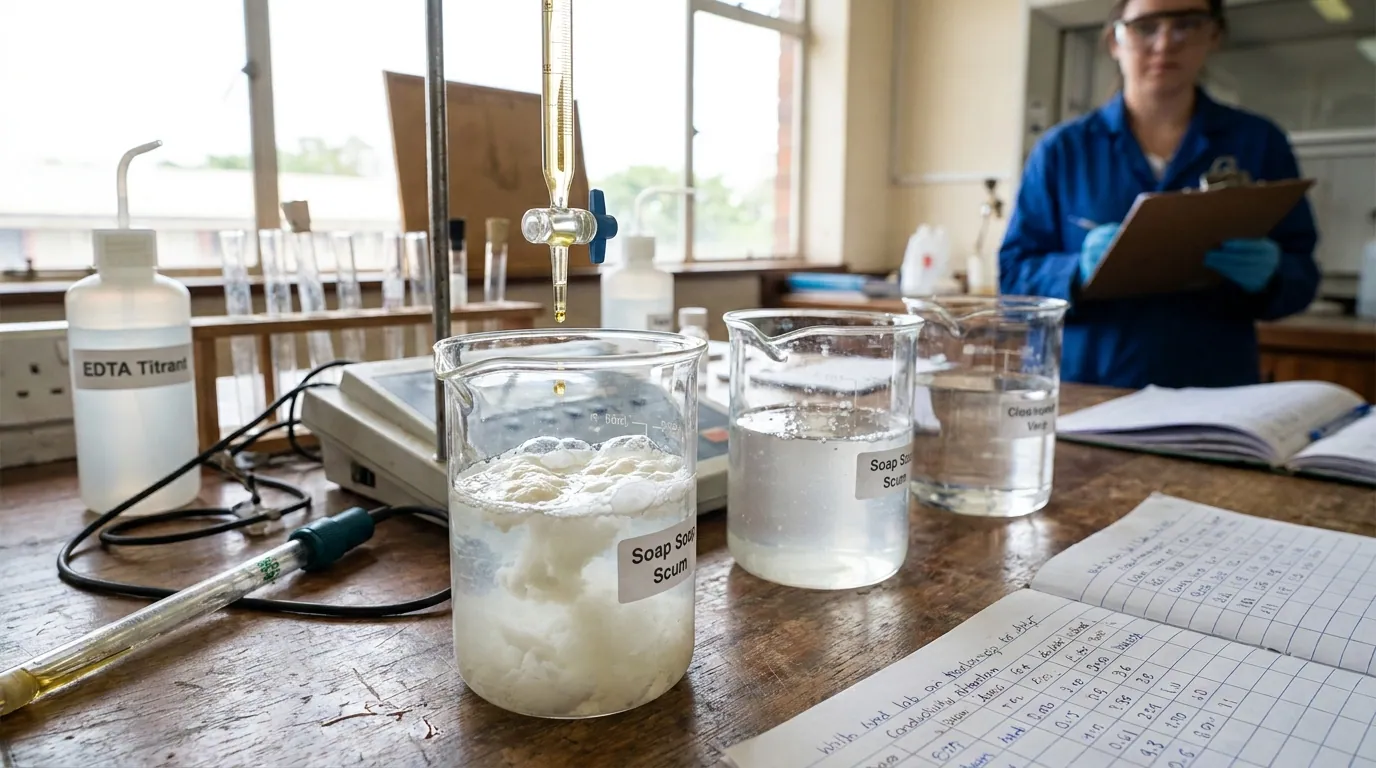
Which water sample was the hardest why is usually answered by looking at the water sample that showed the highest hardness result in the experiment. In simple terms, the hardest water sample is the one that contains the most dissolved minerals, especially calcium ions and magnesium ions. These minerals make water “hard” because they react with soap, reduce lather, form scum, and increase the amount of testing chemical needed in a hardness test.
In a classroom experiment, the hardest sample is often the one that required the most soap drops, produced the least lather, needed the most EDTA during titration, or showed the highest hardness reading in ppm or mg/L as CaCO₃. So, the exact sample name depends on your results, but the reason is always connected to higher mineral content.
Direct Answer: Which Water Sample Was the Hardest?
The hardest water sample was the sample with the highest water hardness reading. If your experiment used a soap lather test, the hardest sample was the one that needed the most drops of soap before bubbles or foam formed. If your experiment used EDTA titration, the hardest sample was the one that required the largest amount of EDTA to reach the endpoint. If you used a water hardness test strip or kit, the hardest sample was the one with the highest ppm or mg/L value.
A simple answer could be:
The hardest water sample was Sample B because it required the most soap drops to form lather. This means it had the highest amount of dissolved calcium and magnesium ions, which caused greater water hardness.
Here is a quick way to understand it:
| Test Method | The Hardest Sample Is the One That… |
| Soap lather test | Needs the most soap or forms the least lather |
| EDTA titration | Requires the most EDTA |
| Hardness test strip | Shows the highest ppm or mg/L reading |
| Observation test | Leaves more soap scum, residue, or scale |
So, when answering “which water sample was the hardest and why?”, do not guess based on appearance. Use the actual test evidence. The hardest sample is not always the clearest, cloudiest, or strongest-tasting sample. It is the one with the strongest hardness result.
Why Was That Water Sample the Hardest?
That water sample was the hardest because it contained the greatest amount of dissolved minerals, mainly calcium and magnesium. These minerals are the main cause of water hardness. When water passes through rocks, soil, limestone, or underground mineral layers, it can dissolve mineral salts and carry them into the water supply.
This is why groundwater, well water, and some types of spring water are often harder than distilled water or deionized water. Well water usually stays underground for a long time, giving it more contact with rocks that contain calcium carbonate, magnesium bicarbonate, and other mineral compounds.
The science behind the result is simple: more dissolved calcium and magnesium ions means greater total hardness. These ions interfere with soap, reduce lather, and may leave behind soap scum or mineral deposits. In an EDTA titration, these same ions require more EDTA to react completely.
For example, if Sample A needed 5 soap drops and Sample C needed 15 soap drops, Sample C was harder. Why? Because Sample C likely had more calcium ions and magnesium ions, which prevented the soap from forming lather easily.
This is the key reasoning:
More calcium and magnesium ions = more dissolved minerals = harder water.
What Water Hardness Means in Simple Words
Water hardness means the amount of dissolved minerals in a water sample. The most important minerals are calcium and magnesium. Water with a high amount of these minerals is called hard water. Water with a low amount of these minerals is called soft water.
Hard water is not the same as dirty water. A sample can be clear and still be hard. It may look normal, but if it contains many dissolved ions, it can react strongly in a hardness test. In contrast, soft water usually contains fewer hardness minerals, so it lathers more easily with soap and leaves less residue.
A simple definition is:
Water hardness is the measure of dissolved calcium and magnesium minerals in water.
Hardness is often measured as calcium carbonate, written as CaCO₃. Test results may appear as ppm, mg/L, or mg/L as CaCO₃. These units help show how much hardness is present in the sample.
There are also two common types of hardness:
Temporary hardness is caused mainly by bicarbonate minerals and can sometimes be reduced by boiling. Permanent hardness is caused by minerals such as sulfates and chlorides, which are not easily removed by boiling.
For most school experiments, you do not need to explain every chemical detail. The main idea is that the hardest water sample has the most dissolved calcium and magnesium minerals.
How the Soap Lather Test Shows the Hardest Sample
A soap lather test is one of the easiest ways to compare the hardness of different water samples. In this experiment, the same amount of water is placed into separate containers. Then, liquid soap is added drop by drop. Each sample is shaken, and the amount of lather or bubbles is observed.
The hardest water sample usually forms the least lather and needs the most soap drops. This happens because calcium and magnesium ions react with soap. Instead of allowing the soap to make bubbles, these ions form a sticky material called soap scum or insoluble curd.
That is why hard water often feels difficult to wash with. It may make soap seem less effective. You may need more soap to clean your hands, wash clothes, or make shampoo foam. This is the same reason hard water can leave white residue on faucets, shower doors, kettles, and dishes.
Here is a simple example:
| Water Sample | Soap Drops Needed to Form Lather | Result |
| Sample A: Distilled water | 3 drops | Softest |
| Sample B: Tap water | 8 drops | Moderately hard |
| Sample C: Well water | 15 drops | Hardest |
In this example, Sample C was the hardest because it needed the most soap drops. The evidence shows that Sample C contained more dissolved minerals than the other samples.
A strong lab answer would be:
Sample C was the hardest because it formed the least lather and required the most soap drops. This shows that it contained more calcium and magnesium ions, which reacted with the soap and reduced bubble formation.
This explanation connects the claim, the evidence, and the scientific reasoning, which makes it much stronger than simply saying, “Sample C was hardest.”
How EDTA Titration or ppm Results Confirm Hardness
Some experiments use EDTA titration instead of a soap lather test. This method is common in chemistry labs because it gives a more measured result for total hardness.
In an EDTA test, EDTA reacts with calcium ions and magnesium ions in the water. The more calcium and magnesium ions the water contains, the more EDTA is needed to react with them. So, if one water sample uses more EDTA than another, it has greater hardness.
The same idea applies to test strips or water hardness kits. If one sample has the highest ppm or mg/L as CaCO₃ reading, that sample is the hardest.
For example:
| Water Sample | Hardness Reading | Classification |
| Sample A | 40 mg/L | Soft |
| Sample B | 115 mg/L | Moderately hard |
| Sample C | 190 mg/L | Very hard |
In this case, Sample C was the hardest because it had the highest hardness reading. A result of 190 mg/L shows more dissolved hardness minerals than 40 mg/L or 115 mg/L.
A common hardness scale looks like this:
| Hardness Level | Classification |
| 0–60 mg/L | Soft water |
| 60–120 mg/L | Moderately hard water |
| 120–180 mg/L | Hard water |
| More than 180 mg/L | Very hard water |
These numbers make your explanation more data-driven. Instead of saying “it seemed harder,” you can say the sample had the highest measured hardness. That makes your answer more scientific and easier to support.
Common Water Samples Ranked by Likely Hardness
Different water samples have different hardness levels because they come from different sources. The more contact water has with mineral-rich rocks and soil, the more likely it is to become hard.
Here is a general ranking of common samples from softest to hardest:
| Water Sample | Usual Hardness | Why |
| Distilled water | Very soft | Most minerals are removed during distillation |
| Deionized water | Very soft | Dissolved ions are removed |
| Rainwater | Usually soft | It has limited contact with minerals before falling |
| Filtered water | Varies | Some filters reduce minerals, but not all |
| Tap water | Varies | Depends on the local water source |
| Spring water | Moderate to hard | May contain natural minerals |
| Mineral water | Often hard | Contains natural or added minerals |
| Well water | Often hard | Passes through underground rocks and mineral layers |
In many classroom experiments, well water or mineral water may be the hardest sample because it often contains more dissolved calcium and magnesium. Distilled water and deionized water are usually the softest because they contain very few dissolved minerals.
However, this is not always the same for every location. Tap water hardness changes from region to region. In some places, tap water is very hard because the local water supply passes through limestone or mineral-rich ground. In other places, tap water may be much softer.
So, the best answer always depends on your actual experiment results. If your well water sample needed the most soap or had the highest ppm reading, then well water was the hardest. If your tap water sample had the highest reading, then tap water was the hardest.
Why Groundwater, Well Water, and Mineral Water Are Often Harder
Groundwater and well water are often harder because they move through soil, rock, and underground layers before being collected. During this process, water can dissolve minerals from rocks such as limestone and chalk. These rocks often contain calcium carbonate, which increases water hardness.
This is why geology matters. Water from areas with limestone, chalk, gypsum, or mineral-rich soil often has more calcium and magnesium. Water from areas with fewer soluble minerals may be softer.
Mineral water may also be hard because it naturally contains dissolved minerals. Some bottled waters are marketed for their mineral content, so they may have more hardness than purified or distilled water.
A simple way to explain this in a lab report is:
The well water sample was probably harder because it had more contact with underground rocks and minerals. This allowed more calcium and magnesium ions to dissolve into the water.
This section is useful because it explains not only which sample was hardest, but also why that type of water might naturally have more hardness.
What Evidence Proves a Water Sample Was Hardest?
A strong answer should always include evidence. In science, you should not only state which sample was hardest; you should explain how you know.
The best evidence depends on the test you used:
| Evidence | What It Shows |
| Most soap drops | More hardness minerals reacted with soap |
| Least lather | Soap could not foam easily |
| Fewest bubbles | Calcium and magnesium reduced soap action |
| Most EDTA used | More calcium and magnesium ions were present |
| Highest ppm or mg/L | Highest measured total hardness |
| More scum or residue | More minerals reacted with soap or deposited |
For example, if Sample B required 12 soap drops while Sample A required 4 and Sample C required 7, Sample B was the hardest. The evidence is the number of soap drops. The reasoning is that hard water minerals prevented soap from lathering easily.
Here is a complete sentence you can use:
Sample B was the hardest because it required the most soap drops to form lather, showing that it had the highest concentration of dissolved calcium and magnesium ions.
This is better than saying:
Sample B was hardest because it looked different.
Appearance alone is weak evidence. A sample may be clear but still contain many dissolved minerals. Good evidence comes from the actual water hardness test, not from color, smell, or taste.
Does Hard Water Mean Dirty or Unsafe Water?
Hard water does not automatically mean the water is dirty or unsafe. This is one of the most common mistakes students make when explaining water hardness.
Hardness mainly describes the amount of dissolved calcium and magnesium in water. Contamination, on the other hand, refers to harmful substances such as bacteria, lead, arsenic, nitrate, or other pollutants. These are different water-quality issues.
A hard water sample may still be safe to drink if it does not contain harmful contaminants. At the same time, a soft water sample could still be unsafe if it contains bacteria or chemicals. That is why drinking water quality testing looks at many factors, including pH, TDS, turbidity, nitrate, chloride, fluoride, iron, manganese, and microbial contamination.
In a lab answer, you can say:
The hardest water sample had the most dissolved minerals, but hardness alone does not prove the water was polluted or unsafe.
This distinction is important because it shows deeper understanding. Hard water can cause practical problems like soap scum, scale buildup, and appliance deposits, but it is not the same thing as contaminated water.
Sample Lab Conclusion You Can Use
If your teacher asks, “Which water sample was the hardest and why?”, your conclusion should include three things: the claim, the evidence, and the reasoning.
A useful structure is:
Claim: Name the hardest sample.
Evidence: State the test result.
Reasoning: Explain calcium and magnesium ions.
Here is a sample conclusion:
The hardest water sample was Sample B because it required the most soap drops to form lather. Sample B needed 14 drops of soap, while the other samples needed fewer drops. This shows that Sample B had the highest water hardness. The reason it was hardest is that it likely contained the greatest amount of dissolved calcium and magnesium ions. These ions reacted with the soap and made it harder for lather to form. Therefore, Sample B was the hardest water sample because it had the highest concentration of hardness minerals.
If you used EDTA titration, you can write:
The hardest water sample was Sample C because it required the greatest volume of EDTA to reach the endpoint. Since EDTA reacts with calcium and magnesium ions, using more EDTA means the sample contained more hardness minerals. Therefore, Sample C had the highest total hardness.
If you used ppm or mg/L results, you can write:
The hardest water sample was Sample A because it had the highest hardness reading in mg/L as CaCO₃. This means it contained more dissolved calcium and magnesium than the other samples.
These examples are strong because they connect the result to the science behind water hardness.
Common Mistakes to Avoid in Your Explanation
When writing about the hardest water sample, avoid common mistakes that weaken your answer.
One mistake is confusing hardness with pH. A sample with a higher pH is not automatically harder. pH measures how acidic or basic water is, while hardness measures dissolved calcium and magnesium minerals.
Another mistake is saying the hardest sample was the one that looked cloudiest. Cloudiness is related to turbidity, not necessarily hardness. Water can be clear and still be hard.
Students also sometimes assume bottled water is always soft or filtered water always has no minerals. That is not always true. Some bottled water contains natural minerals, and many filters do not remove all calcium and magnesium ions.
Another weak answer is saying, “It was hardest because it had more stuff in it.” A better answer is more specific:
It was hardest because it had more dissolved calcium and magnesium ions.
Also, do not say hard water is automatically unsafe. Hardness is about mineral content, not necessarily harmful contamination.
The strongest explanation uses test evidence, scientific vocabulary, and clear reasoning.
Quick Answer Examples for Different Lab Results
Here are a few quick examples you can adapt depending on your experiment.
If your class used a soap test:
The hardest water sample was Sample B because it needed the most soap drops to form lather. This means it had more calcium and magnesium ions than the other samples.
If your class used an EDTA test:
The hardest water sample was Sample C because it required the most EDTA. More EDTA was needed because the sample contained more dissolved calcium and magnesium ions.
If your class used a test strip:
The hardest water sample was Sample A because it had the highest hardness reading in ppm. This shows that it had the highest total hardness.
If your samples were named by water type:
The well water sample was the hardest because it likely passed through mineral-rich underground rocks, allowing calcium and magnesium minerals to dissolve into it.
If distilled water was the softest:
Distilled water was the softest because most dissolved minerals had been removed, so it formed lather more easily.
These answer styles are short, clear, and accurate. They also match what teachers usually expect in a water hardness lab report.
Final Takeaway
The answer to which water sample was the hardest why depends on your experiment results, but the rule is simple: the hardest sample is the one with the highest hardness evidence. It may be the sample that needed the most soap drops, formed the least lather, required the most EDTA, or showed the highest ppm or mg/L as CaCO₃ reading.
The reason it was hardest is that it contained the greatest amount of dissolved calcium ions and magnesium ions. These minerals cause water hardness by reacting with soap, reducing bubbles, forming scum, and increasing hardness test readings.
Disclaimer: This article is for general informational and educational purposes only. Water hardness results can vary depending on the testing method, sample source, mineral content, equipment accuracy, and experimental conditions. Always base conclusions on actual test data, such as soap lather results, EDTA titration values, or ppm readings, rather than appearance alone.