

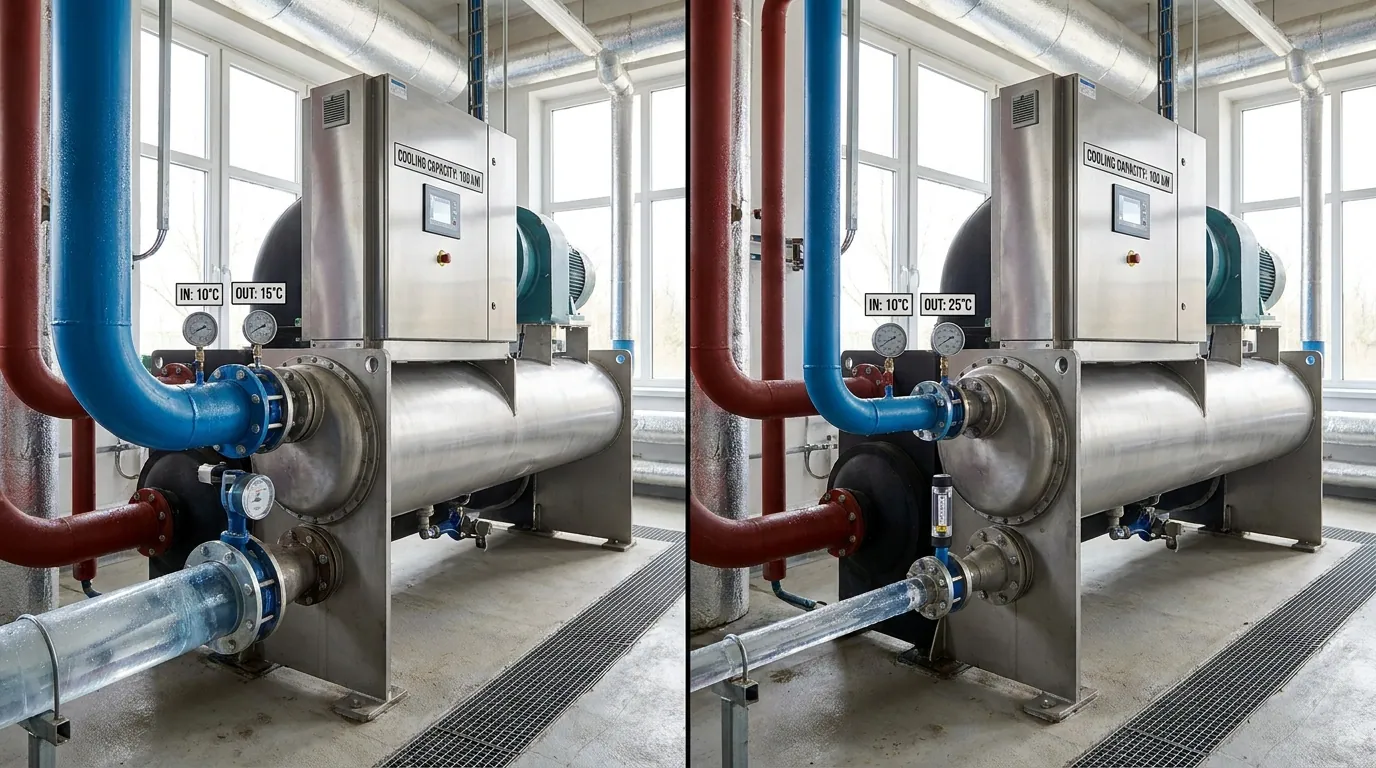
Cooling water requirements for the same cooling capacity is a question that seems simple at first, but the real answer depends on flow rate, temperature rise, fluid properties, heat transfer conditions, and the way the chiller or cooling system is operating. In other words, two systems can deliver the same cooling capacity in kW, BTU/hr, or tons of refrigeration, yet still need different amounts of cooling water because the temperature differential (ΔT) and operating conditions are different. That distinction is exactly where many articles fall short. Current competitor content explains what cooling capacity is, how it is measured, and how flow rate affects performance, but it rarely centers the practical question of cooling water requirement for equal cooling load.
If you work with water chillers, recirculating chillers, industrial water chillers, or any temperature control setup, this matters a lot. Choosing the wrong water flow rate can increase power consumption, reduce efficiency, create unstable setpoint temperature control, and even raise cooling costs. A better way to think about the problem is this: cooling capacity tells you how much heat must be removed, while cooling water requirement tells you how much water must move through the system to carry that heat away under the chosen operating conditions. Plasquip’s worked examples make this especially clear by showing that a fixed 10 kW duty can pair with very different L/h values and very different ΔT values.
What Cooling Capacity Actually Means
At its core, cooling capacity is the rate at which a system removes heat. It is commonly expressed in watts (W), kilowatts (kW), BTU/hr, or tons of refrigeration (RT). Several competitors define it in nearly the same way: a measurement of how much heat a cooling system can remove over time. Cooling Power Corp explains it through AC and heat pump sizing, ATC ties it to chiller specification, Plasquip connects it to heat removed in water chillers, and Labsup explains it for recirculating chillers.
That means what is cooling capacity is not really a mysterious question. The tricky part is how people interpret it. Many assume that if two systems have the same nameplate cooling capacity, then they must need the same water flow. That is not true. Cooling capacity is the target result, but flow rate, temperature difference, and specific heat capacity of water shape how the system reaches that result.
A familiar example is 1 ton of refrigeration, often described as about 12,000 BTU/hr. Cooling Power Corp also notes the historic equivalence through 200 Btu/min and about 211 kJ/min, which helps explain why tons of refrigeration still appear in HVAC discussions even when engineers prefer kW.
Load vs Cooling Capacity: Why Equal Cooling Duty Matters
To understand cooling water requirement, you first need to separate load from capacity. Load is the actual thermal load or cooling demand created by a space, process, machine, or fluid. Cooling capacity is the system’s ability to remove that heat. ATC explicitly discusses load versus cooling capacity, and Cooling Power Corp talks about load calculation when sizing equipment.
This matters because the phrase same cooling capacity usually means the same heat removal duty. If the system must remove 10 kW of heat, that heat can still be carried away through different combinations of mass flow rate and ΔT. The total cooling duty stays the same, but the cooling water flow rate does not have to stay the same.
Think of it like carrying boxes. Moving the same number of boxes can be done with many small trips or fewer large trips. In a cooling system, the “boxes” are units of heat. More water flow means each kilogram of water carries less temperature rise. Less water flow means each kilogram must absorb more temperature increase.
Does Cooling Capacity Change With Water Flow Rate?
One of the most useful long-tail questions here is does cooling capacity change with flow rate. The clean answer is: not automatically. Plasquip states that a chiller’s cooling capacity in kW does not change simply because the water flow rate changes. What changes is the temperature rise or temperature differential across the system. ATC also discusses how mass flow rate and temperature differentials affect observed performance.
That is why water flow rate vs cooling capacity is such an important distinction. A higher flow rate can lower ΔT, while a lower flow rate can raise ΔT, even when the system is still handling the same total cooling duty. In practice, this means operators should stop asking only, “What is the capacity?” and start asking, “At what flow rate, with what entering water temperature, what leaving water temperature, and what fluid?”
This is also where real-world confusion starts. People mix up cooling capacity, cooling water requirement, condenser water flow, and chilled water flow. They are related, but they are not identical. The system can maintain the same heat transfer rate through different operating balances, as long as the equipment is working within its safe design limits.
The Basic Formula Behind Cooling Water Requirement
The most practical way to understand chiller water requirement calculation is through the standard heat-transfer relationship:
Cooling Capacity (kW)=m˙ Cp ΔT3600\text{Cooling Capacity (kW)}=\frac{\dot m\, C_p\, \Delta T}{3600}Cooling Capacity (kW)=3600m˙CpΔT
In plain English:
- Cooling Capacity is the heat removed.
- ṁ is the mass flow rate.
- Cp is the specific heat capacity of the fluid.
- ΔT is the temperature difference.
- 3600 seconds in an hour converts hourly flow values into kW.
For water, competitors repeatedly reference 4.186 kJ/kg·°C as the specific heat capacity of water, and Plasquip also notes that 1 L ≈ 1 kg for practical water calculations.
This formula explains the main keyword perfectly. For the same cooling capacity, you can increase flow rate and reduce ΔT, or reduce flow rate and allow ΔT to rise. So the answer to cooling water requirements for the same cooling capacity is not one fixed number. It depends on what temperature rise you allow and what conditions the equipment can handle.
A Real Example: Same 10 kW Cooling Capacity, Different Water Flow
Plasquip provides one of the most useful examples in the current SERP. For a fixed 10 kW cooling duty:
| Cooling capacity | Water flow | Approx. ΔT |
| 10 kW | 200 L/h | 43°C |
| 10 kW | 300 L/h | 28.6°C |
| 10 kW | 100 L/h | 86°C |
These figures show something important. The cooling capacity stays at 10 kW, but the cooling water circulation rate changes the temperature differential dramatically.
That means same cooling capacity different water flow is not a contradiction. It is basic thermodynamics. A process designer may prefer a higher flow rate to keep the temperature rise smaller, especially where temperature stability matters. A different application may tolerate a larger ΔT and use less flow. The right answer depends on process fluid characteristics, control needs, equipment limits, and operating economics.
What Changes Cooling Water Requirement Even When Capacity Stays the Same
This is where theory becomes real operation. Competitor articles repeatedly point to the same performance factors, even if they do not phrase them as cooling water requirement issues.
1. Ambient temperature and ambient conditions
ATC and Labsup both note that ambient temperature can change how effectively a system rejects heat, especially with air-cooled condensers or systems tied to facility water conditions. Higher ambient conditions can reduce effective performance and influence the flow needed for stable operation.
2. Entering and leaving water temperature
This is a major gap keyword area that competitors only touch indirectly. The acceptable entering water temperature and leaving water temperature determine the system’s workable ΔT. If the entering water is already warm, the system may need more flow or different operating settings to maintain the same cooling duty.
3. Setpoint temperature
ATC and Labsup both explain that lower set temperature or setpoint temperature can reduce effective capacity or make control harder. When a system must deliver colder fluid, the relationship between flow rate, temperature difference, and actual performance becomes more sensitive.
4. Fluid properties
If you use glycol instead of plain water, the required flow can change because the liquid heat capacity changes. ATC specifically notes that glycol can lower effective cooling performance compared with water.
5. Fouling, scale, corrosion, and maintenance
Competitors also mention dust accumulation, fouling, scale formation, corrosion, and biological growth. These issues reduce heat transfer efficiency, which can push the system toward higher flow needs, poorer control, or higher energy consumption.
Cooling Water Requirement vs Energy Use and Operating Cost
A smart article cannot stop at calculations. Cooling water requirement also affects power consumption and cooling costs. Cooling Power Corp uses a consumer example of 1,200 watts, 9,600 watts per day, and $0.12/kWh to explain how capacity choices affect cost, while ATC discusses controls such as Hot Gas Bypass, variable speed designs, and digital scroll compressors that help manage efficiency.
The lesson for industrial and process systems is simple: more water flow is not free. Higher flow may mean more pump energy, different pressure losses, and extra operating cost. On the other hand, very low flow can create large ΔT, poor stability, and even equipment stress. The best operating point is usually a balance between water usage at same cooling duty, energy efficiency, and process reliability.
“The right cooling water flow is not the maximum flow. It is the flow that delivers the required heat removal at stable conditions and reasonable cost.”
That line is not a direct source quote, but it summarizes the shared logic behind the competitor guidance on sizing, control, and performance.
How to Calculate the Water Flow You Actually Need
If you are wondering how much cooling water is needed, the practical workflow looks like this:
First, define the required cooling capacity or thermal load in kW, BTU/hr, or tons of refrigeration. Second, choose the acceptable ΔT across the process or cooling loop. Third, confirm the fluid properties, especially whether you are using water or a glycol mixture. Fourth, apply the standard formula to solve for mass flow rate or L/h. Fifth, check whether that flow sits within the equipment’s recommended range and whether the system can maintain the required setpoint temperature under real ambient conditions.
Here is a simplified decision table:
| Known value | Why it matters |
| Cooling duty (kW) | Defines the total heat that must be removed |
| ΔT target | Decides whether you need more or less flow |
| Fluid type | Changes specific heat capacity |
| Entering water temperature | Affects real operating margin |
| Equipment limits | Prevents unstable or unsafe operation |
This step-by-step approach is one of the biggest content gaps in the current competitor set. They explain the pieces, but they do not fully develop the workflow as a stand-alone answer for process cooling water demand or heat exchanger water requirement.
Common Mistakes People Make
The biggest mistake is assuming that same cooling capacity means same water requirement. It does not. The heat load may be the same, but the chosen flow rate, allowed temperature rise, and fluid properties can vary.
Another common mistake is thinking that more water flow always increases cooling capacity. In many cases, more flow simply reduces ΔT while the system still removes the same total heat.
A third mistake is ignoring maintenance. Fouling, scale, corrosion, and dust accumulation reduce heat-transfer effectiveness, so real-world cooling water requirement can drift away from ideal calculations. Competitors repeatedly mention these maintenance-related performance losses.
A fourth mistake is treating water and glycol as interchangeable. They are not. The fluid’s specific heat capacity changes the numbers.
Case Study Style Scenario
Imagine a CNC machine, a laser, and a welding system all requiring process cooling. Competitor pages use these kinds of industrial examples when describing industrial process cooling and water chillers.
All three systems might need similar headline cooling capacity, but their actual cooling water requirement can differ because one needs tight temperature stability, another runs in hotter ambient temperature, and the third uses a glycol blend. The result is that identical nameplate kW does not always lead to identical L/h in practice.
That is why the best operators and designers focus on cooling duty, ΔT, flow rate, entering water temperature, and maintenance condition together, not on one number alone.
FAQ: Cooling Water Requirements for the Same Cooling Capacity
Cooling water requirements for the same cooling capacity is what, exactly?
It is the amount of water flow needed to remove a fixed heat load under a chosen temperature differential and fluid condition. The answer is not one universal value.
Does higher water flow increase cooling capacity?
Not necessarily. It often lowers ΔT rather than increasing the actual cooling duty. Plasquip’s example shows the same 10 kW with several different flow values.
Why does ΔT fall when flow rises?
Because more water is sharing the same heat load, so each unit of water absorbs less temperature rise.
How do I estimate water flow for 10 kW cooling duty?
Use the standard cooling capacity formula for water chillers with Cp, ΔT, and the required load. Plasquip’s example numbers show how different L/h choices pair with different ΔT values at 10 kW.
Does glycol change the required flow?
Yes. Glycol changes liquid heat capacity, so the needed flow can be different from plain water. ATC discusses this directly.
Is condenser water flow the same as chilled water flow?
No. They are related but different parts of the system. This is a valuable gap topic because competitor pages do not explain it clearly enough.
Conclusion
The best answer to cooling water requirements for the same cooling capacity is that the required water flow depends on ΔT, specific heat capacity, fluid type, entering and leaving water temperature, and real operating conditions such as ambient temperature and maintenance quality. Current competitor content gives you the building blocks by explaining cooling capacity, load, flow rate, setpoint temperature, BTU/hr, kW, and tons of refrigeration. But the real competitive edge comes from connecting those ideas directly to cooling water requirement.
So, if you remember one thing, let it be this: equal cooling capacity does not automatically mean equal water flow. The heat removed may be the same, but the path the system uses to remove it can change a lot. That is why smart sizing, clean maintenance, and correct flow rate selection matter so much in water-cooled chiller and process-cooling design.
Disclaimer: This article is for general educational and informational purposes only. Cooling water requirements, chiller sizing, and heat-transfer calculations can vary based on equipment design, fluid type, operating conditions, and industry standards. Always consult qualified HVAC, mechanical, or process-cooling professionals before making engineering, safety, or system-design decisions.