

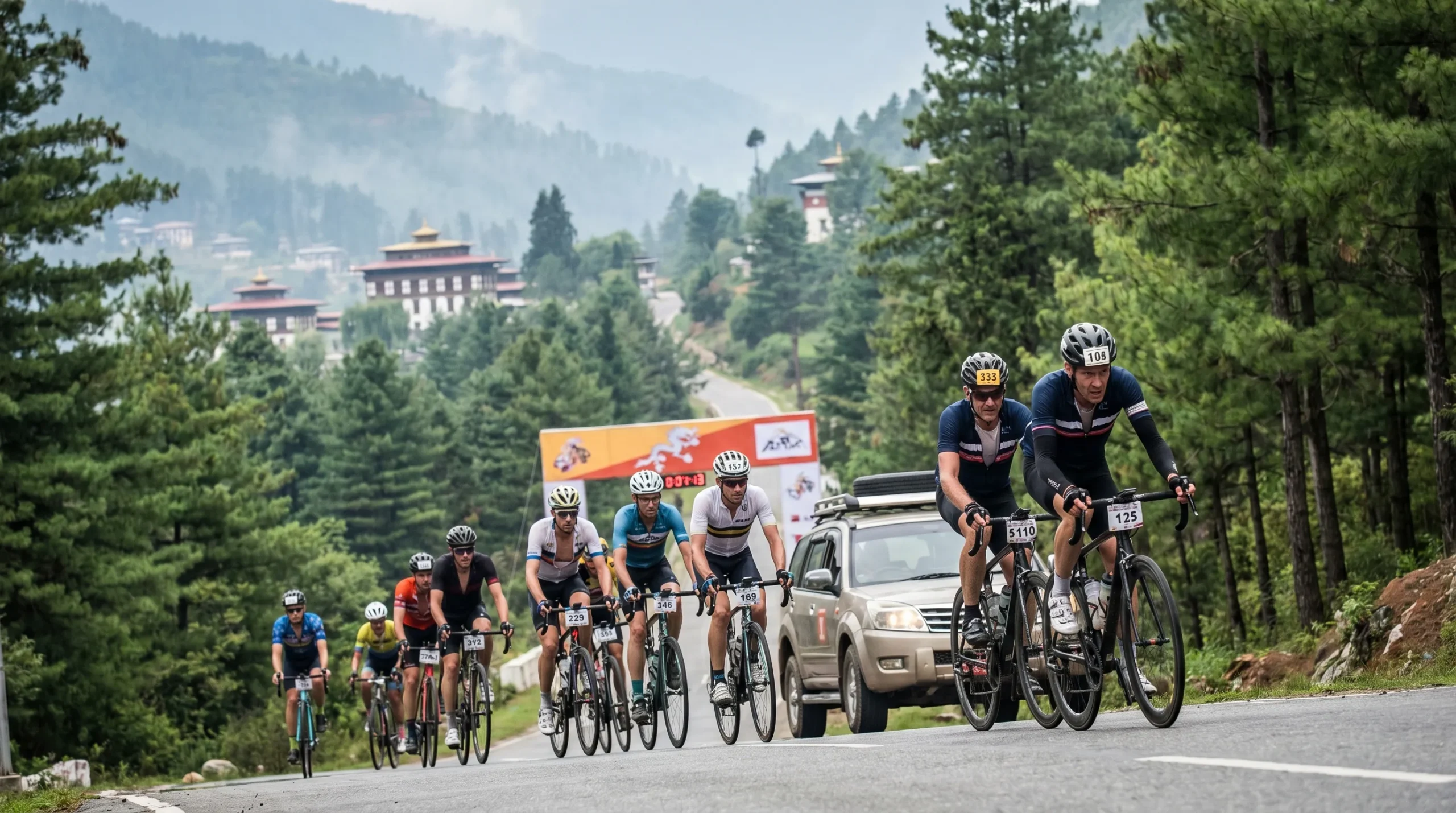
Tour of the Dragon cycling race is one of the most demanding endurance events in Asia, and it has earned a reputation as Bhutan’s signature mountain bike race and one of the toughest one-day mountain bike races in the world. The event is widely described as a route from Bumthang to Thimphu that crosses four high mountain passes through the Eastern Himalayas, with published distance figures that vary by source from roughly 255 km to 268 km. Official and tourism sources consistently agree on the core identity of the race: it is a long, high-altitude, one-day challenge held in early September in Bhutan.
For riders, travelers, and cycling fans, that combination explains the race’s appeal. It is not just a Bhutan mountain bike race. It is a high-altitude cycling race, a Bhutan bike challenge, and a bucket-list test of endurance cycling, route management, and mental toughness. Some pages present it as a 255 km race, while official-style listings also describe it as a 268-kilometer event, which is why many people search for route details, elevation, and what the real challenge looks like on the ground.
What Is the Tour of the Dragon?
The Tour of the Dragon is an annual one-day mountain bike race in Bhutan. It is commonly associated with the Bhutan Olympic Committee and is widely framed as a major cycling event in the kingdom. Current event pages describe it as being held on the first Saturday of September, while historical coverage ties the race to Bhutan’s effort to promote sport, challenge, and national pride through endurance competition.
What makes the race special is the way it combines distance, altitude, and Bhutanese terrain. Riders do not just cover a long road. They move across mountain scenery, deep valleys, and steep passes while dealing with changing elevations, limited recovery time, and long hours on the bike. That is why the phrase “toughest one-day mountain bike race in the world” shows up so often in race-related coverage. Red Bull’s feature on the event emphasizes the sheer brutality of the course, especially the climbing load packed into a single day.
There is also a cultural layer that makes this event stand out from many other ultra-distance rides. Articles about the race often connect it to Bhutan’s identity, the Kingdom of Bhutan, and ideas such as Gross National Happiness, which gives the event a very different feel from a standard commercial race calendar stop. That blend of adventure cycling in Bhutan, endurance sport, and destination travel is one reason the event attracts both serious riders and travel-focused searchers.
Route Overview: From Bumthang to Thimphu
The route is the heart of the race. Most descriptions agree that the event starts in Bumthang, usually around Jakar Town, and finishes in Thimphu, often at Clock Tower Square or the city center. Along the way, riders cross four major passes and roll through some of the most dramatic road scenery in Bhutan.
The exact published distance varies depending on the source. Some travel pages describe the route as 255 km, while official-style sources and older Bhutan Olympic Committee material describe it as 268 km. A historical race guideline PDF snippet lists the total distance as 255.5, which helps explain why several versions circulate online. The safest, most accurate way to describe it in an SEO article is that the race is roughly 255–268 km, depending on the edition and source.
That distance alone would be impressive, but the route profile is what truly matters. Riders leave Bumthang and work their way west toward Thimphu, dealing with long climbs, fast descents, changing road conditions, and fatigue that builds all day. For many readers, the route question is really a difficulty question in disguise: they want to know not just where the race goes, but whether a rider can realistically survive that kind of effort in one day.
Distance, Elevation, and the Four Mountain Passes
The race is famous for its four mountain passes, and that is one of the most important pieces of route data to include. The most commonly cited passes are Kiki La, Yotong La, Pele La, and Dochu La/Dochula. Travel-package pages often list the passes at about 2870m, 3434m, 3430m, and 3150m respectively, while other sources round some of those figures slightly differently.
Here is a simple route-data table you can use for clarity:
| Course Detail | Commonly Published Figure |
|---|---|
| Distance | 255–268 km |
| Passes | 4 |
| Kiki La | 2870m / 2,980 meters |
| Yotong La | 3434m / 3,425 meters |
| Pele La | 3430m / 3,390 meters |
| Dochu La / Dochula | 3150m |
| Climbing | 13,500–15,000+ feet |
These numbers explain why the race is often grouped with extreme endurance challenges rather than ordinary long rides. Red Bull describes the event as taking riders over 15,000 feet of brutal climbing in one day, while official and tourism pages stress the constant climbing and descending across high mountain terrain.
For search intent, this section matters because many users type queries like “how long is the Tour of the Dragon race,” “elevation changes during the Tour of the Dragon,” and “tour of the dragon route through Kiki La Yotong La Pele La and Dochu La.” An article that answers those questions clearly has a much better chance of satisfying the SERP than a generic travel page.
How Hard Is the Tour of the Dragon Cycling Race?
The honest answer is simple: it is extremely hard. The combination of distance, altitude, climbing, and time-on-bike makes the race difficult even for experienced endurance cyclists. Sources repeatedly describe it as one of the hardest one-day bike races in the world, and that description is not just marketing language. A route of 255–268 km with four high passes and 13,500–15,000+ feet of climbing is brutal by almost any standard.
The race can feel hard in several different ways. First, there is the obvious physical strain. Riders must manage long climbs at altitude, then stay focused on descents when fatigue is already high. Second, there is the pacing problem. Going too hard early can ruin the final third of the race. Third, there is the mental load. Spending an entire day on the bike in changing road and weather conditions requires patience as much as fitness. Red Bull’s story-driven coverage captures that emotional side well, showing how the event tests the rider’s mind along with the legs and lungs.
One useful way to frame it for readers is this: the Tour of the Dragon Bhutan mountain bike race is not just for someone who can ride far. It is for someone who can ride far, climb repeatedly, tolerate thin air, manage nutrition, and stay composed deep into the day. That makes it a very different challenge from a flatter ultra-distance event.
Who Can Join and What Kind of Rider Is It Best For?
Travel and event pages indicate that the race is open to interested participants, including international riders, but they also make it clear that this is not a casual-entry ride. One competitor page states directly that you must be fit enough to cover 255 km on a bicycle before joining, which is a practical way of saying that basic cycling enthusiasm is not enough.
So who is this race really for? It best suits riders with a strong background in long-distance cycling, mountain climbing routes, or all-day endurance events. A rider who has never completed a major climbing day will likely struggle. A rider with good base fitness, climbing experience, and smart preparation has a far better chance. That distinction matters because many users search “who can join the Tour of the Dragon” or “is the Tour of the Dragon suitable for amateurs.” The best answer is that a determined amateur can attempt it, but only with serious preparation and realistic expectations.
A practical comparison helps here. Think of the event as less like a casual gran fondo and more like an ultra mountain bike race in Bhutan where self-management is part of the challenge. That kind of framing makes the search intent match stronger and keeps the article honest.
Registration, Entry Fees, and How to Participate
The tour of the dragon registration process is often bundled into travel or support packages on commercial sites, which is why the keyword has a clear commercial layer in the SERP. Travel pages list race-related costs such as an international registration fee of USD 250, a SAARC registration fee of USD 165, and a visa fee of USD 40, though users should always verify the most current numbers with the organizer or the latest event listing before paying.
This is also where many practical questions appear. Searchers want to know how to join, whether they need a Bhutan travel operator, and what is bundled into a package. Commercial pages often pair the race with hotels, transfers, meals, and post-race sightseeing, which makes sense because Bhutan travel can be logistically complex for foreign visitors.
The smartest way to write this section is to balance usefulness with caution. Explain the common fee structures and package style, but remind readers that registration windows, fees, and inclusions can change by edition. That protects trust and improves the article’s real-world value.
Best Bike, Gear, and Setup for the Race
A lot of pages mention the event, but very few do a good job on bike setup. That is a major content gap. Given the route’s mix of climbing, descending, and variable road quality, most riders will need a setup that favors durability, comfort, and control rather than pure speed.
A sensible setup usually means a well-maintained mountain bike or a very capable gravel bike, depending on the year’s route conditions and the rider’s handling skills. Strong braking, reliable gearing for long climbs, puncture resistance, and a repair kit matter more than shaving a little weight. Since the race is often described as neither a pure road race nor a classic off-road event, the best equipment choice is the one that helps the rider stay stable and efficient for the whole day.
For readers, this is where practical SEO value rises. People search for “what type of bike is required for the Tour of the Dragon,” but what they really need is advice on gearing, tire choice, spare tubes or tubeless repair, layers for temperature changes, and how to keep the bike reliable over a very long day.
Training, Altitude, and Race-Day Strategy
This is where a strong article can beat the current competitors. Nearly all of them say the race is hard. Very few explain how to prepare for it well.
A good Tour of the Dragon training plan should focus on three things. First, build a deep endurance base with long rides that teach the body to stay strong after many hours. Second, train climbing specifically. The race is defined by repeated ascents, not just distance. Third, prepare for altitude as much as possible. Since the major passes rise above 3,000 meters, riders who can arrive early and give themselves time to adapt may handle the effort better than riders who rush in at the last minute.
Fueling and pacing matter just as much as training. Riders should think in hours, not kilometers. Waiting until the body feels empty is already too late in an event this long. Regular eating, steady drinking, and conservative pacing early on are usually smarter than chasing speed in the first big climb. Support-oriented pages mention support stations, refreshments, and basic race assistance, but the responsibility for managing effort still belongs to the rider.
A useful way to summarize the strategy is this: respect the altitude, respect the climbs, and ride the first half with the second half in mind. That advice sounds simple, but it matches the demands of an all-day, high-mountain event far better than aggressive early pacing.
“The Tour of the Dragon takes mountain-bike riders over 15,000 feet of brutal climbing in just one day.” Red Bull’s description is short, but it captures exactly why preparation must go beyond normal event training.
Weather, Safety, and Travel Planning in Bhutan
The race is tied to early September, which means weather and road conditions matter. Some sources present the timing as a positive, linking it to autumn conditions, while Red Bull’s coverage also highlights hazards such as slippery roads, mud, and landslides in the broader environment. The real takeaway is that riders should expect changing conditions rather than assuming a perfectly predictable day.
Travel logistics are another important part of the user journey. Commercial pages often build the race into a full Bhutan cycling tour package, sometimes around 9 days / 8 nights, with airport transfers, hotel stays, and extra sightseeing. Some package descriptions mention a 25–30 minute domestic flight, an 8-hour drive, or shorter transfers depending on itinerary design.
That means many searchers are really looking for two answers at once: Can I do this race? and Can I manage this trip? A strong article should answer both. Mention Paro, Thimphu, Bumthang, and the travel-support structure naturally, but keep the tone practical. Readers want to know what to expect, not just be sold a package.
Best Time to Ride and Why September Matters
Most current pages tie the event to early September, and official-style event information describes it as being held on the first Saturday of September. That timing gives the race a strong seasonal identity, which is important for SEO because search demand is likely to rise well before the event as riders plan training, booking, and logistics.
For the article, this section should do more than repeat the month. It should explain why the timing matters. September affects travel planning, rider preparation, and the kind of weather or road conditions a participant might face. It also affects content freshness. A reader looking for Tour of the Dragon 2026 may need different practical details from someone reading a timeless guide about the route and difficulty. That is why evergreen sections on training and route data should be paired with caution around dates and fees.
Quick Facts Table
| Topic | Key Detail |
|---|---|
| Race type | One-day mountain bike race / ultra-distance challenge |
| Location | Bhutan |
| Route | Bumthang to Thimphu |
| Distance | About 255–268 km |
| Major passes | Kiki La, Yotong La, Pele La, Dochu La/Dochula |
| Timing | Early September / first Saturday of September |
| Difficulty | One of the toughest one-day mountain bike races in the world |
These are the facts most readers want first, and they also map neatly to high-intent long-tail queries.
FAQ
How long is the Tour of the Dragon cycling race?
Most sources place it between 255 km and 268 km, depending on the edition and source cited.
Where does the race start and finish?
It starts in Bumthang and finishes in Thimphu, often associated with Clock Tower Square.
How many mountain passes are there?
There are four major passes: Kiki La, Yotong La, Pele La, and Dochu La/Dochula.
Why is the race considered so difficult?
Because it combines ultra-long distance, high altitude, and 13,500–15,000+ feet of climbing in one day.
Can non-Bhutanese riders join?
Travel pages indicate that international participants can join, often through registration and travel-support packages.
What kind of bike works best?
A reliable mountain bike or highly capable gravel bike is the usual practical choice, depending on current route conditions and rider preference.
Conclusion
The Tour of the Dragon cycling race is more than a long ride. It is a true Bhutan bike challenge that blends distance, altitude, climbing, travel logistics, and mental resilience into one unforgettable day. Whether you know it as a Bhutan mountain bike race, a Bumthang to Thimphu cycling race, or one of the toughest one-day mountain bike races in the world, the core appeal is the same: it asks riders to earn every kilometer across one of the most memorable routes in the Himalayas.
For SEO and for readers, the best approach is to treat it as both an event guide and a preparation guide. Explain the route, acknowledge the distance variations, respect the altitude, and help riders understand what it really takes to finish. That is what turns a generic article into one that genuinely deserves to rank.
Disclaimer:
This article is for informational purposes only. The Tour of the Dragon is an extreme endurance event. Readers should not attempt the race without proper training, preparation, and guidance. Consult professionals before participating.